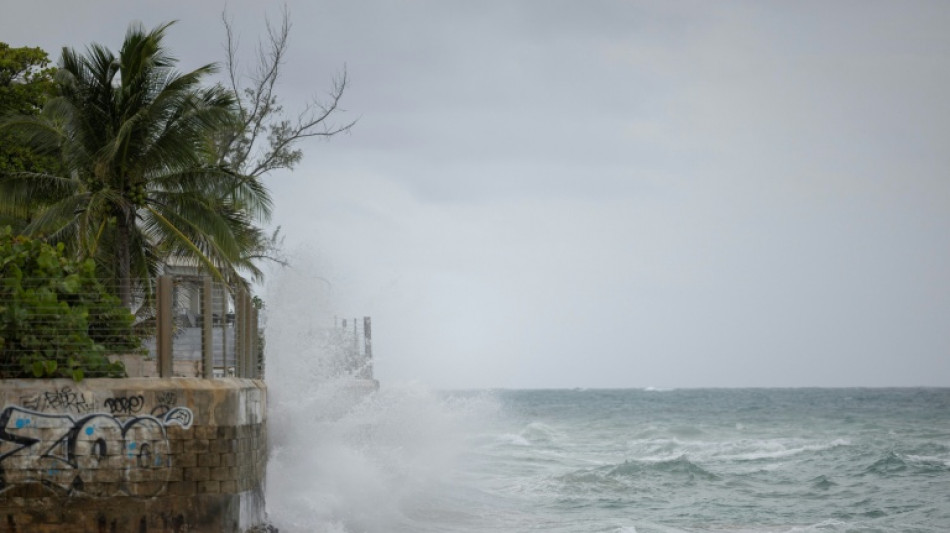
Hurricane Erin intensifies offshore, lashes Caribbean with rain / Photo: © AFP

 2 killed, 13 wounded in bus blast near Syrian capital: state media

 All Blacks skipper Taylor cautiously recovering from calf strain

 UN chief denounces Russia, Ukraine for civilian deaths

 UEFA turn up the pressure on Infantino and repeat boycott threat

 Rodri approves Barcelona transfer talks with Man City: Barca source to AFP

 Venezuela unable to tally missing from cataclysmic quakes

 Le Court sprints to stage six Tour de France Femmes win

 Doping body says Parker's positive cocaine test caused by nutritionist

 UEFA says boycott of World Cups stands despite FIFA backdown on private investment

 Rheinmetall sales keep surging despite cancelled naval frigate project

 Pogacar teammate Del Toro gets new UAE deal after Tour podium
 Stocks tread water with earnings, tech in focus

 Forex Expo Dubai Announces Opportunity to Win Up to 150 Grams of Gold This September 2026

 Forlan named new Uruguay head coach

 UEFA chief Ceferin: 'Underdog' leader taking fight to FIFA's Infantino

 Salah completes move to Turkey's Trabzonspor
 UK clears Paramount's takeover of Warner Bros

 North Korea fires ballistic missile: South Korea military

 'Don't have to hide': Thai IDs, legal work give hope to Myanmar refugees

 Stocks mixed with tech firms back under pressure

 How Blundell's old school tactic ended England's 'Bazball' era

 Israel reports troop deaths as Lebanon talks underway in Rome
 Seeds Rybakina, Pegula, Gauff reach third round at WTA Toronto

 Police raid South Korea FA in probe into World Cup coach appointment

 Low water on Germany's Rhine river threatens new blow to economy

Hurricane Erin rapidly strengthened offshore to a "catastrophic" Category 5 storm on Saturday, as rain lashed Caribbean islands and weather officials warned of possible flash floods and landslides.
The first hurricane of what is expected to be a particularly intense Atlantic season, Erin is expected to drench Caribbean islands with rain and strong winds but not make landfall.
The US National Hurricane Center (NHC) said in its latest report the storm's maximum sustained winds had increased to 160 miles (255 kilometers) per hour.
It was located about 135 miles (215 kilometers) northwest of Anguilla in the northern Leeward Islands, an area that includes the US and British Virgin Islands.
A flash flood warning was issued for Saint Thomas and Saint John in the US Virgin Islands as outer rain bands from Erin swept across, according to the US National Weather Service.
Tropical storm watches were in effect for St Martin, St Barthelemy, Sint Maarten and the Turks and Caicos Islands.
"Erin is now a catastrophic Category 5 hurricane," the NHC announced earlier Saturday, denoting highly dangerous storms with sustained windspeeds above above 157 mph.
The storm reached the highest level on the Saffir-Simpson scale just over 24 hours after becoming a Category 1 hurricane, a rapid intensification that scientists say has become more common due to global warming.
The hurricane's center is expected to move over the weekend just north of the northern Leeward Islands, the Virgin Islands and Puerto Rico.
It is then forecast to pass east of the Turks and Caicos Islands and the southeastern Bahamas on Sunday night before weakening.
The storm could drench the islands with as much as six inches (15 centimeters) of rain in isolated areas, the NHC said.
"Continued rapid strengthening is expected today, followed by fluctuations in intensity through the weekend," the agency said in an earlier report.
It also warned of "locally considerable flash and urban flooding, along with landslides or mudslides."
- Climate hazard -
Swells generated by Erin will affect portions of the northern Leeward Islands, Virgin Islands, Puerto Rico, Hispaniola and the Turks and Caicos Islands through the weekend.
Those swells will spread to the Bahamas, Bermuda and the US East Coast early next week, creating "life-threatening surf and rip currents," the NHC said.
The hurricane is expected to turn northwest on Saturday night, then turn northward early next week. It is expected to weaken from Monday.
While meteorologists have expressed confidence that Erin will remain well off the US coastline, they said the storm could still cause dangerous waves and erosion in places such as North Carolina.
The Atlantic hurricane season, which runs from June until late November, is expected to be more intense than normal, US meteorologists predict.
Several powerful storms wreaked havoc in the region last year, including Hurricane Helene, which killed more than 200 people in the southeastern United States.
The National Oceanic and Atmospheric Administration -- which operates the NHC -- has been subject to budget cuts and layoffs as part of US President Donald Trump's plans to greatly reduce the size of the federal bureaucracy, leading to fears of lapses in storm forecasting.
Human-driven climate change -- namely, rising sea temperatures caused by the burning of fossil fuels -- has increased both the possibility of the development of more intense storms, and their more rapid intensification, scientists say.
O.Schlaepfer--VB