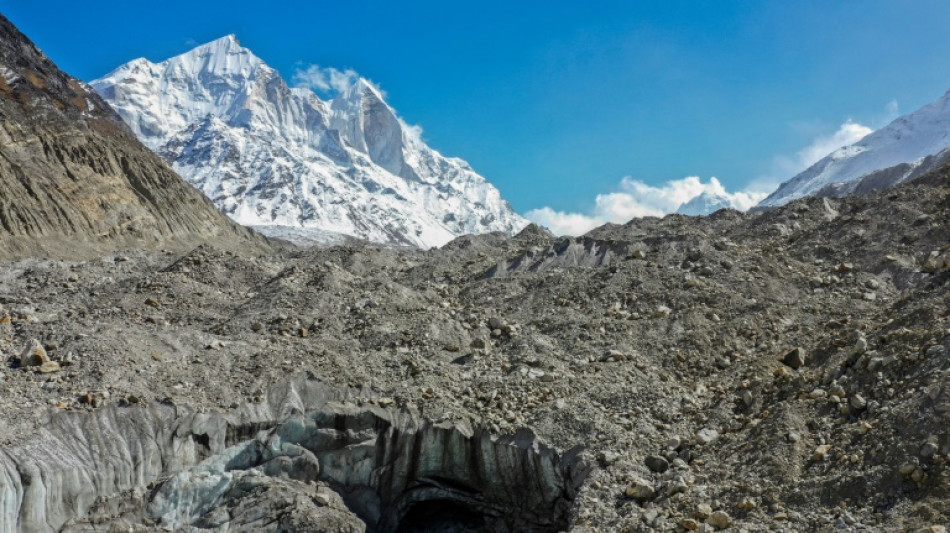
India at 75: Melting glaciers, heatwaves and climate crisis / Photo: © AFP

 Carrick confident Man Utd can 'work through' tough time

 Mbappe ends Nike partnership to join Swiss brand On

 Liverpool boss Iraola puts Bournemouth love affair on hold

 'A disaster' if Man City do not win says Maresca after flawless start

 Kerry James Marshall: American 'blackness' painter celebrated in Europe

 Spain coach De la Fuente offers 'full support' to people of Ceuta

 Russia seizes assets of Nestle, French firms over West's Ukraine support
 England can build on World Cup 'spirit', says Tuchel

 UNESCO can be 'moderator' in AI debate: chief to AFP

 Infantino 'must go', says German FA vice-president

 Russia seizes assets of Nestle, French firms

 Japan's busiest rail station tests robot bins

 Anthropic says AI systems moving towards building themselves

 Asian stocks boosted by falling oil, yen weakens after BoJ rate hike
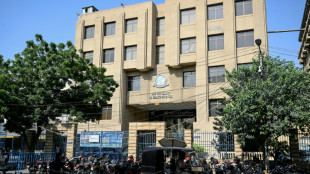 Pakistan court blocks expulsion of Afghan medical college students

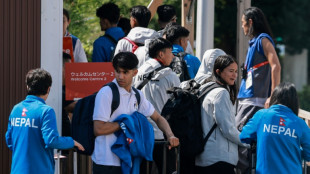 Athletes 'can't take it any more' as Asian Games issues mount

 Allen lights up Bills' new stadium with 41-31 win over Lions

 Afghan medical students in Pakistan hope court stops college expulsions

 AI doomsday warnings unlikely to slow IPOs but questions linger
 ICC eyes China in bid to expand cricket
 Nkunku craving freedom and fun on RB Leipzig return

 Bhutan's traditional archers lose ground to development
 Asian stocks track Wall St rally as oil prices drop

 South Korea makes Asian Games complaint over Japan warlord ceremony

 US aid cuts are killing Kenyan sex workers

From prime ministers and millionaires to labourers and ascetics, Hindu faithful dream of trekking at least once in their lives to Gaumukh, where the waters of India's holiest river, the Ganges, emerge from a Himalayan glacier.
But the ice at the end of the arduous journey is receding rapidly and portends an increasingly dry future for a country of 1.4 billion people facing existential challenges from climate change.
"It is quite astonishing, so quick and it is happening every day and every second," said Sheethal Vepur Ramamurthy, a researcher with Friedrich Schiller University in Jena, Germany.
"We can even see the glacier dripping," she told AFP at the site. "So, it is a harsh reality."
"Climate change definitely plays a role. Although people may deny it is happening in front of our eyes, we just have to witness it."
The Ganges flows for around 2,500 kilometres (1,550 miles) across India and is central to both Hindu identity -- believers revere it as "mother Ganga" -- and the survival of 500 million people who depend on its water for their daily farming, domestic and industrial needs.
Seventy-five years after independence, India has overtaken former coloniser Britain to become the world's fifth-largest economy.
It is also the world's third-biggest carbon emitter and second-biggest coal user.
Now, it is experiencing increasingly frequent droughts, floods and water shortages.
- 'Our identity' -
"The Ganges is our culture, heritage, identity, and if it disappears, so will our life and existence," said Sanjeev Semwal, 53, a Hindu priest in Gangotri, the town below the glacier.
Anything that impacts the river "should be a cause of worry for everyone", he told AFP.
His family have served for generations at the town's temple to Ganga, the goddess who personifies the river, on the banks of the meltwater stream.
With increasing prosperity and investment in infrastructure, hundreds of thousands of devotees now visit annually -- a far cry from the few hundred in his father's time.
"The human presence and the region's weather patterns have both changed in my lifetime," he said.
The area is a microcosm of India's wider changes: Gangotri town has been transformed by construction in recent years, and is now packed with shops, tourist facilities, and traffic.
At the same time, the glacier of the same name has shrunk by 1.7 kilometres in 90 years, according to the Wadia Institute of Himalayan Geology.
Deadly natural disasters are becoming more frequent: at least 26 people died in an avalanche on the route to Gangotri in October.
A glacial burst in the region killed at least 72 people last year, and around 5,000 others died in 2013 when heavy rains led to flooding near another Hindu pilgrimage site.
- Water scarcity -
India is one of the world's most water-stressed countries.
It has 17 percent of the world's population but only four percent of its water resources, and the government's NITI Aayog public policy centre says about 600 million people already face "high to extreme water stress".
The UN Intergovernmental Panel on Climate Change said in February that food security and agriculture-dependent economies such as India were the "most vulnerable" to the impacts of global warming.
The country's rice production could fall by 10 to 30 percent, it projected, with maize dropping 25 to 70 percent in the face of rising temperatures, increasing groundwater scarcity and extreme weather patterns.
India saw its warmest March on record this year when a heatwave made life unbearable for hundreds of millions of people, with some poor districts of even the capital New Delhi only receiving tanker deliveries twice a week.
Poverty remains widespread in India and nearly 45 percent of households do not have piped water connections.
The country's outdated agricultural sector remains its biggest employer and water consumer, depleting groundwater resources through wells and pumps, and the environmental challenges have already forced farmers in some areas off their land.
The climate crisis "is not something we are going to face sometime in the future", said Manshi Asher of campaign group Himdhara.
"It is something that is already happening. The reason it is not evident is because people who bear the cost of the crisis are the most vulnerable and don't get heard in the media or by the planners."
If action was not taken, she added, "those who can -– privileged people -– will continue to live in their safe spaces while most others bear the brunt of water shortages and other impacts of climate crisis".
-'Small is beautiful'-
Coal-dependent India consumed about a billion tonnes of the dirty fuel in 2021. Three-quarters of it went to electricity generation in a new all-time high for the country, according to an International Energy Agency report in July.
New Delhi also plans to increase production by more than 50 percent in the next two years and relaxed environmental compliance rules for mines in May.
Prime Minister Narendra Modi said India will cut its emissions to net-zero only by 2070 -- missing a key goal of last year's COP26 summit for countries to commit to doing so by 2050.
India and China were blamed for blocking a commitment to "phase out" coal at that gathering.
Modi is not attending the COP27 summit under way in Egypt, where India is demanding rich countries offer more financing to help developing nations deal with the impact of climate change and to adapt their economies.
Indian policymakers say fossil fuels power its economy that helps lift millions out of abject poverty, and that the country's per capita emissions are far lower than those of rich countries, as are its historical carbon contributions.
But environmentalists like Manoj Misra accuse policymakers of "not looking beyond the next election".
"They are not looking at the future and this shortsightedness is the problem," he said.
"Everyone wants to consume like the United States but where are the resources?" he asked. "We need to return to the Gandhian heart of small is beautiful and less is more."
C.Kovalenko--BTB



