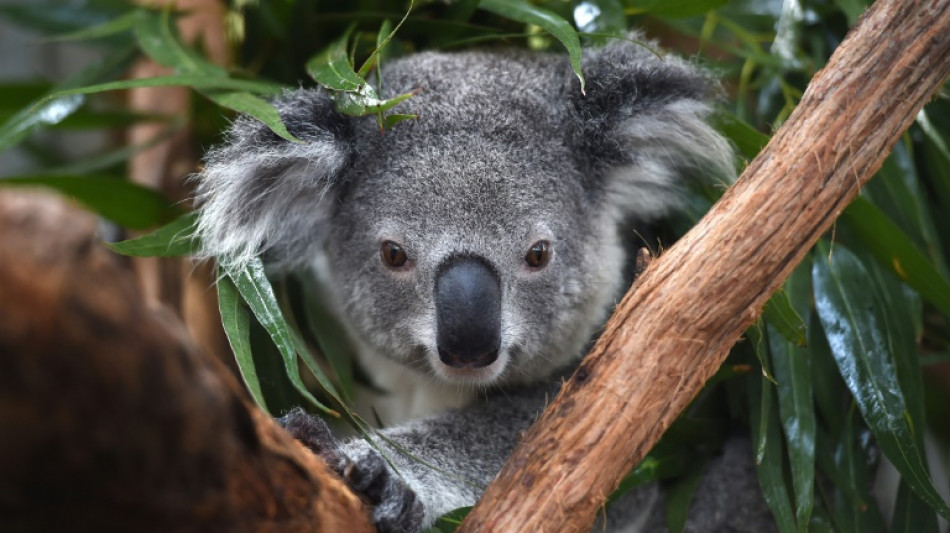
Australia warns koalas 'endangered' as numbers plunge / Photo: ©

 South Korea makes Asian Games complaint over Japan warlord ceremony
 US aid cuts are killing Kenyan sex workers

 October 7 survivors, families take centre stage in Israel vote
 Captain Mat Ryan axed from Socceroos squad for Brazil games

 US approves sale of 48 F-35 jets to Saudi Arabia

 Juventus, Palace cruise to Europa League wins, Bournemouth beat Sociedad

 Stocks climb as oil retreats, Fed calms inflation fears

 Russians begin voting in controlled election as war drags

 Hispanics feel 'betrayed' on immigration, Republican warns Trump

 High-scoring Bears face Vikings in battle of NFL unbeatens
 'In our lane': Fed's Warsh defies Trump but still fighting for credibility

 Trump admin makes major cut to endangered species protections

 Princess Diana's brother makes new explosive claims against Charles

 Ovechkin on Russian political video: 'I support my country'
 Can we shut down AI?

 Teenager Sullivan named in new-look US squad
 Travis Scott and Keith Richards feature on GTA VI soundtrack

 AFP photo shows Trump examining image of apparent Kennedy Center razing

 Pochettino rings changes for USA friendlies

 Alonso says Chelsea ambition 'very clear' after end of Boehly era

 Mbappe draws political fire over Ceuta t-shirt controversy

 Third malaria death in Germany from outbreak tied to Frankfurt airport

 AtlasClear Holdings Reports Preliminary Fiscal 2026 Revenue of Approximately $20.1 Million, Up 85%; Revenue Plus Interest Income of Approximately $21.9 Million

 Alonso says Chelsea ambition clear after end of Boehly era

 Micron's Taiwan workers say 68 months' bonus not enough
Australia officially listed koalas across a swathe of its eastern coast as "endangered" on Friday, with the marsupials fighting to survive the impact of bushfires, land-clearing, drought and disease.
Conservationists said koala populations had crashed in much of eastern Australia over the past two decades, warning that they were now sliding towards extinction.
Environment Minister Sussan Ley said she had designated koala populations as "endangered" to offer them a higher level of protection in New South Wales, the Australian Capital Territory and Queensland.
The koala, a globally recognised symbol of Australia's unique wildlife, had been listed as "vulnerable" on the eastern coast just a decade earlier.
"We are taking unprecedented action to protect the koala," the minister said, highlighting a recent government promise of Aus$50 million (US$36 million) to protect and recover koala habitats.
Environmentalists welcomed the koalas' new status but condemned Australia's failure to protect the species so far.
"Koalas have gone from no-listing to vulnerable to endangered within a decade. That is a shockingly fast decline," said WWF-Australia conservation scientist Stuart Blanch.
"Today's decision is welcome but it won't stop koalas from sliding towards extinction unless it's accompanied by stronger laws and landholder incentives to protect their forest homes."
Conservationists said it was hard to give precise figures on koala populations in the affected eastern states.
But estimates by an independent government advisory body -- the Threatened Species Scientific Committee -- indicated that koala numbers had slumped from 185,000 in 2001 to just 92,000 in 2021.
- 'Losing a national icon' -
Alexia Wellbelove of the Humane Society International said east coast koalas could be extinct by 2050 if no action was taken.
"We can't afford any more clearing," she said.
The Australian Conservation Foundation said its own research showed that the federal government had approved the clearing of more than 25,000 hectares of koala habitat since the species was declared vulnerable a decade ago.
"Australia’s national environment laws are so ineffective they have done little to stem the ongoing destruction of koala habitat in Queensland and NSW since the species was supposedly protected a decade ago," said the foundation's nature campaign manager, Basha Stasak.
"The extinction of koalas does not have to happen," Stasak added.
"We must stop allowing their homes to be bulldozed for mines, new housing estates, agricultural projects and industrial logging."
Australia's koalas had been living on a "knife edge" even before the devastating "Black Summer" bushfires of 2019-2020 because of land-clearing, drought, disease, car strikes and dog attacks, said Josey Sharrad, wildlife campaign manager at the International Fund for Animal Welfare.
"We should never have allowed things to get to the point where we are at risk of losing a national icon," Sharrad said.
"The bushfires were the final straw. This must be a wake-up call to Australia and the government to move much faster to protect critical habitat from development and land-clearing and seriously address the impacts of climate change."
F.Pavlenko--BTB