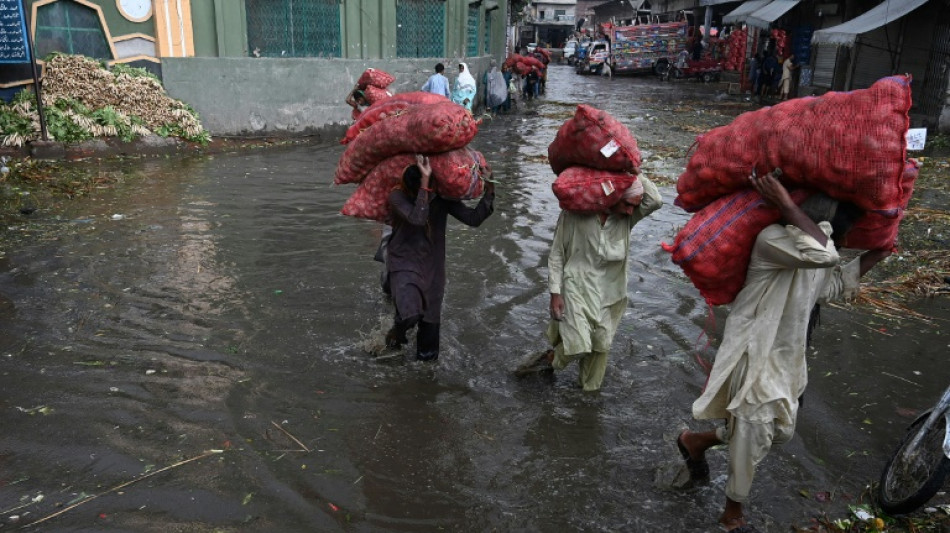
'Third' of Pakistan under water as flood aid efforts gather pace / Photo: © AFP

 Alexander-Arnold and Palmer return to England squad for Nations League

 Russians vote as Ukraine war drags on for fifth year

 Backpackers fret over Australian visa crackdown

 Most Asian stocks track Wall St rally, yen drops after BoJ rate hike
 Russians begin voting in controlled election as war drags on

 Trump 'clearly' wants dialogue with Pyongyang: South Korean President

 Bank of Japan hikes rates to 31-year high to battle inflation
 Thailand's Muslim separatists vow to fight to the end

 Mideast turmoil, AI set to dominate UN gathering of world leaders

 Australia to detain tourists who overstay visa, minister says

 Championship rivals brace for renewal of bitter feuds

 In Brazil's Amazon, the hunt for oil fuels hopes and fears

 Australian athlete who soiled herself apologises for continuing Hyrox race

 Baby orangutans in India expose 'frightening' scale of trafficking
 Doom Loop? Ed Sheeran struggles against Gaza tide

 Sudanese women hold fast to threatened henna body art

 Man Utd misery puts Carrick under pressure, Spurs feeling the heat

 Prized Mexican relic returns on loan, two centuries on

 Venezuela unblocks some censored news sites

 Samba stars on debut in Man City rout of Norwich

 Oversight Board blasts 'inadequate' Meta safeguards for AI deepfakes

 The Easter Island origins of buzzy Malkovich drama 'Wild Horse Nine'

 Third body recovered after Grand Canyon flash flood

 Harry makes first public appearance since return to UK

 Abhishek hits record T20 ton as India sweep series 3-0

Aid efforts ramped up across flooded Pakistan on Tuesday to help tens of millions of people affected by relentless monsoon rains that have submerged a third of the country and claimed more than 1,100 lives.
The rains that began in June have unleashed the worst flooding in more than a decade, washing away swathes of vital crops and damaging or destroying more than a million homes.
Authorities and charities are struggling to accelerate aid delivery to more than 33 million people affected, a challenging task in areas cut off because roads and bridges have been washed away.
In the south and west, dry land is limited, with displaced people crammed on to elevated highways and railroad tracks to escape the flooded plains.
"We don't even have space to cook food. We need help," Rimsha Bibi, a schoolgirl in Dera Ghazi Khan in central Pakistan, told AFP.
Pakistan receives heavy -- often destructive -- rains during its annual monsoon season, which are crucial for agriculture and water supplies.
But such intense downpours have not been seen for three decades.
Pakistani officials have blamed climate change, which is increasing the frequency and intensity of extreme weather around the world.
"To see the devastation on the ground is really mind-boggling," Pakistan's climate change minister Sherry Rehman told AFP.
"When we send in water pumps, they say 'Where do we pump the water?' It's all one big ocean, there's no dry land to pump the water out."
She said "literally a third" of the country was under water, comparing scenes from the disaster to a dystopian movie.
The Indus River, which runs along the length of the South Asian nation, is threatening to burst its banks as torrents of water rush downstream from its tributaries in the north.
The meteorological office says the country as a whole had been deluged with twice the usual monsoon rainfall, but Balochistan and Sindh provinces had seen more than four times the average of the last three decades.
- 'Pakistan is drowning' -
The disaster could not have come at a worse time for Pakistan, where the economy is in free fall.
The government has declared an emergency and appealed for international help.
Aid flights have arrived in recent days from Turkey and the UAE, while other nations including Canada, Australia and Japan have also pledged assistance.
The United Nations has announced it will launch a formal $160 million appeal on Tuesday to fund emergency aid.
Pakistan was already desperate for international support and the floods have compounded the challenge.
Prices of basic goods -- particularly onions, tomatoes and chickpeas -- are soaring as vendors bemoan a lack of supplies from the flooded breadbasket provinces of Sindh and Punjab.
Finance Minister Miftah Ismail has told local media that the disaster could cost upwards of $10 billion, and on Monday said "Pakistan is drowning".
There was some relief on Monday when the International Monetary Fund approved the revival of a loan programme for Pakistan, releasing an initial $1.1 billion.
Makeshift relief camps have sprung up all over Pakistan -- in schools, on motorways and in military bases.
In the northwestern town of Nowshera, a technical college was turned into a shelter for up to 2,500 flood victims.
They sweltered in the summer heat with sporadic food aid and little access to water.
"I never thought that one day we will have to live like this," said 60-year-old Malang Jan.
"We have lost our heaven and are now forced to live a miserable life."
J.Fankhauser--BTB