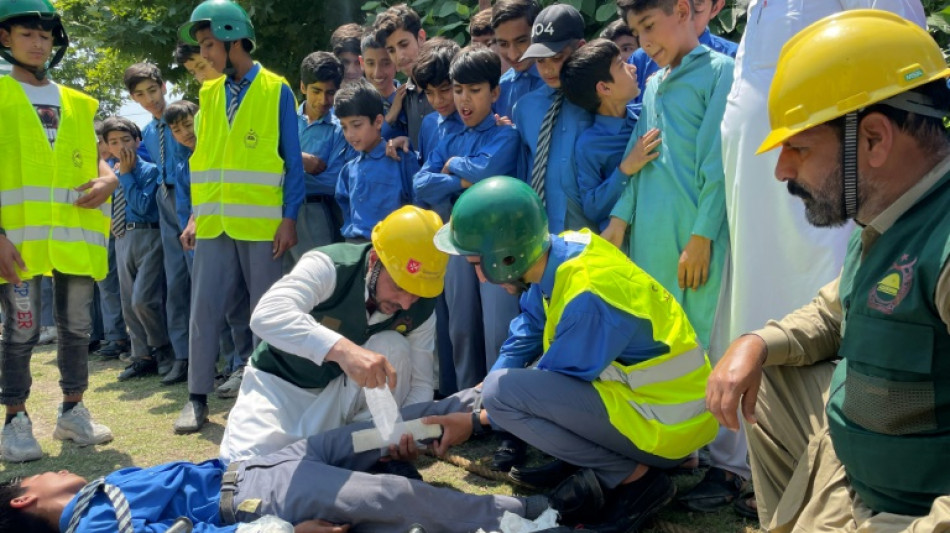
Children learn emergency drills as Kashmir tensions rise / Photo: © AFP

 Make-A-Wish Announces 2026 Starblazer Award Honorees; Allied World Becomes First Corporate Founder

 Lee-Trump Golf Diplomacy Faces Diplomatic Dilemma Ahead of G20 Summit

 Mavericks Defeat Jazz 112-100 Behind Washington’s 26 Points and Second-Half Surge

 BingX: Major Announcement of Far-Reaching Significance

 James Blunt Scores First Number One Album in 19 Years; Wife Sofia Wellesley Celebrates

 UCLA Stays Unbeaten With Ty Dieffenbach's Heroic Return Against Illinois

 Malta Court Rejects Libel Claims by Developer Kurt Buhagiar Against MEP Peter Agius
School playing fields in Pakistan's Kashmir are being transformed into first aid camps for children to learn how to respond if war breaks out with India.
Wearing a protective helmet and a fluorescent vest, 13-year-old Konain Bibi listened attentively to her first aid lesson.
"With India threatening us, there's a possibility of war, so we'll all have to support each other," she told AFP.
Pakistan's government has warned that it has "credible intelligence" that India was planning an imminent military strike.
Already frosty relations between the nuclear-armed neighbours have plummeted since a deadly assault on tourists in Pahalgam in Indian-administered Kashmir last week.
India blames Pakistan for the gun attack that killed 26 people on April 22, with Prime Minister Narendra Modi giving his military "complete operational freedom", although Islamabad has denied any involvement.
Muslim-majority Kashmir, a region of around 15 million people, is claimed in full by both Islamabad and New Delhi but is divided between them.
There are more than 6,000 schools, colleges and universities on the Pakistan side of the border -- including 1,195 along the Line of Control (LoC), the heavily militarised de facto border separating the disputed territory.
Local authorities launched first aid training this week, teaching students how to jump out of a window, use an inflatable evacuation slide, or carry an injured person.
- 'Come straight home' -
Pakistan and India have exchanged fire at the border for several nights in a row, breaking a ceasefire agreement.
In Muzaffarabad, the largest city in Pakistani Kashmir, training sessions have already taken place in 13 schools, according to emergency workers.
"In an emergency, schools are the first to be affected, which is why we are starting evacuation training with schoolchildren," Abdul Basit Moughal, a trainer from Pakistan's Civil Defence directorate, told AFP.
The agency will deploy its rescue workers to schools bordering the LoC in the coming days.
"We're learning to help our friends and provide first aid in case India attacks us," said 12-year-old Faizan Ahmed as students watched an instructor handle a fire extinguisher.
Eleven-year-old Ali Raza added: "We have learned how to dress a wounded person, how to carry someone on a stretcher and how to put out a fire."
In Chakothi village, about three kilometres (two miles) from the Line of Control, there are around 30 bunkers for a community of 60 families overlooked by Indian army check posts atop the surrounding green mountains.
"For a week we are living under constant fear," said Iftikhar Ahmad Mir, a 44-year-old shopkeeper in Chakothi.
"We are extremely worried about their safety on the way to school because the area was targeted by the Indian army in the past," he said of the village's children.
"We make sure they don't roam around after finishing their school and come straight home."
S.Spengler--VB