Strengthening El Nino likely to 'rank among largest' on record: US agency / Photo: © AFP/File

 Hong Kong court set to sentence activist Joshua Wong in security case

 Australia raises benchmark rate to highest level in 18 years

 'The Remarried Empress' Cast Discusses Bringing Fantasy Royal Drama to Life

 Asian stocks retreat as AI worries outweigh steep oil-price drop

 Hamad International Airport stages emergency drills during WATAN 2026

 Global failure to punish attacks leaves journalists at continuing risk

 Researchers Warn 'Bookkeeping Trick' Masks Beef Industry's Methane Emissions

 Climate Change Intensified Atlantic Hurricanes, Study Finds

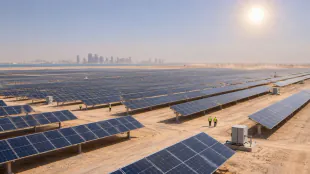 Qatar solar expansion opens scope for technical performance gains

The El Nino weather pattern picked up strength over the past month and is highly likely to "rank among the largest" ever recorded when it peaks between October and December, US forecasters said Thursday.
El Nino warms surface temperatures in the central and eastern equatorial Pacific Ocean, triggering worldwide changes in winds, pressure and rainfall patterns.
In its latest update, the US Climate Prediction Center (CPC) said there is an 81 percent chance of a "very strong" El Nino between October-December that would rank among the largest such events in the historic record going back to 1950.
"Very strong" is defined as being 2.0 degrees Celsius (3.6 degrees Fahrenheit) or more above an index value. The CPC also put the odds at 97 percent that the event will persist through early spring 2027.
El Ninos typically have knock-on effects globally, including drier conditions and drought in Australia, wetter winters in East Africa and the southern United States, and warmer overall global temperatures.
"Even the strongest El Nino events do not lead to the typical impact everywhere, but stronger events can more significantly tilt the odds in favor of expected outcomes," the CPC said.
Sea surface temperatures are now 1.2C (2.2F) above average in a defined stretch of the equatorial Pacific known as the Nino 3.4 region, the CPC said.
Combined with warming waters below the surface and shifting wind and pressure patterns, the "ocean-atmosphere system reflected a strengthening El Nino."
While El Nino usually peaks between November and February, the resulting spike in temperatures typically comes later.
Compounded with human-induced climate change, the last El Nino contributed to making 2023 the second-hottest year on record and 2024 the all-time high.
D.Bachmann--VB