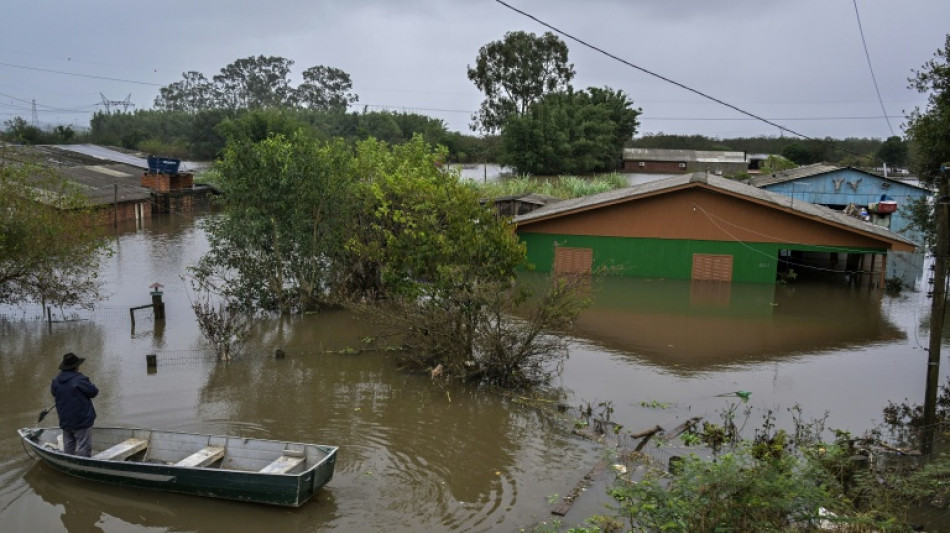
This year's El Nino likely to become record-breaker: top expert / Photo: © AFP/File

 Hong Kong court set to sentence activist Joshua Wong in security case

 Australia raises benchmark rate to highest level in 18 years

 'The Remarried Empress' Cast Discusses Bringing Fantasy Royal Drama to Life

 Asian stocks retreat as AI worries outweigh steep oil-price drop

 Hamad International Airport stages emergency drills during WATAN 2026

 Global failure to punish attacks leaves journalists at continuing risk

 Researchers Warn 'Bookkeeping Trick' Masks Beef Industry's Methane Emissions

 Climate Change Intensified Atlantic Hurricanes, Study Finds

 Qatar solar expansion opens scope for technical performance gains

The current El Nino weather phenomenon is expected to break records for its overall strength, a top expert said Tuesday, as regions face the risk of droughts, floods and other extremes linked to the event.
El Nino warms surface temperatures in the central and eastern equatorial Pacific Ocean, bringing worldwide changes in winds, pressure and rainfall patterns.
It typically takes place every two to seven years and lasts around nine to 12 months, and it can lead to droughts in some parts of the world and flooding in others.
This year's El Nino is unlike anything seen in more than three decades of tracking the phenomenon, with forecast models pointing to an "extreme" event, said Tim Stockdale, an El Nino expert at the European Centre for Medium-Range Weather Forecasts (ECMWF), an intergovernmental organisation.
"I think it's absolutely true to say we've never had a forecast of an El Nino that was so strong and so consistent across (forecast) models," he said in a media briefing.
Stockdale said it would be "a very, very big surprise" if the event failed to be a record-breaker.
"I would expect it to break records," he said, while cautioning: "but no guarantees."
While El Nino usually peaks between November and February, the resulting spike in temperatures typically comes later.
Combined with human-induced climate change, the last El Nino contributed to making 2023 the second-hottest year on record and 2024 the all-time high.
- Floods, droughts, wildfires -
The US weather agency declared last month that El Nino had developed and would would intensify into potentially historic strength.
Last week, the World Meteorological Organization (WMO) said El Nino would quickly develop into a strong event between July and September.
UN food aid agencies appealed last month for funds to enact prevention measures over El Nino.
In India, agricultural officials said they would prepare contingency plans to help farmers cope with potentially low rainfall linked to the phenomenon.
Many parts of Asia experience drier-than-average conditions and drought during El Nino years.
El Nino can suppress the monsoon over South Asia, depriving India and other parts of the subcontinent of vital rain that supports hundreds of millions of people.
El Nino also raises the likelihood of drought, heatwaves and wildfires in Australia as warmer-than average conditions grip the continent.
It is often associated with increased rainfall in parts of the Horn of Africa.
But swathes of southern, west, central and eastern Africa usually see drier-than-normal conditions.
Parts of western South America, including coastal Peru and Ecuador, often see above-average rainfall during strong events, raising the risk of flooding and landslides.
In contrast, the weather pattern is tied to drier-than-average conditions in northern Brazil, increasing the risk of wildfires in the Amazon.
I.Stoeckli--VB