Mine-riddled French island becomes unlikely walkers' paradise / Photo: © AFP

 Most Asian stocks track Wall St rally, yen drops after BoJ rate hike

 Russians begin voting in controlled election as war drags on

 Trump 'clearly' wants dialogue with Pyongyang: South Korean President

 Bank of Japan hikes rates to 31-year high to battle inflation

 Thailand's Muslim separatists vow to fight to the end

 Mideast turmoil, AI set to dominate UN gathering of world leaders

 Australia to detain tourists who overstay visa, minister says

 Championship rivals brace for renewal of bitter feuds

 In Brazil's Amazon, the hunt for oil fuels hopes and fears

 Australian athlete who soiled herself apologises for continuing Hyrox race

 Baby orangutans in India expose 'frightening' scale of trafficking

 Doom Loop? Ed Sheeran struggles against Gaza tide

 Sudanese women hold fast to threatened henna body art

 Man Utd misery puts Carrick under pressure, Spurs feeling the heat

 Prized Mexican relic returns on loan, two centuries on

 Venezuela unblocks some censored news sites

 Samba stars on debut in Man City rout of Norwich

 Oversight Board blasts 'inadequate' Meta safeguards for AI deepfakes

 The Easter Island origins of buzzy Malkovich drama 'Wild Horse Nine'

 Third body recovered after Grand Canyon flash flood

 Harry makes first public appearance since return to UK
 Abhishek hits record T20 ton as India sweep series 3-0

 Abhishek hits record T20 ton as India sweep T20 series 3-0

 English FA calls for Infantino to release World Cup sell-off documents

 GM delivers first components for US interceptor missiles

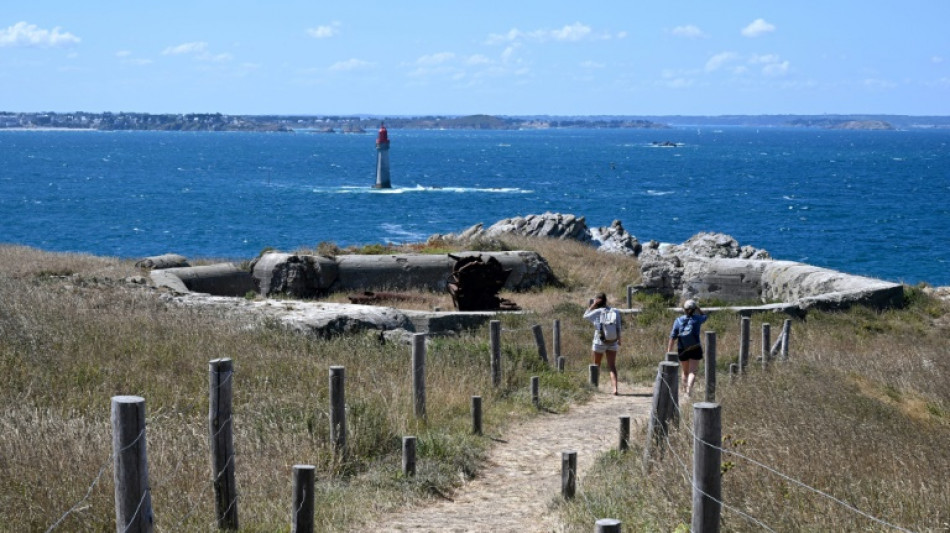
Every year, thousands of day-trippers make the short boat journey from France's northern coast to the island of Cezembre, marvelling at the spectacular maritime views and flourishing wildlife.
But they better tread carefully and stick to the path, as almost all the island remains perilous due to unexploded munitions from World War II.
Cezembre opened to visits only in 2018, over seven decades after the end of World War II, after extensive demining efforts allowed the opening of a marked path for visitors.
However, the area safe for visitors makes up just three percent of the island, which experts say was the most bombed area of all of World War II in terms of the number of hits per square metre.
"It's magnificent!" enthused Maryse Wilmart, a 60-year-old visitor from the southwestern town of La Rochelle, contemplating the sandy beach with turquoise waters and looking out to the ramparts of the port city of Saint-Malo beyond.
"But when you see all that behind us... Can you even imagine what happened here?" she asked, pointing to the barbed wire and signs warning "Danger! Ground not cleared beyond the fences!"
- 'Like Stalingrad' -
A visitor needs to go back 80 years to understand what happened on this usually uninhabited rocky outcrop.
In 1942, the occupying Nazi German army seized the strategically important island and installed bunkers and artillery pieces.
On August 17, 1944, Saint-Malo was liberated by the Americans but the Nazi commander of Cezembre, leading some 400 men, refused to surrender.
There then followed a devastating bombardment from the air by the Allies.
"It is said that per square metre it sustained the greatest number of bombardments of all the theatres of operation of World War II," said Philippe Delacotte, author of the book "The Secrets of the Island of Cezembre".
"There were between 4,000 and 5,000 bombs dropped", some of which contained napalm, he said.
On September 2, 1944, the white flag was finally raised and some 350 exhausted men surrendered.
"Some survivors claimed it was like Stalingrad," Delacotte said. The island was completely devastated, to the extent that its altitude even dropped because of the bombs.
After the war, the island became the property of the French ministry of defence and access was totally closed, with the first demining efforts starting in the 1950s.
It was handed over to a public coastal conservation body, the Conservatoire du Littoral, in 2017.
- 'Recolonised and revegetated' -
The path of about 800 metres (875 yards) lets visitors wander between rusty cannons and bunkers, with breathtaking views towards Cap Frehel and the Pointe de la Varde.
Since the opening of the path, "there has been no accident" even if "there are always people who want to go beyond the authorised section," said Jean-Christophe Renais, a coast guard.
Over time, colonies of seabirds have reappeared, including seagulls, cormorants, razorbills and guillemots.
"Biodiversity is doing wonderfully, everything has been recolonised and revegetated, birds have taken back possession of the site," said Gwenal Hervouet, who manages the site for Conservatoire du Littoral.
"It's just a joy."
Because of the focus on restoring wildlife, the trail was partially closed in April "to maximise the chances of success and the flight of peregrine falcon chicks," said local conservation activist Manon Simonneau.
Some walkers say they hope the trail will be lengthened to allow a complete tour of the island, but according to the Conservatoire there is little chance of this -- the cost of further demining would be astronomical, so it is now birds and nature that are the masters of Cezembre.
I.Meyer--BTB