Money, lobbyists, inertia: why fossil fuels are so hard to quit / Photo: © AFP

 Most Asian stocks track Wall St rally, yen drops after BoJ rate hike

 Russians begin voting in controlled election as war drags on

 Trump 'clearly' wants dialogue with Pyongyang: South Korean President

 Bank of Japan hikes rates to 31-year high to battle inflation

 Thailand's Muslim separatists vow to fight to the end

 Mideast turmoil, AI set to dominate UN gathering of world leaders

 Australia to detain tourists who overstay visa, minister says

 Championship rivals brace for renewal of bitter feuds

 In Brazil's Amazon, the hunt for oil fuels hopes and fears

 Australian athlete who soiled herself apologises for continuing Hyrox race

 Baby orangutans in India expose 'frightening' scale of trafficking

 Doom Loop? Ed Sheeran struggles against Gaza tide

 Sudanese women hold fast to threatened henna body art

 Man Utd misery puts Carrick under pressure, Spurs feeling the heat

 Prized Mexican relic returns on loan, two centuries on

 Venezuela unblocks some censored news sites
 Samba stars on debut in Man City rout of Norwich

 Oversight Board blasts 'inadequate' Meta safeguards for AI deepfakes

 The Easter Island origins of buzzy Malkovich drama 'Wild Horse Nine'

 Third body recovered after Grand Canyon flash flood

 Harry makes first public appearance since return to UK

 Abhishek hits record T20 ton as India sweep series 3-0

 Abhishek hits record T20 ton as India sweep T20 series 3-0

 English FA calls for Infantino to release World Cup sell-off documents

 GM delivers first components for US interceptor missiles

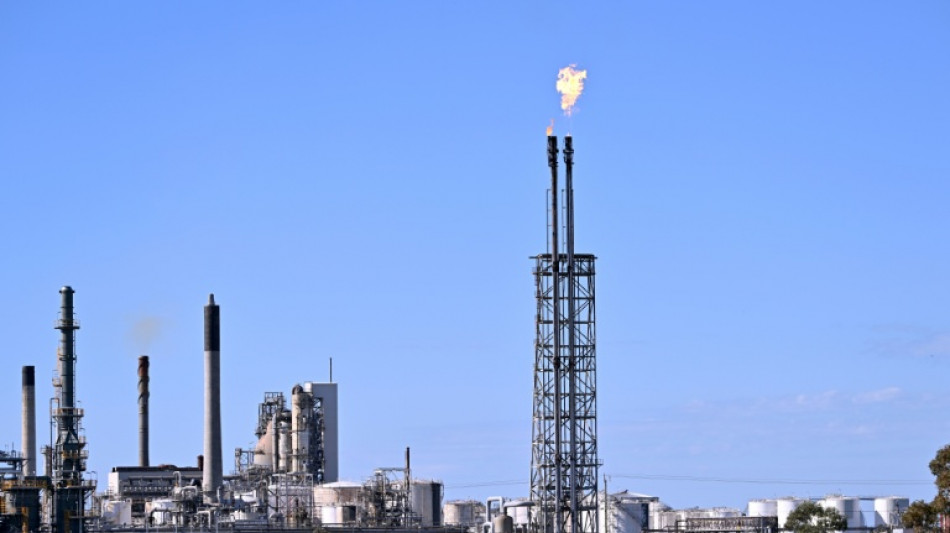
When the international community agreed to transition away from fossil fuels at the 2023 COP28 global climate summit, some hailed the moment as the beginning of the end for oil.
But little progress has been made since then, even though the vast majority of scientists agree there's overwhelming evidence of global warming and that it is driven chiefly by the burning of fossil fuels.
The Middle East war, meanwhile, has shown that the world is as dependent as ever on "black gold," with the effective closure of the Strait of Hormuz holding the global economy and energy supply in a chokehold.
Some have pointed to the ripple effects of the war as yet another reason to decrease humanity's dependence on fossil fuels. But several global trends indicate the 2023 promise is still a ways away from coming true.
Among them is the agenda of US President Donald Trump, whose energy slogan is "drill, baby, drill" and has intervened with military force in two countries with vast crude reserves: Venezuela and Iran.
But why is it so hard for countries to quit oil? Here are some factors:
- It's the economy -
If financial markets rise and fall with the fluctuating price of crude, it's because they have deep ties to assets linked to hydrocarbons.
"We cannot make the transition by shutting down fossil fuel companies overnight, because that would be an unprecedented worldwide economic disaster," Claudio Angelo, the international policy coordinator at Brazil's Climate Observatory, told AFP.
The economies of some countries like Iraq, Kuwait and Saudi Arabia are completely dependent on oil.
But Angelo said that even for other countries with more diverse economic models, like Brazil, removing crude oil exports would be enough to tank the economy.
- 'Political will' -
Bill Hare, director of a policy institute called Climate Analytics, said some oil-exporting countries like the United States, Canada and Australia have the means to undertake a green energy transition.
"For these countries, I think it's a matter of political will," he told AFP.
But with Trump back in Washington, along with a host of other right-wing leaders assuming power around the globe, economic interests are once again being prioritized over the issue of global warming -- with some denying the climate phenomenon even exists.
"There is a whole vision of the West, led by the United States, of going back to a model that's already been tried," said Leonardo Stanley, an associate researcher at the Center for the Study of State and Society in Buenos Aires.
- Powerful lobbyists -
"The oil and gas sector is the most powerful lobbying interest on Earth," Climate Observatory's Angelo said.
"For 30 years, they have been playing for time to delay changes," he added.
For example, an AFP investigation in 2023 showed that consulting firm McKinsey, with clients such as ExxonMobil in the United States and Saudi Arabia's Aramco, defended their interests during a preparatory meeting for COP28.
- Who foots the bill? -
To move away from oil, financial support is needed for both wealthy oil-producing countries and poorer countries entirely dependent on oil imports.
"But to start this process it's got to be some willingness from the big economic powers, the middle and big economic powers to actually come up with an international system that will facilitate this," Hare said.
Despite the headwinds, there has been some progress made in transitioning to green energy.
Renewable energy sources accounted for nearly half of global electricity capacity in 2025, a record, according to the International Renewable Energy Agency (IRENA).
China, the world's largest producer of greenhouse gasses, nevertheless has become a global leader in renewable energy production, increasing its wind and solar power capacities substantially within the past year.
And in Pakistan, solar power has gone from being a marginal source of power in 2020 to one of its main source of electricity today.
Hare highlighted renewable energy sources have also led to decreased electricity bills in some regions of the United States and Australia.
S.Spengler--VB