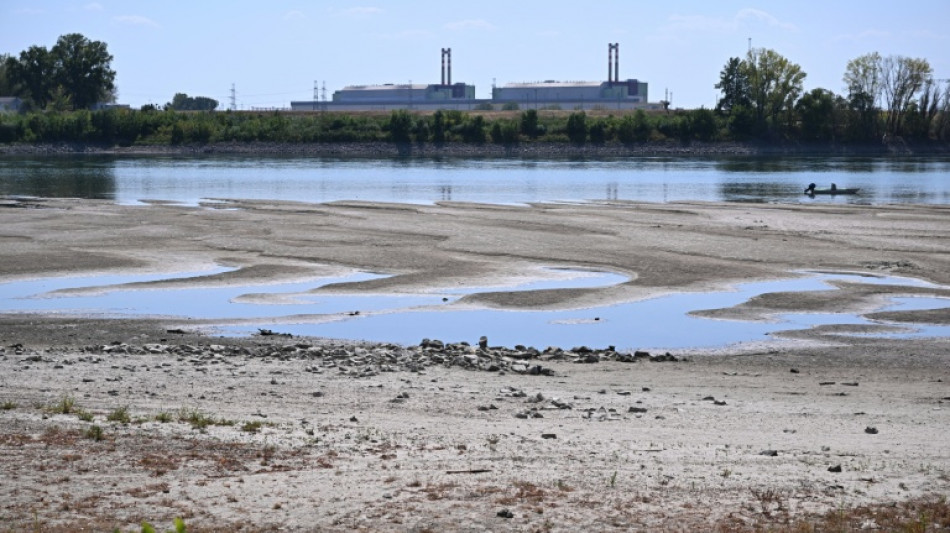
Hungary to shut nuclear plant as heatwave hits central Europe / Photo: © AFP

 Stocks rise on AI buzz, oil prices cool

 India narrowly survive huge scare against minnows Japan

 Missing F-35 fighter parts 'not sensitive', says Australia minister

 Cambodia showcases scams crackdown with global conference

 Afghan cyclist who disguised herself as man wins Asian Games silver

 Typhoon Dujuan leaves four dead in Japan, 45,000 houses without power

 G7 leaders condemn Houthi strikes on Saudi Arabia

 Google data centre sparks protests in Austria

 Shin Ohashi: Junk food-loving teen and Japan's next big swimming hope

 Stocks rise on AI buzz, drop in oil prices

 China's robot dancers limber up for America's Got Talent final

 Despite military might, Saudi struggles to crush the Houthis

 Trump to tout deals, defend Iran war in UN speech

 Sri Lanka to issue verdict in landmark Easter attack trial

 Macron says talks with Trump on Red Sea, Ukraine 'constructive'

 Green policies just good politics, says UK minister

 Bardot auction in Paris fetches nearly one million euros
 No timeline on Daniels injury return, says Commanders coach

 British Columbia sues OpenAI in US court over Canada school shooting

 French star Batum retires after 18-year NBA career

 Zidane leads first France training session

 Man shot by ICE agent in Texas detained with bullet inside him: lawyer

 California declares state of emergency ahead of El Nino

 South Africa arrests three more suspects, after nine women murdered

 Carse needs time away from England, says captain Brook

Hungary's sole nuclear power plant will be shut down next week because of low water levels in the river Danube, Prime Minister Peter Magyar said Friday as central Europe slogs through the latest in a series of heatwaves.
The nuclear plant in Paks, south of Budapest, provides around 40 percent of Hungary's annual electricity generation.
The operator of the plant, whose four reactors built with Soviet-era technology are cooled by water pumped from the Danube, warned earlier that a shutdown was "unavoidable".
"According to current calculations... this could happen on Tuesday or Wednesday," Magyar told a press conference at the plant, which has already reduced output in recent days.
The Danube has dropped to record low levels in some parts because of prolonged rain shortages and successive heatwaves since May.
Romania has already shut one of its nuclear reactors for the same reason and has announced it would close the second.
The shutdowns are just one effect of an already record-breaking spell of hot weather, with several countries taking steps to reduce the risk of fires and ease pressure on water and energy networks.
- 'Unbearable' -
Hungary's government has called on businesses to use less electricity, banned outdoor fires and ordered decorative lighting on state buildings to be switched off to save energy.
Kata Serfozo, 36, a designer on maternity leave in Budapest, said she was spending "a lot of time outdoors in the shade" because it feels better than staying at home with "the curtains drawn, the blinds down, and the shades closed".
In the town of Szentendre north of Budapest, where about 7,000 residents face cuts to their water supply, Janos Keresztes, 75, a retired translator, said the heat and lack of water were "really, really taking a toll".
The regional water company has sent water carts to provide emergency supplies, but "even though I can get enough water from the water cart to drink, (it is) not enough to wash up", he said.
In Hungary's northern neighbour Slovakia, local authorities in the capital Bratislava have set up more than 30 cooling stations offering air-conditioned spaces and drinking water.
Darina Justusova, 33, pregnant and on maternity leave, said the heat was making her "much more tired" and forcing her to "take more breaks" during the day.
"I have a daughter -- we don't go outside until it cools down a bit, because the current temperatures are unbearable," she said.
- Austrian record -
Forecasters in Slovenia, meanwhile, have said the western part of the country is facing an "extremely high" fire risk.
The authorities have banned activities that could spark fires in the area.
"This heat wave will be extraordinary due to its length, not only the high temperatures," climatologist Gregor Vrtacnik said in a press conference hosted by meteorological agency ARSO.
Sea temperature off Slovenia's the Adriatic coast could beat the all-time record of 30.4C set in 2010, according to marine experts.
Austria recorded its highest ever July temperature on Friday at 40.3C in the town of Wieselburg west of Vienna.
The country is already experiencing an "extreme" drought, according to the Geosphere Austria national weather agency.
"Since the beginning of the year, precipitation has been around 30 percent below normal levels," the agency said in a statement on Wednesday.
P.Staeheli--VB