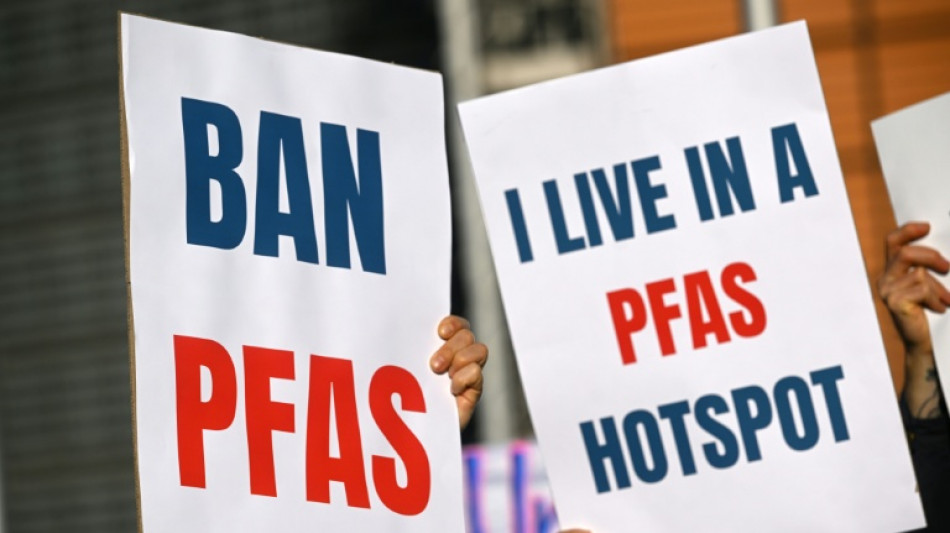
Forever chemicals and pesticides under Trump: what to know / Photo: © AFP

 Allen lights up Bills' new stadium with 41-31 win over Lions

 Afghan medical students in Pakistan hope court stops college expulsions

 AI doomsday warnings unlikely to slow IPOs but questions linger

 ICC eyes China in bid to expand cricket

 Nkunku craving freedom and fun on RB Leipzig return

 Bhutan's traditional archers lose ground to development
 Asian stocks track Wall St rally as oil prices drop

 South Korea makes Asian Games complaint over Japan warlord ceremony

 US aid cuts are killing Kenyan sex workers

 October 7 survivors, families take centre stage in Israel vote

 Captain Mat Ryan axed from Socceroos squad for Brazil games

 US approves sale of 48 F-35 jets to Saudi Arabia

 Juventus, Palace cruise to Europa League wins, Bournemouth beat Sociedad

 Stocks climb as oil retreats, Fed calms inflation fears

 Russians begin voting in controlled election as war drags

 Hispanics feel 'betrayed' on immigration, Republican warns Trump

 High-scoring Bears face Vikings in battle of NFL unbeatens

 'In our lane': Fed's Warsh defies Trump but still fighting for credibility

 Trump admin makes major cut to endangered species protections

 Princess Diana's brother makes new explosive claims against Charles

 Ovechkin on Russian political video: 'I support my country'

 Can we shut down AI?

 Teenager Sullivan named in new-look US squad
 Travis Scott and Keith Richards feature on GTA VI soundtrack

 AFP photo shows Trump examining image of apparent Kennedy Center razing

Since returning to power, President Donald Trump's administration has approved five new pesticides considered by many to be PFAS "forever chemicals," a class of toxic substances facing increasing restrictions around the world.
But Trump's Environmental Protection Agency (EPA) has an alternative definition of per- and polyfluoroalkyl substances that excludes the pesticides, and says they pose no threat to human health.
The last three approvals were made without press statements, surfacing only when nonprofits publicized them this month.
Critics say the chemicals may pose hidden risks, and many of them break down into trifluoroacetic acid (TFA), now abundant in global drinking water and potentially linked to serious harms, including fetal and reproductive damage.
"If we want to do something about this class of chemicals, then you need to draw boundaries," Cindy Hu, an environmental scientist at George Washington University told AFP.
- Damning history -
PFAS are defined by the carbon-fluorine bond, the most stable in organic chemistry, whose strength and liquid repelling properties made the chemicals prized firefighting foam, nonstick pans, raincoats and more.
But evidence linking them to cancers, immune conditions and reproductive harms has triggered billion-dollar settlements, new laws and corporate phase-outs.
The Organization for Economic Co-operation and Development (OECD) adopted a broad definition in 2021 encompassing any molecule with a single fully-fluorinated carbon atom. Roughly half of US states, Congress and the Pentagon have upheld it, as did 150 scientists in a 2024 consensus statement.
In 2023, the EPA under then-president Joe Biden went its own way, narrowing the definition to only include chemicals with two or more adjacent fully-fluorinated carbon atoms, which it deemed less likely to persist.
One such pesticide was greenlit under Biden. Trump's second term has added five more.
Trump's EPA says pesticides are essential for food abundance, that all are reviewed, and that single-fluorinated ones can be less toxic than alternatives. It notes they are also registered or proposed in the European Union, Canada and Australia.
- 'Getting worse' -
That is not good enough for many scientists and activists, who fear a growing threat to the food supply and to farm workers.
Trifludimoxazin, one of the new herbicides, has "suggestive evidence of carcinogenic potential," the EPA's own review found.
And the new approvals are just the tip of the iceberg: a 2024 retrospective analysis revisited hundreds of pesticide ingredients approved in the past and found 66 would have met the OECD definition of PFAS.
"It's an issue that most administrations have kind of conveniently swept under the rug," Nathan Donley of the Center for Biological Diversity, who led the study, told AFP. "But it's definitely getting worse."
"If you were to buy 10 peaches or plums at random in the US, chances are nine of them are going to have at least residues of highly toxic PFAS pesticides," Varun Subramaniam, an Environmental Working Group scientist who conducted an analysis of produce samples, told AFP.
Many such pesticides break down into TFA, which is now found extensively in water, and the EU's food safety agency last week sharply cut the acceptable daily intake.
- Ex-lobbyists -
Criticism has focused on former lobbyists in senior EPA posts.
A Freedom of Information Act request led by Donley found those officials, alongside EPA chief Lee Zeldin, coordinated edits last November to the agency's webpage on PFAS and pesticides, stripping out any acknowledgment of the more widely-accepted definition.
The edit came the same day CropLife America, the pesticide industry's trade association, submitted a paper arguing against further regulation that cited the revised page. CropLife America told AFP it did not coordinate with the EPA over the timing of its submission, but rather re-submitted its manuscript to reference the revised page.
For researcher Hu, the debate echoes an earlier chapter in the PFAS story. When first-generation PFAS were phased out in the 2000s, industry replaced them with shorter-chain molecules marketed as safer -- one of which, GenX, caused a drinking water contamination crisis in North Carolina.
"It's a continuation of the same storyline," she said, advocating the "precautionary principle" that would presume such chemicals as harmful until proven otherwise.
A.Kunz--VB