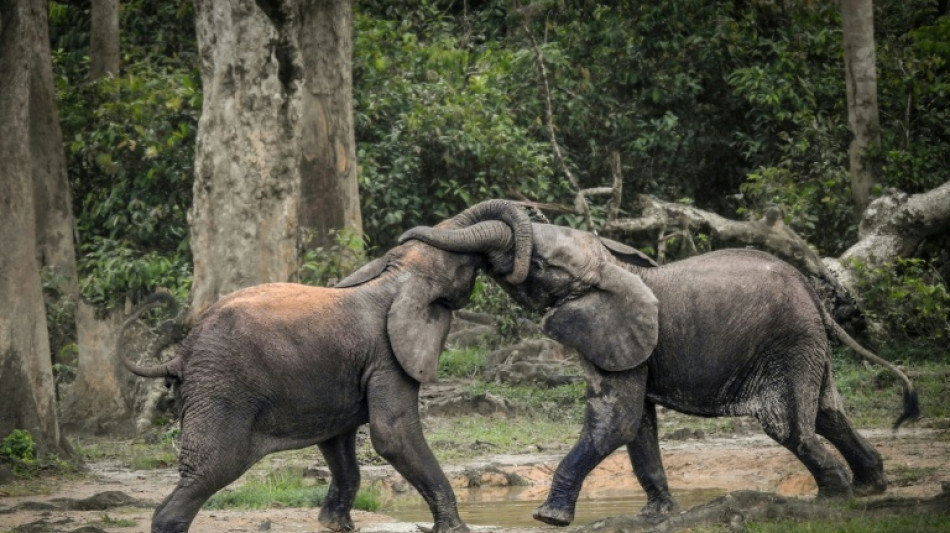
Survey raises estimate of African forest elephant numbers / Photo: © AFP

 Russia seizes assets of Nestle, French firms over West's Ukraine support

 England can build on World Cup 'spirit', says Tuchel

 UNESCO can be 'moderator' in AI debate: chief to AFP

 Infantino 'must go', says German FA vice-president

 Russia seizes assets of Nestle, French firms

 Japan's busiest rail station tests robot bins

 Anthropic says AI systems moving towards building themselves

 Asian stocks boosted by falling oil, yen weakens after BoJ rate hike

 Pakistan court blocks expulsion of Afghan medical college students

 Athletes 'can't take it any more' as Asian Games issues mount

 Allen lights up Bills' new stadium with 41-31 win over Lions

 Afghan medical students in Pakistan hope court stops college expulsions

 AI doomsday warnings unlikely to slow IPOs but questions linger

 ICC eyes China in bid to expand cricket

 Nkunku craving freedom and fun on RB Leipzig return

 Bhutan's traditional archers lose ground to development
 Asian stocks track Wall St rally as oil prices drop

 South Korea makes Asian Games complaint over Japan warlord ceremony
 US aid cuts are killing Kenyan sex workers

 October 7 survivors, families take centre stage in Israel vote

 Captain Mat Ryan axed from Socceroos squad for Brazil games

 US approves sale of 48 F-35 jets to Saudi Arabia

 Juventus, Palace cruise to Europa League wins, Bournemouth beat Sociedad

 Stocks climb as oil retreats, Fed calms inflation fears

 Russians begin voting in controlled election as war drags

DNA pulled from the dung of African forest elephants has given experts a more accurate -- and higher -- population estimate for the elusive animal, but the species remains critically endangered, a study showed Thursday.
The new status report shows there were 135,690 African forest elephants in 2024, a 16 percent increase from the previous figures published in 2016, according to the International Union for Conservation of Nature (IUCN).
"This report provides the most accurate picture of elusive African forest elephant populations to date," IUCN Director General Grethel Aguilar said in a statement.
"It shows us that conservation action is working for these iconic animals," Aguilar said.
The IUCN, however, said the animal remained on its "red list" of threatened species due to poaching and habitat destruction.
"The updated numbers of African forest elephants should not be interpreted as population growth, but rather as the result of improved survey coverage made possible by DNA-based methods," Rob Slotow, an African elephant specialist at the IUCN.
The elephants were counted by collecting DNA samples from their faeces. The samples act like genetic fingerprints, helping researchers avoid counting the same animal twice.
African forest elephants, which inhabit the dense rainforests of west and central Africa, are smaller than their African savanna elephant cousins.
Two thirds of the population live in Gabon and 20 percent in Congo-Brazzaville.
Their population fell by 86 percent between the mid-1980s and 2015, according to the IUCN.
The slow reproductive rate of the species has further hampered its recovery.
Poaching rates have fallen since 2018-2019, but illegal killing for ivory remains a threat, the IUCN said.
Expanding mines, road and rail development, and large-scale agricultural projects are also "fragmenting habitat and pushing elephants into shrinking forest areas", it said.
The elephants are also venturing into nearby farmlands, where they eat and trample crops, putting them in conflict with humans.
"Crop raiding often lowers people's tolerance for elephants and, unfortunately, can lead to reciprocal killings and political ramifications," the IUCN said.
The report coincided with the conference of the Convention on International Trade in Endangered Species (CITES), the global treaty that regulates trade in threatened wildlife.
P.Staeheli--VB