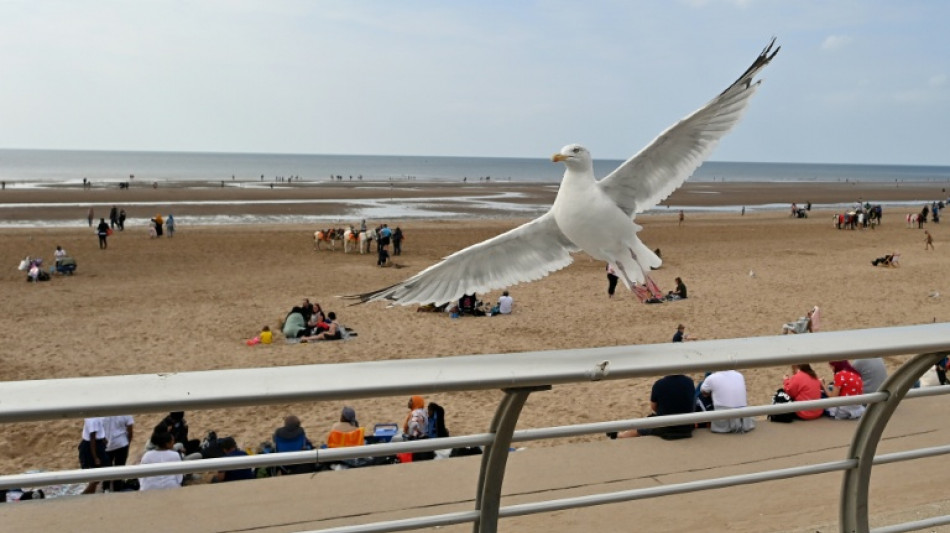
UK holidaymakers told to shout, not get in a flap over seagulls / Photo: © AFP

 Carrick confident Man Utd can 'work through' tough time

 Mbappe ends Nike partnership to join Swiss brand On

 Liverpool boss Iraola puts Bournemouth love affair on hold

 'A disaster' if Man City do not win says Maresca after flawless start

 Kerry James Marshall: American 'blackness' painter celebrated in Europe

 Spain coach De la Fuente offers 'full support' to people of Ceuta

 Russia seizes assets of Nestle, French firms over West's Ukraine support

 England can build on World Cup 'spirit', says Tuchel

 UNESCO can be 'moderator' in AI debate: chief to AFP

 Infantino 'must go', says German FA vice-president

 Russia seizes assets of Nestle, French firms

 Japan's busiest rail station tests robot bins

 Anthropic says AI systems moving towards building themselves

 Asian stocks boosted by falling oil, yen weakens after BoJ rate hike

 Pakistan court blocks expulsion of Afghan medical college students

 Athletes 'can't take it any more' as Asian Games issues mount

 Allen lights up Bills' new stadium with 41-31 win over Lions

 Afghan medical students in Pakistan hope court stops college expulsions

 AI doomsday warnings unlikely to slow IPOs but questions linger

 ICC eyes China in bid to expand cricket

 Nkunku craving freedom and fun on RB Leipzig return

 Bhutan's traditional archers lose ground to development

 Asian stocks track Wall St rally as oil prices drop

 South Korea makes Asian Games complaint over Japan warlord ceremony

 US aid cuts are killing Kenyan sex workers

Aggressive seagulls have long terrorised British holidaymakers trying to enjoy fish and chips or an ice cream on a day at the seaside.
Now, animal behaviourists say they have discovered the best way to tackle the feathery bandits: shout at them.
Experts at the University of Exeter in southwestern England placed a portion of fish and chips in front of gulls and then played one of several different recordings.
One recording featured a male voice yelling, "No, stay away, that's my food, that's my pasty!"
The second used the same voice speaking the words calmly, while the third was a recording of a robin's birdsong.
The researchers tried the recordings on the squawking menaces across nine seaside towns in tourism hotspot Cornwall, according to a paper published Wednesday in the journal Biology Letters.
The birds were three times more likely to take flight when exposed to the shouting voice compared to the speaking voice, while the birdsong was the least effective deterrent, it found.
Out of 21 birds given the shouting treatment, 10 flew away and three walked away. Eight stood their ground.
Of 20 birds that heard the speaking voice, three flew away, 10 walked away and seven stayed put.
Of another 20 played the birdsong, three flew off, three walked off and 14 remained.
"Gulls were more likely to fly away at the shouting and more likely to walk away at the speaking," said Neeltje Boogert of the university's Centre for Ecology and Conservation.
"So when trying to scare off a gull that's trying to steal your food, talking might stop them in their tracks but shouting is more effective at making them fly away," she said.
R.Fischer--VB