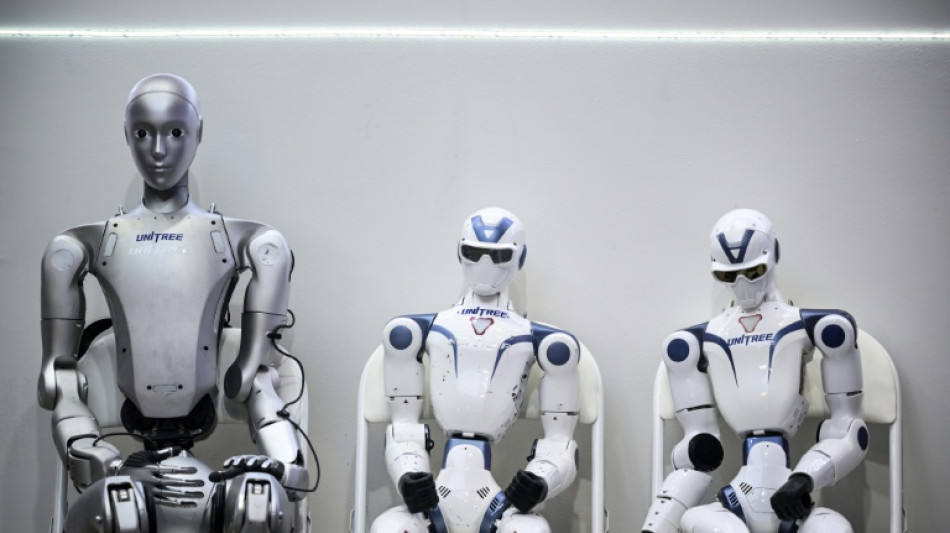
Robots pour cocktails and run marathons, but still can't multitask / Photo: © AFP

 Colombian judge bans strikes on guerrillas if minors are present

 Khachanov shocks ailing Auger-Aliassime, Swiatek and Osaka advance at US Open

 Lone juror blocking verdict in US mother's child murder trial: defense

 'Kinda chic' - Williams sisters set to launch US Open doubles bid

 Volkswagen says cutting 100,000 jobs by end of decade

 Russia slaps curfew on charity director over army criticism

 Ailing Auger-Aliassime upset by Khachanov at US Open

 Richarlison omitted from Tottenham's Premier League squad

 How El Nino is choking the Panama Canal

 Hamilton drives his Ferrari dream at Monza

 Senegal has an IMF loan, now what?

 Auger-Aliassime upset by Khachanov at US Open

 Hugging Face, the French start-up that became AI's warehouse

 World Cup winner Llorente retires from Spain team at 31

 Osaka squeezes into US Open third round
 Apple faces £2 bn lawsuit in UK over app privacy feature
 Former champ Swiatek eases into US Open third round

 DR Congo latest to promise moving Israel embassy to Jerusalem

 War criminal Mladic's body returns to Serbia with military honours
 Pierre Cardin museum brings designer's futurist style to Venice

 Slovenian rookie Omrzel triumphs as Mas extends Vuelta lead

 British, French leaders talk migrants, EU relations

 Heading for Ferrari's home race, Leclerc still dreams of world title

 Cafe at centre of Israel culture clash agrees to shut on Sabbath
 Spacecraft bound for Mercury begins 'tricky' arrival
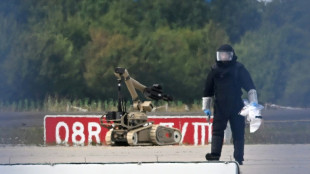
They can mix cocktails, run marathons and fold laundry. But humanoid robots are still a long way from doing lots of different jobs on command, whatever the marketing says.
The gap was easy to spot at the Robotics Summit in Boston in late May. The glossy brochures promised one thing. The people who actually build the machines said another.
Elon Musk loves to show off his Optimus prototype, recently filmed jogging in short strides. Figure 03, a third-generation robot developed by Figure AI, can tidy and clean a living room by itself.
China's AgiBot and Matrix Robotics say their robots can greet visitors, serve coffee and give them a tour, a little like C-3PO from "Star Wars."
The reality is more modest.
"Most of the humanoids you see are being teleoperated, or they've got very specific paths and chores that they do," said Chris Matthieu of startup RealSense, which makes cameras for robots.
In other words, many are either run by a human with a remote control or stuck doing one narrow task.
Take Neo, the robot that 1X launched with great fanfare last October. It was billed as "the world's first consumer-ready humanoid robot designed to transform life at home" -- but was actually steered by a person off to the side.
Progress is real, though, and artificial intelligence is driving it. "I think AI has extremely accelerated that growth," said William Okazaki of sensor maker Renesas.
One big hurdle is the hands. Long the holy grail of robotics, they are getting close: robots can now grip with a delicate touch, and some sensors can even tell when they are touching human skin.
Much of this comes from a new kind of AI known as a VLA model, short for vision-language-action. It blends written instructions with what a camera sees in real time, so the robot can link what it is looking at to what it should do.
There is also the "world model" -- an AI that learns from vast amounts of images and video until it can predict what will happen next in the real world, such as how an object will shift when it is squeezed.
-- Hunt for data --
But an android that can do a bit of everything is still years off.
"For general purpose robots, it will take longer," said Daniel Fan of Innodisk, which makes parts for robots.
Plenty of humanoids are already out in the world -- Boston Dynamics' Atlas at Hyundai, Hexagon Robotics' AEON at a BMW site -- but these are trials, not final products.
"Until you actually get the robot actually trying to do the thing you think it can do, you don't really know," said Charlie Kemp of Hello Robot, which sells robots for people with limited mobility.
Running fully on their own, at scale, is not yet possible, "because there is not enough data," said Xinrui Bi of AgiBot.
To gather it, companies are setting up cameras everywhere to record human movement -- from people cooking at home to workers in a textile workshop in India.
The stakes are higher than for a chatbot like ChatGPT. A robot acts in the physical world, so its mistakes can hurt someone.
"If you want to move into a more social domain, it really has to be safe for the users around the robot," said Valentino Fagard of Japan's XELA Robotics, which works on giving robots a sense of touch.
Engineers can set limits -- telling the machines not to grip too hard, or not to get too close to a person. But there is a catch. Like chatbots, these AI systems don't always behave the same way twice, which makes them hard to predict.
"The issue with, call it the world model, or the end-to-end VLA, is they're non-deterministic, they're a black box," said John Black of Brain Corp, whose robots stick to a very specific task, like cleaning floors or checking store shelves.
"They're nowhere close to reaching the safety levels required," he said, because even the people who build these systems can not fully see why they do what they do.
S.Leonhard--VB