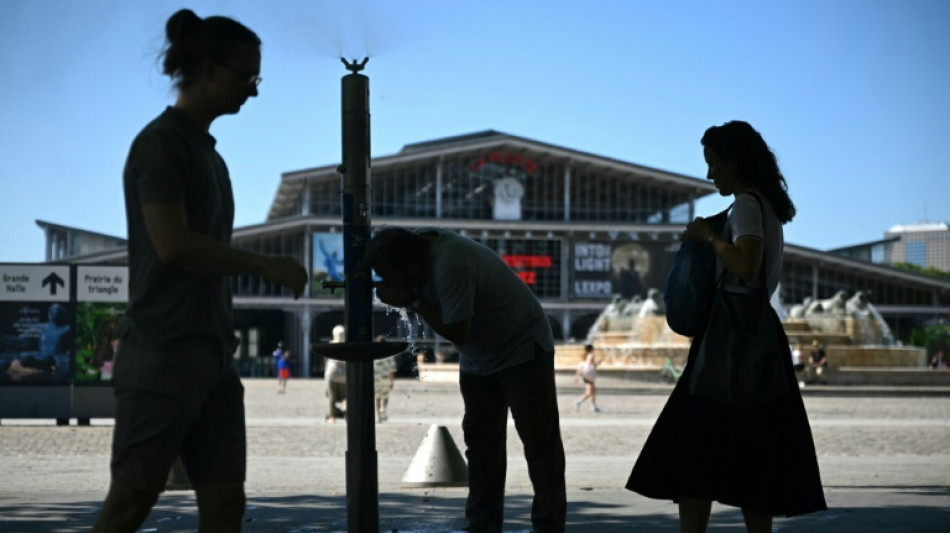
Ambulances on stand-by as southern Europe heatwave intensifies / Photo: © AFP

 Ebola outbreak in DR Congo kills more than 2,000
 ChargeAfter Powers BYLD Finance Expansion into Consumer Financing for Equipment Retailers

 MEXC Upgrades RealStocks With Three New Features to Enhance U.S. Stock Trading Experience

 Israel demolishes home of slain Palestinian involved in deadly West Bank clash
 Liverpool fans seek clarity on Bezos bid to buy stake

 Solar eclipse sparks scramble for protective glasses across Europe

 Oil prices jump as US-Iran deal hopes falter

 Newly crowned world's best pastry chef stays true to artisan roots
 Johnson signs for Everton in McNeil swap deal

 Syria sentences Bashar al-Assad to death in absentia over atrocities

 Hong Kong's tech index plans expansion with AI and robotics themes

 The Infantino saga -- What they said
 Economic losses from natural disasters fall to $100 bn in first half of 2026: Swiss Re
 Colombia scrambles to find survivors as quake kills 132
 Singapore says AI-related demand lifting economy

 Demeter Tactical Investments (ME) Limited bolsters governance with two board appointments

 Russian barrage on Ukraine kills 9, wounds dozens

 Schools closed as Indonesia battles wildfires

 Swiatek dominates Shnaider to set up Toronto semi with Svitolina

 Oil prices rise further as hopes for Hormuz deal fade

 One year after Putin-Trump summit, 'spirit of Anchorage' dissipated

 Farage vs Count Binface: What to know about UK snap poll

 Torment of Afghan fathers as daughters deprived of education
 Return of displaced Syrian Kurds to hometown suspended after violence
 Swiatek races past Shnaider into Toronto semi-finals
Authorities across Southern Europe urged people to seek shelter Sunday and protect the most vulnerable as punishing temperatures from Spain to Portugal, Italy and France climbed higher in the summer's first major heatwave.
Ambulances stood on standby near tourist hotspots and regions issued fire warnings as experts warned that such heatwaves, intensified by climate change, would become more frequent.
Peaks of 43 degrees Celsius (109 Fahrenheit) were expected in areas of southern Spain and Portugal, and nearly all of France sweltered in an intense heat expected to last for several days.
In Italy, 21 cities across the length of the country were on high alert for extreme heat, including Milan, Naples, Venice, Florence, Rome and Catania.
"We were supposed to be visiting the Colosseum, but my mum nearly fainted," said British tourist Anna Becker, who had travelled to Rome from a "muggy, miserable" Verona.
Hospital emergency departments across Italy have reported an increase in heatstroke cases, according to Mario Guarino, vice president of the Italian Society of Emergency Medicine.
"We've seen around a 10-percent increase, mainly in cities that not only have very high temperatures but also a higher humidity rate," he told AFP.
It is mainly elderly people, cancer patients or homeless people, presenting with dehydration, heat stroke, fatigue."
- 'Climate shelters' -
Hospitals such as the Ospedale dei Colli in Naples have set up dedicated heatstroke pathways to speed access to vital treatments such as cold water immersion, Guarino said.
In Venice, authorities offered free guided tours for people over 75s in air-conditioned museums and public buildings.
Bologna has set up seven "climate shelters" with air conditioning and drinking water, Florence has called on doctors to flag up the lonely and vulnerable, Ancona is delivering dehumidifiers to the needy, and Rome has offered free access to city swimming pools for those over 70.
In Lisbon, 39-year-old pharmacist Sofia Monnteiro said despite advising people "not to go out" during the hottest hours of the day, "we have already had some cases of heat strokes and burns".
French tourist Cedric Gerard, on holiday in the Portugese capital, said the heatwave was "particularly intense this year".
"It's hard to bear," the 50-year-old added.
Several areas in the southern half of Portugal, including Lisbon, are under a red warning until Monday night due to "persistently extremely high maximum temperature values", said the Portuguese Institute for Sea and Atmosphere (IPMA).
Two-thirds of Portugal was also on high alert Sunday for extreme heat and forest fires -- as was the Italian island of Sicily, where firefighters tackled 15 blazes Saturday.
- Invasive species -
Scientists say climate change is stoking hotter and more intense heatwaves, particularly in cities where the so-called "urban heat island" effect amplifies temperatures among tightly packed buildings.
"The heat waves in the Mediterranean region have become more frequent and more intense in recent years, with peaks of 37 degrees or even more in cities, where the urban heat island effect raises the temperatures even further," said Emanuela Piervitali, a researcher at the Italian Institute for Environmental Protection and Research (ISPRA).
"A further increase in temperature and heat extremes is expected in the future, so we will have to get used to temperatures with peaks even higher than those we are experiencing now," she told AFP.
The heat is also attracting invasive species, which are thriving in the more tropical climes.
ISPRA launched a campaign this week urging fishermen and tourists alike to report sightings of four "potentially dangerous" venomous species.
The lionfish, silver-cheeked toadfish, dusky spinefoot and marbled spinefoot are beginning to appear in waters off southern Italy as the Mediterranean warms, it said.
"With this stifling heat, the temperature can exceed 40 degrees in some nests," said Allain Bougrain-Dubourg, president of the League for the Protection of Birds (LPO).
"We are taking in birds in difficulty everywhere; our seven care centres are saturated," he added.
burs-ide/jj
P.Vogel--VB