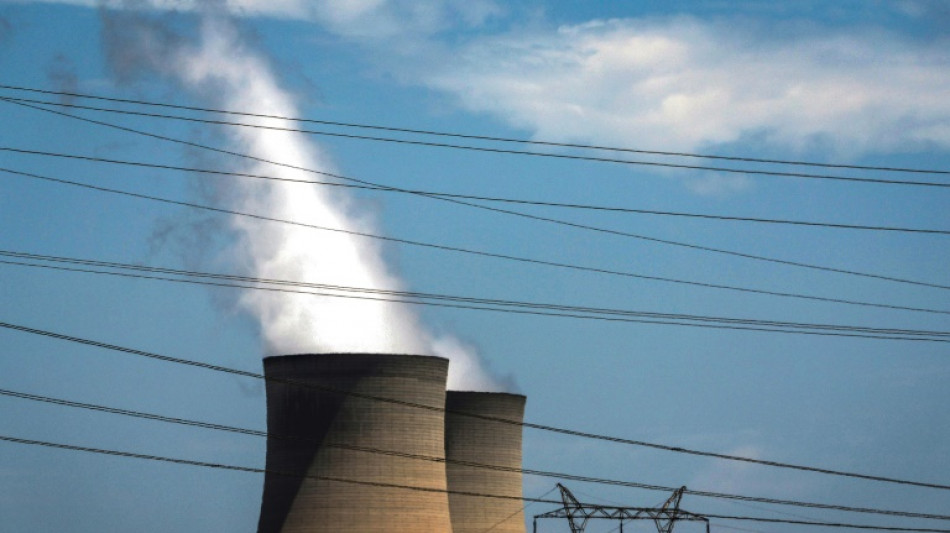
Australia says reliance on coal-fired power drops to record low / Photo: © AFP

 Greenland parliament approves security agreement with United States

 Qatar envoy meets incoming UN General Assembly president

 Trump Signals Willingness to Work With Democrats After Midterm Defeat

 Galloway accuser could not foresee publishing-sector fallout, lawyer argues

 New York City Center revives In the Heights as a timely community story

 Godzilla Minus Zero shifts focus toward postwar human drama

 Mehbooba Mufti urges dialogue and renewed Central Asia links for Kashmir

 Seacliff Healthcare Seeks Specialist GP in Thirroul

 US stocks fall before midterm Election Day as technology shares weaken

 BLS Polymers makes strong market debut at ₹248 per share

 Petrol and diesel prices remain broadly steady across major Indian cities

 Reliance shares remain in focus after near-12% surge

 2026 Arizona Midterms: Key Races, Ballot Measures, and Voter Deadlines

 Coal India prepares possible $1 billion Mahanadi Coalfields listing

Australia's reliance on coal-fired power stations has dropped to a record low, accounting for less than 50 percent of its electricity for the first time, the market operator said Thursday.
Overall electricity demand hit a record high in the final quarter of 2024 as temperatures rose and people shifted away from gas, the Australian Energy Market Operator said.
At the same time, roof-top solar output surged 18 percent and grid-scale solar climbed nine percent -- both reaching record levels, it said in an update on the National Electricity Market (NEM).
"The rise in rooftop solar output, coupled with record low coal-generation availability, resulted in coal-fired generation contributing less than 50 percent of the NEM's total generation for the first time," said Violette Mouchaileh, a senior official at the market operator.
Renewable energy sources supplied a record 46 percent of electricity in the quarter, she said, peaking at 75.6 percent on November 6.
That drove greenhouse gas emissions in the period to record lows, the market operator said.
Australia's government last week announced an extra US$1.2 billion in clean energy financing to speed a transition from coal and other fossil fuels to renewables.
The country -- one of the world's leading coal exporters -- has vowed to reach net zero carbon emissions by 2050.
- Climate wars -
But energy authorities say quick action is needed to fill the gap left by shuttered coal-fired power stations.
Wholesale electricity prices surged 83 percent during 2024, the report noted, mostly due to high demand, the decline of available coal-fired power, and transmission constraints.
"The data confirms what we know -- unreliable coal is having a negative impact on energy prices, more renewables in the system bring wholesale prices down, and new transmission infrastructure is critical to keeping prices lower," said Chris Bowen, the minister for climate change and energy.
"We are building an energy grid so everyone, everywhere has access to the cheapest form of energy at any given time," he said in a statement to Australian media.
Over the past decade, an ideological brawl dubbed the "climate wars" has dominated Australian politics, repeatedly undermining attempts to reduce carbon emissions.
In the run-up to general elections that must be held by May 17, Australia's conservative opposition Liberal Party has announced plans to launch nuclear power so as to rely less on solar and wind.
The national science agency CSIRO said in a report last month that nuclear power would be 50 percent more expensive than renewables and would take at least 15 years to build.
Australia sits on bulging deposits of coal, gas, metals and minerals, with mining and fossil fuels stoking decades of near-unbroken economic growth.
But it has also begun to suffer from more intense bushfires and increasingly severe droughts, which scientists have linked to climate change.
W.Huber--VB