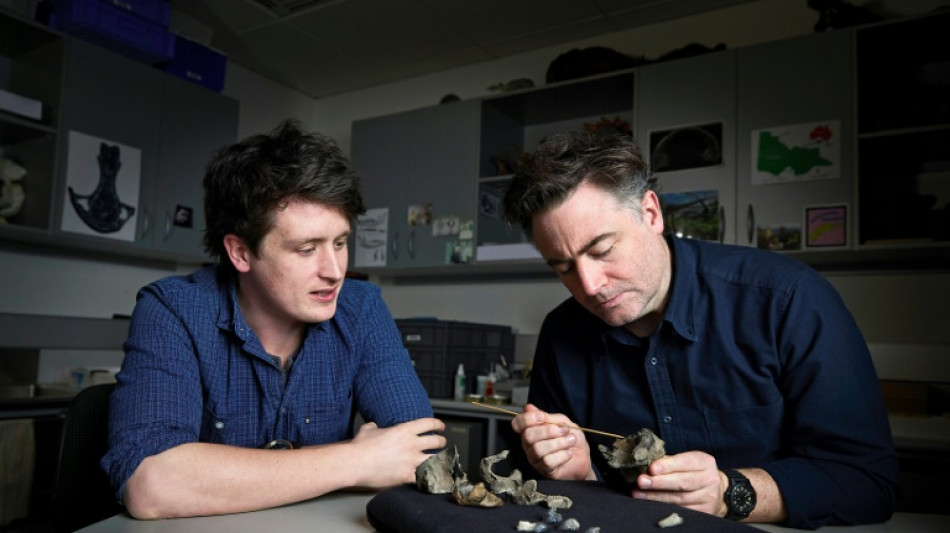
Scientists unearth 'cute' but fearsome ancient whale / Photo: © MUSEUMS VICTORIA/AFP

 Modi vows punishment for exam fraud fuelling India protests

 Six candidates in race to lead UN set for televised debate

 Comic-Con kicks off with Marvel's return

 Dutch riders dreaming of crazy party corner of Alpe d'Huez
 Houthis target Red Sea shipping as US hits Iran

 Record-equalling Red Sox streak halted at 15 wins

 Messi-less Miami beat Fire 3-2 to spoil Lewandowski's MLS debut

 Mercedes expect Hungary challenge from Hamilton and Ferrari

 In Ghana, one man's race to save critically endangered fish
 Wilson captain, Slipper absent in Kiss's first Wallabies squad

 New Mideast fighting puts eurozone rate-setters on alert

 Venezuelans search for animal companions lost in the quakes

 Argentine Football Association says US did not detain its president

 June heatwave cost UK economy more than £1bn: study

 Google-parent Alphabet beats expectations, cloud revenue nearly doubles

 US announces civilian nuclear deal with Saudi Arabia

 Tesla shares dip after profit misses expectations

 Red Sox tie club record with 15th straight MLB win

 US eyes offshore nuclear reactors

 The Sterling Announces Luxury Cocktail Lounge Concept and Investor Showcase in Orlando

 Inter Miami signs Brazil veteran Casemiro but MLS probes deal

 White House accuses China's Moonshot of stealing Anthropic AI

 Pogacar sweating on Yates's fitness ahead of Tour Queen stage

 Ukrainian soldiers and civilians welcome new army commander

 UK fintech Revolut valuation soars to $115 bn: source

Australian scientists have discovered a razor-toothed whale that prowled the seas 26 million years ago, saying Wednesday the species was "deceptively cute" but a fearsome predator.
Museums Victoria pieced together the species from an unusually well-preserved skull fossil found on Victoria's Surf Coast in 2019.
Scientists discovered a "fast, sharp-toothed predator" that would have been about the size of a dolphin.
"It's essentially a little whale with big eyes and a mouth full of sharp, slicing teeth," said researcher Ruairidh Duncan.
"Imagine the shark-like version of a baleen whale -- small and deceptively cute, but definitely not harmless."
The skull belonged to a group of prehistoric whales known as the mammalodontids, distant smaller relatives of today's filter-feeding whales.
It is the fourth mammalodontid species ever discovered, Museums Victoria said.
"This fossil opens a window into how ancient whales grew and changed, and how evolution shaped their bodies as they adapted to life in the sea," said palaeontologist Erich Fitzgerald, who co-authored the study.
Victoria's Surf Coast lies on the Jan Juc Formation -- a geological feature dating to the Oligocene epoch between 23 and 30 million years ago.
A string of rare fossils have been unearthed along the scenic stretch of beach, a renowned site for the study of early whale evolution.
"This region was once a cradle for some of the most unusual whales in history, and we're only just beginning to uncover their stories," said Fitzgerald.
"We're entering a new phase of discovery.
"This region is rewriting the story of how whales came to rule the oceans, with some surprising plot twists."
The species was named Janjucetus dullardi, a nod to local Ross Dullard who stumbled across the skull while strolling the beach in 2019.
It was described in the peer-reviewed Zoological Journal of the Linnean Society.
G.Frei--VB