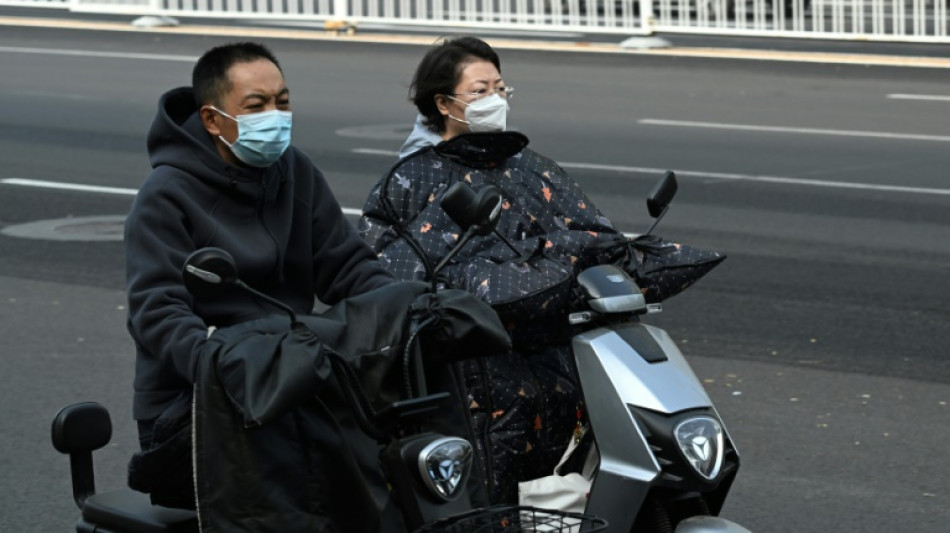
North China smog to last until mid-November: state media / Photo: © AFP

 Equitas Small Finance Bank rebounds after naming interim chief executive

 Titan quarterly profit seen rising as jewellery business drives growth

 Kuwait finance minister holds economic cooperation talks at COMCEC

 82-Year-Old American Transforms 2003 Mercedes Sprinter into Permanent Home

 Abdul El-Sayed declares victory in Michigan Senate contest

 Democrats capture US Congress in sweeping midterm victory

 Manchester United rallies past Roma as PSG dominates in Champions League
 Qatar prime minister advances mediation through diplomatic calls

 Greenland parliament approves security agreement with United States

 Qatar envoy meets incoming UN General Assembly president

 Trump Signals Willingness to Work With Democrats After Midterm Defeat

 Pitches and Keynote Speakers Are Confirmed for Blue Magic Netherlands on November 17
Serious pollution is expected to remain over Beijing and surrounding areas until the middle of the month, Chinese state media said Wednesday.
Tens of millions of people in the capital and surrounding areas have this week been hit by some of the region's worst prolonged smog in months.
On Wednesday, Beijing's concentrations of hazardous PM 2.5 particles were more than 20 times higher than World Health Organisation guidelines, air quality monitoring firm IQAir said.
And the Chinese capital was the third most polluted major city in the world, the firm said, just ahead of Bangladesh's capital Dhaka.
In response to the smog, authorities have taken steps to limit the activity of heavy-emitting vehicles and encouraged residents to remain indoors.
Chinese officials were cited by the state-run Beijing Daily as saying that "moderate" and "severe and above" levels of pollution were expected to affect the Beijing-Tianjin-Hebei area until mid-November.
The area is home to more than 100 million people.
A "moderate" pollution ranking still means pollutants in the air are well over WHO-recommended limits.
The forecasts for the region were based on joint analysis conducted by the China National Environmental Monitoring Centre and local meteorological authorities across the country.
"The primary pollutants (in the Beijing-Tianjin-Hebei region) are PM2.5 and PM10," the report said.
Those pollutants have been linked to premature deaths in people with heart or lung disease, as well as a host of breathing and other health issues, according to the US's Environmental Protection Agency.
In Beijing, authorities issued Monday the country's second-highest pollution warning.
And in parts of Hebei, one official forecast showed that hazy conditions brought visibility down to lower than 50 metres.
Authorities have blamed the smog on "unfavourable weather conditions".
China's capital declared "war on pollution" in 2015 after winning a bid to host the Winter Olympics, shutting down dozens of coal plants and relocating heavy industries to shed its status as one of the world's most polluted cities.
But while there have been improvements in recent years, air quality remains far below World Health Organization standards.
China is the world's biggest emitter of the greenhouse gases driving climate change, such as carbon dioxide.
A jump in approvals for coal-fired power plants has added to concerns that China will backtrack on its goals to peak emissions between 2026 and 2030 and become carbon-neutral by 2060.
J.Marty--VB