Brazil high court resumes key Indigenous lands case / Photo: © AFP

 Indians living in Japan on stand-by to house Asian Games athletes
 Trump signs bill authorizing sweeping Russia sanctions

 Protesters form human chain at Kennedy Center after Trump threat

 Death toll from attack at police HQ in Pakistan rises to 31

 Trump says Denmark to give US 'permanent control' over Greenland security
 Kennedy Center: future unclear for iconic Washington arts hub

 Trump claims 'infinite' Greenland security deal with Denmark

 Helicopters battle wildfire threatening Ecuador's capital

 Brentford batter Chelsea to undo Alonso's promising start
 Kane hits Bundesliga century as Bayern rout Union
 Trump says CNN, MS NOW, Politico banned from White House
 Hushing and hedging: US companies retreat on climate

 Springboks to face Fiji before 2027 Rugby World Cup

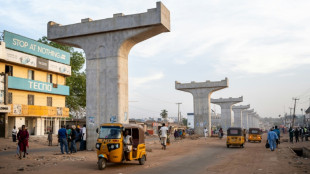 Nigeria miners struggled to breathe in cell before 37 died: survivors

 McIlroy on the charge at PGA Championship as Reed withdraws

 McIlroy on the charge at PGA Championship

 Crisis-wracked Volkswagen warns of 10-bn-euro hit to profits

 Costa Rica's Grynspan tops third informal poll for UN chief: diplomat

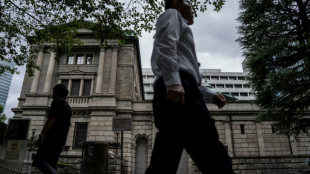 Stock markets retreat after central bank rate hikes
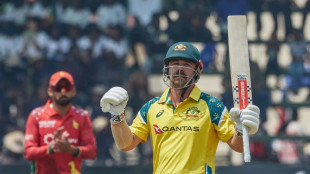
 Russia labels director of Cannes Grand Prix winner a 'foreign agent'

 Macron warns of Russian 'hybrid' threat after meeting presidential hopefuls

 UN holds third informal poll for new chief

 Kulusevski return can spark Spurs: De Zerbi

 Shakira to cap off world tour with Madrid 12-gig run

 Isolated Syrian-Druze city blames Damascus for shortages

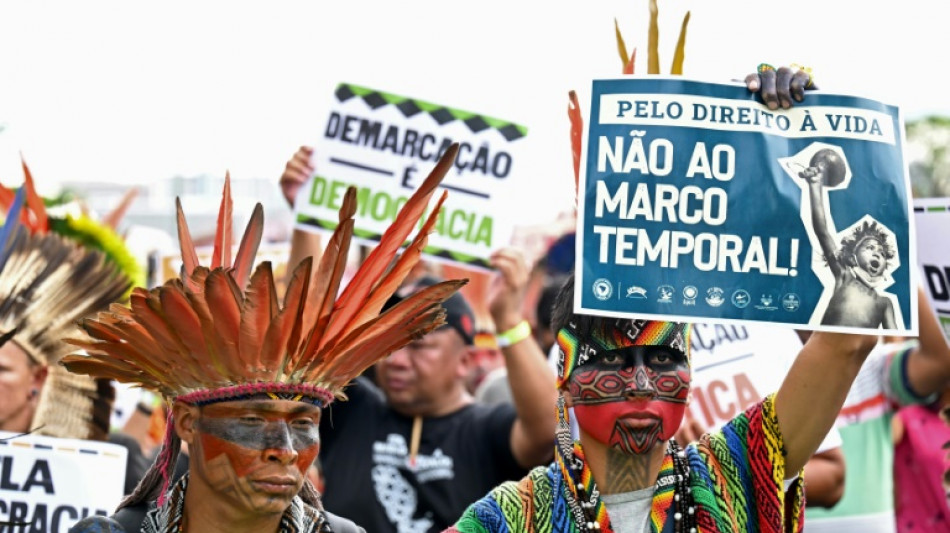
Brazil's Supreme Court resumed hearings Wednesday in a closely watched case on whether to restrict native peoples' rights to claim their ancestral lands, a key buffer against climate change.
Hundreds of Indigenous protesters, many in traditional feather headdresses, rallied in the capital Brasilia as the court weighed the legality of the so-called "time-frame argument," which holds that native peoples should not have the right to lands where they were not present in 1988, when the current constitution was ratified.
Indigenous groups say that violates their rights, given that many were forced from their ancestral lands, including during the military dictatorship that ruled Brazil from the 1960s to 1980s.
The Supreme Court began hearing the case in 2021, but has adjourned the proceedings several times.
So far, two of the court's 11 justices have sided with the Indigenous plaintiffs, and two against them, one of these a judge who announced his stance on Wednesday.
The proceedings were to resume on Thursday with the remaining seven judges due to state their opinion.
Climate campaigners have joined Indigenous activists in pressing for the court to reject the time-frame argument, given that numerous studies have found that protected Indigenous reservations are one of the best ways to fight deforestation and, with it, global warming.
"The argument ignores our constitutional rights to our ancestral lands, puts existing Indigenous reservations at risk and makes creating new ones unviable," Dinamam Tuxa, coordinator of the Association of Brazil's Indigenous Peoples (APIB), told AFP ahead of the trial.
Indigenous rights groups have dubbed the case the "trial of the century."
The UN High Commissioner for Human Rights said in a statement that a win for the time-frame limitation argument would be "a big setback" for the rights of Indigenous people in Brazil and go against international human rights norms.
The limitation is backed by Brazil's powerful agribusiness lobby, which scored a victory in May when the lower house of Congress passed a bill enshrining the 1988 cutoff in law.
The bill is now working its way through the Senate.
Leftist President Luiz Inacio Lula da Silva, a self-described ally of Indigenous peoples, is expected to veto the bill if it passes. But Congress, where the agribusiness coalition is a major player, could override a veto.
The case could enter murky legal territory if that happens before the Supreme Court's justices finish delivering their rulings.
The constitution makes no mention of a cutoff date in relation to Indigenous reservations.
Indigenous reservations cover 11.6 percent of Brazil's territory, notably in the Amazon rainforest.
Brazil has around 1.7 million Indigenous inhabitants -- 0.8 percent of the population.
L.Janezki--BTB