Top science publisher withdraws flawed climate study / Photo: © GETTY IMAGES NORTH AMERICA/AFP/File

 Ed Sheeran returns to stage after Palestinian controversy

 Asian Games to open in Japan after troubled build-up

 Drone owners rush to offload devices ahead of Beijing ban

 Trump's beef policies irk Texas ranchers, testing their loyalty

 Nvidia, OpenAI CEOs to attend Xi dinner at White House

 Anthropic picks Accenture for in-house AI safety evaluation
 Balogun returns as Monaco beat Lens to continue strong Ligue 1 start

 'Pause' on overt repression in Venezuela, but reforms still needed: HRW

 Global stocks mixed as yen falls despite Bank of Japan rate hike

 Cuba hit with seventh major blackout of the year

 Murray out with concussion so Wentz will start for Vikings

 UN chief 'deeply regrets' US visa refusal to Abbas for annual meeting

 England quick Carse to face no charges over alleged nightclub assault

 Mancini brings nine newcomers into the first squad of his Italy comeback

 Czechs level Davis Cup tie against USA as South Korea eye Finals

 New France boss Zidane confirms Mbappe as captain after naming first squad

 California governor signs order to explore AI 'kill switch'

 Head leads run spree as Australia win Zimbabwe ODI series

 In-form Raphinha wants to finish career at Barcelona

 Warren Buffett steps down as Berkshire Hathaway chairman

 Carrick confident Man Utd can 'work through' tough time

 Mbappe ends Nike partnership to join Swiss brand On

 Liverpool boss Iraola puts Bournemouth love affair on hold

 'A disaster' if Man City do not win says Maresca after flawless start

 Kerry James Marshall: American 'blackness' painter celebrated in Europe

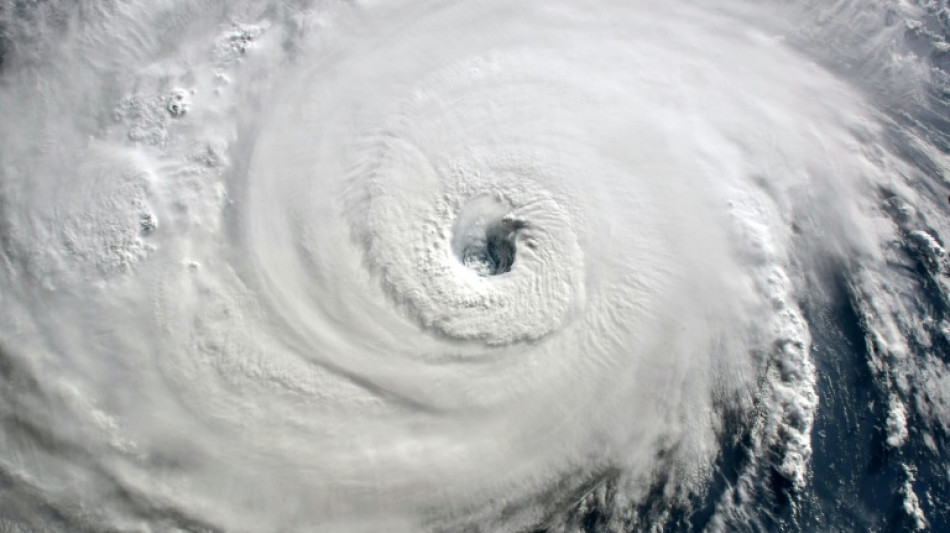
Top science publisher Springer Nature said it has withdrawn a study that presented misleading conclusions on climate change impacts after an investigation prompted by an AFP inquiry.
AFP reported in September 2022 on concerns over the peer-reviewed study by four Italian scientists that appeared earlier that year in the European Physical Journal Plus, published by Springer Nature.
The study had drawn positive attention from climate-sceptic media.
The paper, titled "A critical assessment of extreme events trends in times of global warming", purported to review data on possible changes in the frequency or intensity of rainfall, cyclones, tornadoes, droughts and other extreme weather events.
Several climate scientists contacted by AFP said the study manipulated data, cherry picked facts and ignored others that would contradict their assertions, prompting the publisher to launch an internal review.
"The Editors and publishers concluded that they no longer had confidence in the results and conclusions of the article," Springer Nature told AFP in an email late Wednesday.
The journal's editors published an online note stating that the paper was retracted due to concerns over "the selection of the data, the analysis and the resulting conclusions".
- Peer-review standards -
It said the paper had been freshly reviewed by experts and the authors invited to submit an addendum in response to the criticisms.
But a review found this "not suitable for publication and that the conclusions of the article were not supported by available evidence or data provided by the authors".
Springer Nature said in its email that the investigation was conducted by its Research Integrity Group in line with guidelines of the Committee on Publication Ethics (COPE).
The paper's authors were identified in order as Gianluca Alimonti, a physicist at a nuclear physics institute; Luigi Mariani, an agricultural meteorologist, and physicists Franco Prodi and Renato Angelo Ricci.
The latter two were named as signatories of the World Climate Declaration, a text that repeated various debunked claims about climate change, an AFP fact check article found.
Their study was "not published in a climate journal," Stefan Rahmstorf, Head of Earth Systems at the Potsdam Institute for Climate Impact Research, told AFP at the time.
"This is a common avenue taken by 'climate sceptics' in order to avoid peer review by real experts in the field."
Recent studies have indicated that climate misinformation has flourished online as governments push reforms to curb use of the fossil fuels that cause planet-warming carbon emissions.
A further investigation published by AFP in April 2023 showed that sceptics opposed to the scientific consensus on human-caused climate change had got other misleading studies published in peer-reviewed journals.
Experts pointed to widespread concerns about peer-review standards in the lucrative academic publishing industry.
Retraction Watch, a blog that tracks withdrawals of academic papers, counted 5,000 such cases in 2022 -- about a tenth of a percent of the total number of studies published, its co-founder Ivan Oransky told AFP.
L.Janezki--BTB