'Things will improve': Bolivians look forward to right's return / Photo: © AFP

 Inflation slows in top eurozone economies as ECB ponders next move

 Starmer boosts budget to modernise UK military before exit
 Stocks mostly higher, yen stays near 40-year low against dollar

 Data centres emitting more CO2 than thought: study

 Over 1 million migrants apply for Spain's mass regularisation
 Germany questions footballing identity after fresh World Cup failure
 MEXC Lists Ondo's Tokenized Strategy Preferred Stock on Spot Market

 Stocks climb, yen stays near 40-year low against dollar
 Swim star Marchand limps out of French nationals as Europeans loom

 UN says transport infrastructure must adapt to climate
 Sommer, Acerbi, Darmian, De Vrij leave Inter Milan

 Germany's labour market dilemma: rising unemployment despite vacancies
 Skating allows Russian, Belarussians to return as neutrals

 Russian double Olympic figure skating champion Dmitriev dies aged 58
 S. Africa deploys police as anti-migrant protests loom
 Monaco parcel bomb blast wounds Ukrainian oligarch
 Sweden face France's attacking firepower at the World Cup

 Online same-sex romance series embrace AI 'freedom'

 New Oxford academic centre symbolises UK's big-donor era

 Trump says Iran meeting set in Qatar, despite uncertainty

 Morocco down Netherlands to reach World Cup last 16

 Asian stocks unable to track Wall St higher, yen holds at 40-year low

 'We came from nothing': DR Congo dreams of England World Cup upset

 Peruvian political heir Fujimori wins presidency

 What to expect as EU small parcel levy kicks in

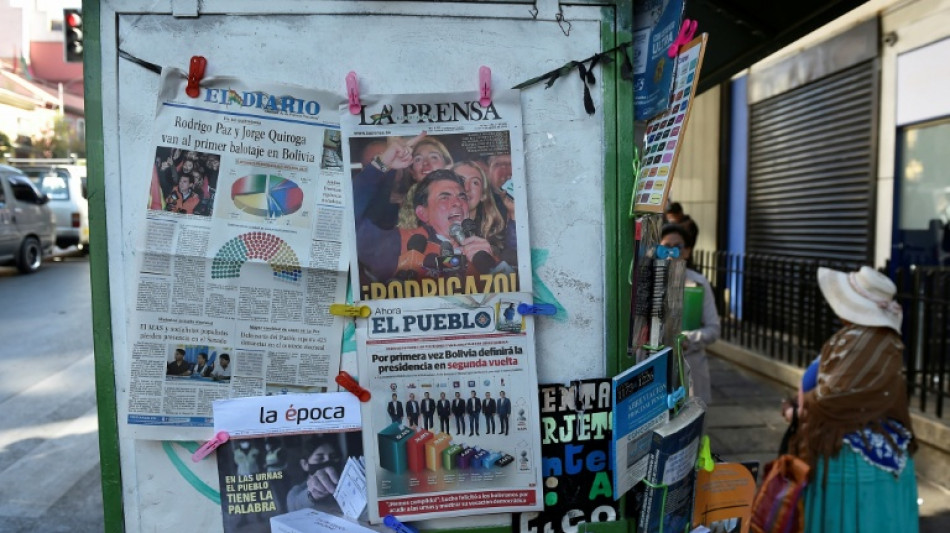
Bolivians on Monday began looking to a future without the ruling socialists of the past two decades, after the first round of presidential and parliamentary elections were won by a resurgent right.
The Movement towards Socialism (MAS), in power since iconic leader Evo Morales was elected to the presidency in 2005, suffered a cataclysmic defeat in Sunday's elections over its handling of a severe economic crisis.
The party's presidential candidate Eduardo del Castillo garnered just 3.1 percent of the vote in the South American nation.
MAS also lost nearly all its Congress seats to the opposition, led by centre-right senator Rodrigo Paz and right-wing ex-president Jorge "Tuto" Quiroga, who snagged the two places in October's presidential run-off.
Franz Yupangui, a 49-year-old lecturer in sustainable engineering, said he hoped the right-ward shift would end the worst shortages of fuel and dollars -- the currency in which Bolivians save -- that he could recall since the 1980s.
"I think that now, given we are going to change to another type of politics, things will improve," he told AFP at a fruit and vegetable market in central La Paz.
Clara Rodriguez, a 54-year-old fruitseller whose business has been hit by rising fuel and food prices, also welcomed the dramatic changes to the political landscape.
"In our country we've lacked many things, and for people with very limited resources, things have been very bad. So I think with this change we're going to move forward," she said as she packed sweet cherimoyas, a fruit native to the Andes, for a customer.
Like many Bolivians, she also voiced relief at the peaceful nature of the election, which contrasted with the violence that erupted in 2019 after Morales claimed victory in polls marked by fraud allegations.
Fears that supporters of Morales, who attempted to stand for an unconstitutional fourth term this year but was barred from running, could wreak havoc came to naught.
"Evistos," as his loyal Indigenous and rural followers are known, instead expressed their frustrations at the ballot box.
Nearly one in five voters -- an historic 19.38 percent -- answered his call to spoil their ballots.
- Calls for unity -
Paz was the surprise winner of the first round, with 32.14 percent of the vote, ahead of Quiroga on 26.81 percent.
Millionaire businessman Samuel Doria Medina, who had been tipped to finish first, trailed in third.
In an interview Monday with Bolivia's El Deber daily, Paz, who campaigned as a moderate, attributed his success to a nationwide listening tour.
"I've been traveling for four years now; I didn't come three months before (the election) on a private plane, land on a runway, and give speeches," he said, in an apparent dig at Doria Medina and Quiroga, dismissed by many voters as the candidates of big business.
Both Paz, son of former president Jaime Paz (1989-1993), and Quiroga, who served a year as president in the early 2000s, launched their second-round campaigns Monday with calls for unity.
The two candidates' programmes converge on some points, such as eliminating fuel subsidies, lowering taxes and breaking with MAS's big-state economic model.
"We must turn the page and begin building a new Bolivia," Quiroga said.
G.Schmid--VB