Land and sea efforts to save reefs must work together: study / Photo: © AFP/File

 Ed Sheeran returns to stage after Palestinian controversy

 Asian Games to open in Japan after troubled build-up

 Drone owners rush to offload devices ahead of Beijing ban

 Trump's beef policies irk Texas ranchers, testing their loyalty

 Nvidia, OpenAI CEOs to attend Xi dinner at White House

 Anthropic picks Accenture for in-house AI safety evaluation

 Balogun returns as Monaco beat Lens to continue strong Ligue 1 start

 'Pause' on overt repression in Venezuela, but reforms still needed: HRW

 Global stocks mixed as yen falls despite Bank of Japan rate hike

 Cuba hit with seventh major blackout of the year

 Murray out with concussion so Wentz will start for Vikings

 UN chief 'deeply regrets' US visa refusal to Abbas for annual meeting

 England quick Carse to face no charges over alleged nightclub assault

 Mancini brings nine newcomers into the first squad of his Italy comeback

 Czechs level Davis Cup tie against USA as South Korea eye Finals

 New France boss Zidane confirms Mbappe as captain after naming first squad

 California governor signs order to explore AI 'kill switch'

 Head leads run spree as Australia win Zimbabwe ODI series

 In-form Raphinha wants to finish career at Barcelona

 Warren Buffett steps down as Berkshire Hathaway chairman

 Carrick confident Man Utd can 'work through' tough time

 Mbappe ends Nike partnership to join Swiss brand On

 Liverpool boss Iraola puts Bournemouth love affair on hold

 'A disaster' if Man City do not win says Maresca after flawless start

 Kerry James Marshall: American 'blackness' painter celebrated in Europe

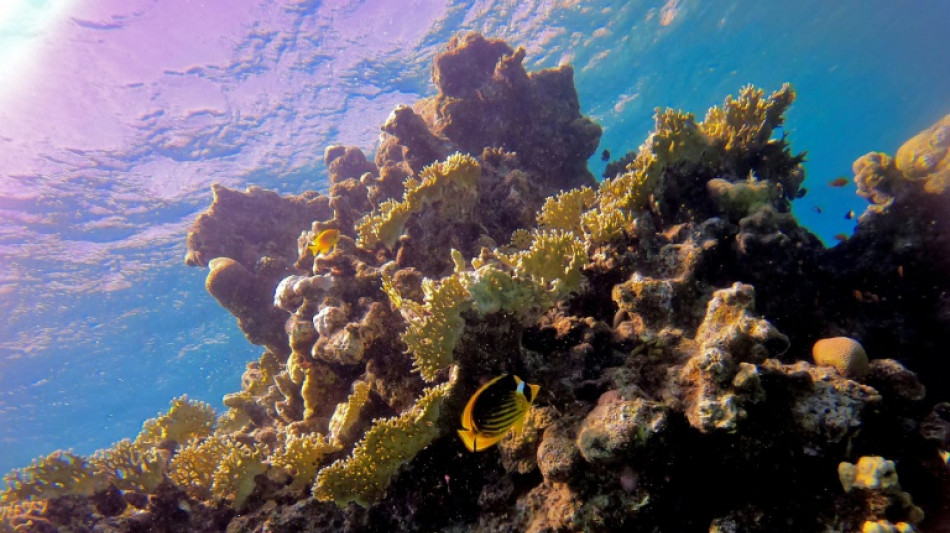
A new study offers a glimmer of hope in efforts to save the world's coral reefs, which play a vital role in underwater life but have been put under threat by rising ocean temperatures.
The study published Wednesday, which is based on 20 years of data from the US island of Hawaii, says that combining local efforts to limit the impact of humans on both the land and sea give coral reefs a greater chance at bouncing back.
"We found that both land-based (for example wastewater pollution) and sea-based human impacts (for example fishing) must be reduced together to ensure coral reef persistence," the study's co-lead author Gareth Williams, a marine ecologist at the UK's Bangor University, told AFP.
Using high-resolution data and thousands of hours of underwater surveys, the researchers looked at connections between human impacts and the recovery of the reef.
They found that not all coral reefs suffer equally during heatwaves.
In 18 percent of the reefs surveyed during an unprecedented marine heatwave in Hawaii in 2015, coral cover remained unchanged -- and in some cases, increased -- despite the heat.
Their ability to recover was dependent on how strained they were by various human pollutants and how many algae-eating fish were around to pave the way for regrowth, the study said.
The more negative impacts that were remedied, the better the reefs recovered, offering a potential path ahead for conservation efforts.
The researchers carried out modelling which indicated that simultaneously reducing these problems on land and sea gave reefs an up to six times higher chance of regrowing after a heatwave than if the efforts were carried out separately.
They called for more cooperation.
"Resource managers have aspired to manage land and sea together, but because governance tends to be centralised, most terrestrial- and ocean-management efforts remain siloed," said the study's co-lead author Jamison Grove of the US National Oceanic and Atmospheric Administration.
But the researchers warned that the frequency and severity of coral bleaching as ocean temperatures rise due to human-caused climate change could "simply overwhelm the positive effects of local management actions".
The study, published in the journal Nature, came just days after it was revealed that the temperature of the world's oceans rose to their hottest level ever recorded on July 30.
Last year most nations committed to protecting 30 percent of the planet's land and ocean by 2030 to safeguard biodiversity.
M.Furrer--BTB