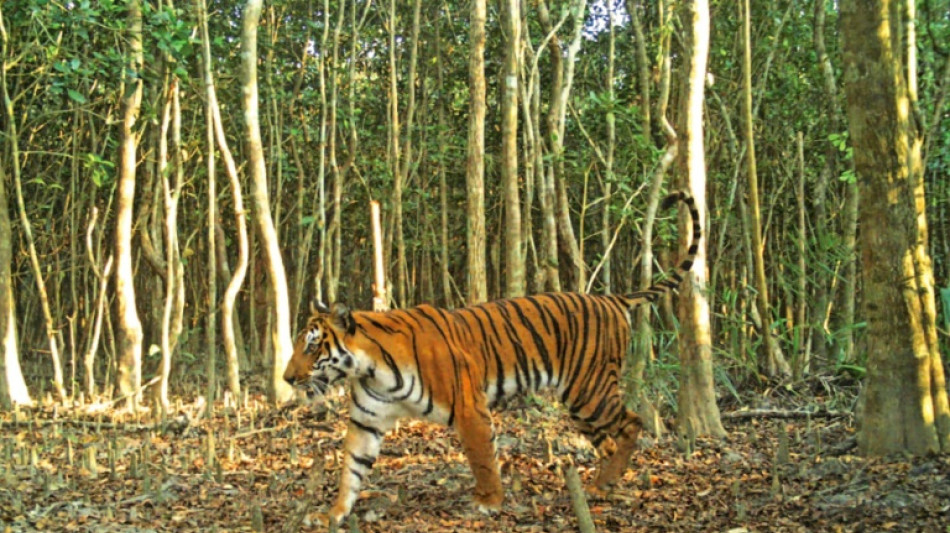
Bangladesh major hub for tiger poaching: study / Photo: © BANGLADESH FOREST DEPARTMENT/AFP/File

 Drone owners rush to offload devices ahead of Beijing ban

 Trump's beef policies irk Texas ranchers, testing their loyalty

 Nvidia, OpenAI CEOs to attend Xi dinner at White House

 Anthropic picks Accenture for in-house AI safety evaluation

 Balogun returns as Monaco beat Lens to continue strong Ligue 1 start

 'Pause' on overt repression in Venezuela, but reforms still needed: HRW

 Global stocks mixed as yen falls despite Bank of Japan rate hike

 Cuba hit with seventh major blackout of the year

 Murray out with concussion so Wentz will start for Vikings

 UN chief 'deeply regrets' US visa refusal to Abbas for annual meeting

 England quick Carse to face no charges over alleged nightclub assault

 Mancini brings nine newcomers into the first squad of his Italy comeback

 Czechs level Davis Cup tie against USA as South Korea eye Finals

 New France boss Zidane confirms Mbappe as captain after naming first squad

 California governor signs order to explore AI 'kill switch'

 Head leads run spree as Australia win Zimbabwe ODI series

 In-form Raphinha wants to finish career at Barcelona

 Warren Buffett steps down as Berkshire Hathaway chairman

 Carrick confident Man Utd can 'work through' tough time

 Mbappe ends Nike partnership to join Swiss brand On

 Liverpool boss Iraola puts Bournemouth love affair on hold

 'A disaster' if Man City do not win says Maresca after flawless start

 Kerry James Marshall: American 'blackness' painter celebrated in Europe

 Spain coach De la Fuente offers 'full support' to people of Ceuta

 Russia seizes assets of Nestle, French firms over West's Ukraine support

Bangladesh remains a major hub for the poaching of endangered tigers despite government claims of a successful crackdown on pirate groups involved in the trade, according to research published Friday.
The vast Sundarbans mangrove forest straddling India and Bangladesh hosts one of the world's largest populations of Bengal tigers.
Their pelts, bones and flesh are bought by black marketeers as part of a broader illegal wildlife trade valued at an estimated $20 billion globally each year.
Research from big cat conservation group Panthera and the Chinese Academy of Sciences said tiger parts harvested in the Sundarbans have been exported to 15 countries, with India and China being the most common destinations.
"Bangladesh plays a much more significant role in the illicit tiger trade than we previously realized," study co-author Rob Pickles said in a statement.
Pirate groups operating in the Sundarbans found a lucrative trade in tiger poaching before a government crackdown starting in 2016.
At least 117 pirates were shot dead and hundreds more were detained, according to official figures, while many others surrendered as part of a government amnesty.
But Panthera's research, published in the Conservation Science and Practice journal, said that the vacuum created by the crackdown had been filled by more than 30 specialist tiger poaching syndicates and opportunistic poachers.
Traders operated through their own logistics companies and in some cases concealed their activities through licenses for legal wildlife trade, the study added.
The research, based partly on interviews with those involved in the wildlife trade, also found that domestic consumption of tiger parts had increased since the crackdown, owing to Bangladesh's burgeoning economy.
Wealthy local buyers were purchasing medicines using tiger parts "as well as large ornamental items for display such as skulls and skins", the study said.
The findings were disputed by Bangladesh's official Sundarbans conservator Abu Naser Mohsin Hossain, who said the crackdown had brought the illicit trade to a standstill.
"We have taken measures to conserve the Bengal tiger population in the Sundarbans," he told AFP.
"No tiger has died from... tiger-human conflict in the past five years. Tiger sightings have increased."
Just 114 Bengal tigers live in Bangladesh's portion of the Sundarbans, according to an official census published in 2019 -- up slightly since a record low four years prior.
An updated population count is due to be published next year.
Poaching is the number one threat to tigers globally, and China is the biggest overall driver of demand, largely for use of their body parts in traditional medicine, according to Panthera.
J.Horn--BTB