South African rhino-lover seeks billionaire successor / Photo: © AFP

 Helicopters battle wildfire threatening Ecuador's capital

 Brentford batter Chelsea to undo Alonso's promising start

 Kane hits Bundesliga century as Bayern rout Union

 Trump says CNN, MS NOW, Politico banned from White House

 Hushing and hedging: US companies retreat on climate

 Springboks to face Fiji before 2027 Rugby World Cup

 Nigeria miners struggled to breathe in cell before 37 died: survivors

 McIlroy on the charge at PGA Championship as Reed withdraws

 McIlroy on the charge at PGA Championship

 Crisis-wracked Volkswagen warns of 10-bn-euro hit to profits

 Costa Rica's Grynspan tops third informal poll for UN chief: diplomat

 Stock markets retreat after central bank rate hikes

 Russia labels director of Cannes Grand Prix winner a 'foreign agent'

 Macron warns of Russian 'hybrid' threat after meeting presidential hopefuls

 UN holds third informal poll for new chief

 Kulusevski return can spark Spurs: De Zerbi

 Shakira to cap off world tour with Madrid 12-gig run

 Isolated Syrian-Druze city blames Damascus for shortages

 Isolated Syrian-Druze city shortages

 Dutch drop Depay for Germany match in Xavi's first pick

 Ronaldo named in Portugal squad for Nations League

 Stock markets diverge after central bank rate hikes

 Anti-Assad music star makes triumphant return to Syria

 In-form Fernandez included in Spain Nations League squad

 Arteta buries hatchet with Hurzeler ahead of Brighton clash

He spent his vast fortune on a 30-year quest to save the rhinoceros.
Today, at 81, his money is all but gone, and South African conservationist John Hume is throwing in the towel.
Later this week, Hume will auction off his rhino farm -- the world's largest -- to the highest bidder.
"I'm left with nothing except 2,000 rhinos and 8,000 hectares (20,000 acres) of land," Hume quipped in an interview with AFP ahead of the sale.
South Africa is home to nearly 80 percent of the world's rhinos, making it a hotspot for poaching driven by demand from Asia, where horns are used in traditional medicine for their supposed therapeutic effect.
The government said 448 of the rare animals were killed across the country last year, only three fewer than in 2021 despite increased protection at national parks such as the renowned Kruger.
Poachers have increasingly targeted privately-owned reserves in their hunt for horns, which consist mainly of hard keratin, the same substance found in human nails.
They are highly sought after on black markets, where the price per weight rivals that of gold and cocaine at an estimated $60,000 per kilogramme.
- 'Worth it' -
Hume said that, through the years, he had lavished around $150 million on his massive philanthropic project to save the world's second largest land mammal.
"From a rhino point of view, it was definitely worth it," the bespectacled octogenarian, wearing a chequered shirt, said in a Zoom interview.
"There are many more rhinos on Earth than when I started the project."
A former businessman who made his fortune developing tourist resorts, Hume said he fell in love with the animals somewhat by accident having bought the first specimen after retiring with dreams of running a farm.
"I've used all my life savings spending on that population of rhinos for 30 years. And I finally ran out of money," he said.
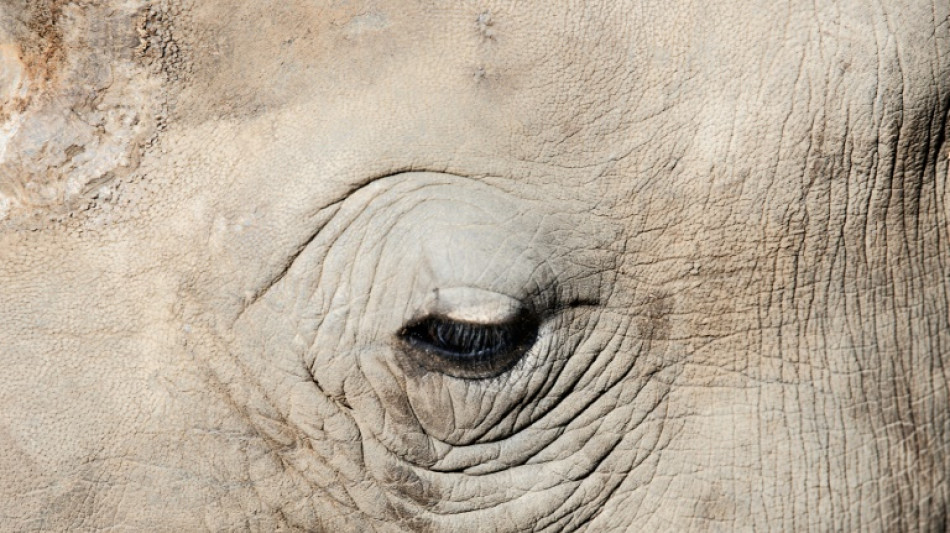
His heavily guarded farm, at an undisclosed location in North West province, has around 2,000 southern white rhinos -- a species that was hunted to near extinction in the late 19th century but gradually recovered thanks to decades of protection and breeding efforts.
Today, the Red List compiled by the International Union for Conservation of Nature (IUCN) categorises white rhinos as "near threatened", with around 18,000 left following a decline in the last decade.
Miles of fences, cameras, heat detectors and an army of rangers patrol the site, which employs about 100 people.
The tight security is meant to dissuade would-be poachers sending the message that "they don't stand a chance", said the farm's head of security, Brandon Jones.
Speaking from the control room however Jones said the exercise is only partially successful, as poachers will merely go and kill rhinos somewhere else.
"We are simply diverting them from our reserve. We know that they will target areas where it is easier to penetrate and where the risk-reward ratio is to their advantage," he said.
- Rhino or yacht? -
The full extent of the security measures taken and the number of armed rangers on guard are kept secret.
Yet Hume said surveillance is the farm's biggest cost -- and potential buyers will need deep pockets.
"I'm hoping that there is a billionaire that would rather save the population of rhinos from extinction than own a superyacht," Hume, a gruff outspoken man, said.
"Maybe somebody for whom five million dollars a year is small change."
Bids start at $10 million.
The online auction opens on Wednesday and on offer is the farm with its animals, land and machinery.
Adding its 10-tonne stock of rhino horns to the lot is negotiable, said Hume.
The horns were preventively cut off as a way to dissuade poachers from killing the animals -- and would be worth more than $500 million on the black market.
Hume believes they should be sold to fund conservation projects, creating a legal market for them.
"I have the solution. But the rest of the world and the NGOs don't agree. And we are losing the war," laments Hume angrily.
"Unfortunately, on the black market, a rhino horn from a dead rhino is still worth more than a live rhino".
B.Shevchenko--BTB