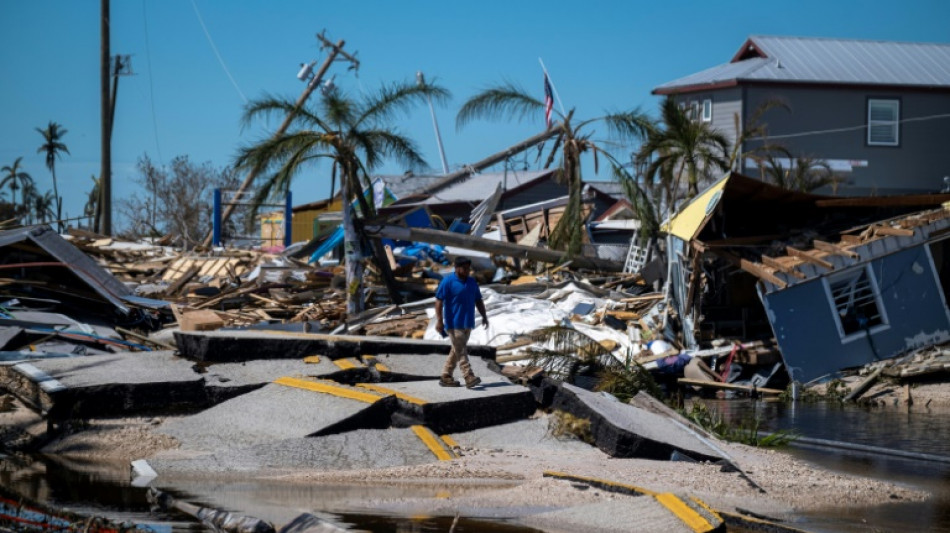
Natural disasters, inflation upped insurers' costs in 2022: Swiss Re / Photo: © AFP/File

 Hushing and hedging: US companies retreat on climate

 Springboks to face Fiji before 2027 Rugby World Cup

 Nigeria miners struggled to breathe in cell before 37 died: survivors

 McIlroy on the charge at PGA Championship as Reed withdraws

 McIlroy on the charge at PGA Championship

 Crisis-wracked Volkswagen warns of 10-bn-euro hit to profits

 Costa Rica's Grynspan tops third informal poll for UN chief: diplomat

 Stock markets retreat after central bank rate hikes

 Russia labels director of Cannes Grand Prix winner a 'foreign agent'

 Macron warns of Russian 'hybrid' threat after meeting presidential hopefuls

 UN holds third informal poll for new chief

 Kulusevski return can spark Spurs: De Zerbi

 Shakira to cap off world tour with Madrid 12-gig run

 Isolated Syrian-Druze city blames Damascus for shortages

 Isolated Syrian-Druze city shortages

 Dutch drop Depay for Germany match in Xavi's first pick

 Ronaldo named in Portugal squad for Nations League

 Stock markets diverge after central bank rate hikes

 Anti-Assad music star makes triumphant return to Syria

 In-form Fernandez included in Spain Nations League squad

 Arteta buries hatchet with Hurzeler ahead of Brighton clash

 Alexander-Arnold and Palmer return to England squad for Nations League

 Russians vote as Ukraine war drags on for fifth year

 Backpackers fret over Australian visa crackdown

 Most Asian stocks track Wall St rally, yen drops after BoJ rate hike

Natural disasters increased insurers' costs in 2022, with inflation pushing up the bill even more, reinsurer Swiss Re said Wednesday, warning of likely further rises in the future due to climate change.
Economic losses caused by natural disasters amounted to $275 billion in 2022, down 5.8 percent compared to the $303 billion in 2021, said the Zurich-based group, which acts as an insurer for insurers.
But of those losses, $125 billion were covered by insurance -- up 3.3 percent on 2021 -- making it the second consecutive year in which insured losses from natural catastrophes topped the $100 billion mark, Swiss Re said.
"The magnitude of losses in 2022 is not a story of exceptional natural hazards, but rather a picture of growing property exposure, accentuated by exceptional inflation," said Martin Bertogg, head of catastrophe perils at Swiss Re.
Inflation drove up compensation costs, particularly for buildings, homes and vehicles damaged by natural disasters.
Rising material costs and labour shortages have also led to higher claims to cover the costs of building repairs. In the United States, the aggregate replacement cost of buildings in 2022 has risen by an estimated 40 percent since the start of 2020.
"While inflation may subside, increasing value concentration in areas vulnerable to natural catastrophes remains a key driver for increasing losses," said Bertogg.
Swiss Re said there had been a five to seven percent uptrend in average annual losses over the last 30 years.
"We expect the trend to continue. The growth has been and will be largely driven by rising loss severity of individual catastrophes... and a backdrop of hazard intensification due to climate change effects," the reinsurance giant said.
- Costly Hurricane Ian -
Hurricane Ian was by far last year's costliest event, resulting in estimated insured losses of $50-65 billion. The storm ranks as the second-costliest natural catastrophe insured loss event after Hurricane Katrina in 2005.
A category-four hurricane, Ian caused more than 150 deaths, almost all in Florida, where it made landfall on September 28.
One of the most powerful storms ever to hit the United States, it flattened whole neighbourhoods and knocked out power for millions of people. Storm surges and immense downpours left even inland neighbourhoods submerged.
Each region of the world suffered a major event, the report said.
In February 2022, storms Eunice, Dudley and Franklin in northwestern Europe triggered combined insured losses of over $4 billion.
France saw its highest ever annual loss ($5 billion) from hailstorms.
Global losses from floods were above average, the main event being flooding in eastern Australia in February-March 2022.
"This resulted in insured losses of $4.3 billion -- the biggest natural catastrophe claims event ever in Australia," Swiss Re said.
In Brazil, monsoon rains were below average, with crop yields, particularly soybean and corn, suffering most, resulting in insured losses of $1 billion.
S.Keller--BTB