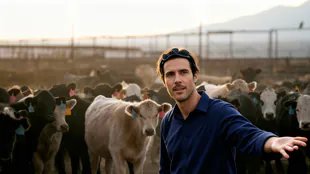
'Feedback loops' worsening climate crisis: report / Photo: © GETTY IMAGES/AFP/File

 Galloway accuser could not foresee publishing-sector fallout, lawyer argues

 New York City Center revives In the Heights as a timely community story

 Godzilla Minus Zero shifts focus toward postwar human drama

 Mehbooba Mufti urges dialogue and renewed Central Asia links for Kashmir

 Seacliff Healthcare Seeks Specialist GP in Thirroul

 US stocks fall before midterm Election Day as technology shares weaken

 BLS Polymers makes strong market debut at ₹248 per share

 Petrol and diesel prices remain broadly steady across major Indian cities

 Reliance shares remain in focus after near-12% surge

 2026 Arizona Midterms: Key Races, Ballot Measures, and Voter Deadlines

 Coal India prepares possible $1 billion Mahanadi Coalfields listing

 Julia Stiles and Ezra Sosa Share Emotional Farewell After 'DWTS' Elimination

 US Buildings Threatened by Wildfires Could Triple by 2060

 Why Pregnancy Cost Estimates Fail: A Family’s $9,000 Surprise

 US Strikes Iranian Targets in Strait of Hormuz Ahead of Midterms

 Brodeur’s Overtime Goal Secures Bethlehem’s Second Consecutive Sectional Title

 Rare 1970 Plymouth ‘Cuda 426 Hemi Listed for $400,000

 The Digital Burden: Why Instant Messaging Feels Like a Full-Time Job
 Alberta Tabled Controversial Riding Boundary Maps Amid Gerrymandering Accusations

 Hong Kong court set to sentence activist Joshua Wong in security case

 Australia raises benchmark rate to highest level in 18 years

 'The Remarried Empress' Cast Discusses Bringing Fantasy Royal Drama to Life

 Asian stocks retreat as AI worries outweigh steep oil-price drop

 Hamad International Airport stages emergency drills during WATAN 2026

 Global failure to punish attacks leaves journalists at continuing risk

Global warming melts sea ice, which leads to further warming because water absorbs more heat than ice, creating what scientists call a "climate feedback loop."
A report released Friday contains what researchers believe is the most comprehensive list of feedback loops ever compiled and a stark warning that climate models may be underestimating their impact.
"Many feedback loops significantly increase warming due to greenhouse gas emissions," the researchers from Oregon State University (OSU), University of Exeter and other institutions said in the report published in the journal One Earth.
"However, not all of these feedbacks are fully accounted for in climate models."
Co-authors William Ripple and Christopher Wolf of OSU said an "immediate and massive" boost in research about feedback loops was needed to help guide world leaders in making climate policy.
They urged UN experts with the Intergovernmental Panel on Climate Change to produce a special report on the effects of feedback loops and their potential "severe consequences."
Th researchers identified 41 climate feedback loops in their report, 27 of which accentuate warming, seven of which have a dampening effect and seven that are uncertain.
Wolf compared a feedback loop to a run on a bank.
People withdraw money because they are concerned about a bank defaulting, raising the risk of it defaulting, which causes more people to withdraw money, and so on.
Among the biological feedback loops they cited were thawing permafrost, forest dieback, loss of soil carbon, and drying and smoldering peatlands.
In the permafrost example, rising temperatures lead to thawing, producing carbon dioxide and methane emissions which lead to further increasing temperatures.
- 'Time is running out' -
The report warned that interacting feedback loops may result in a sequence of catastrophic climate "tipping points," where changes to climate systems become self-sustaining.
"Some feedback loops may be associated with key tipping points that could profoundly disrupt the global climate system and biosphere once critical thresholds are crossed," it said.
"Once sufficient warming has occurred, feedbacks could ultimately cause the Greenland ice sheet to collapse, which is a result of exceeding a tipping point," Wolf said.
The report noted that most nations have signed on to the Paris Accord, which calls for limiting global warming to 2.0 degrees Celsius, and ideally 1.5C, but they said more drastic action is needed to reduce emissions.
"Waiting until 2050 to achieve net-zero carbon emissions might be far too late," the authors said. "Time is running out to avoid the worst effects of climate change."
In the short-term, a failure to dramatically reduce emissions could result in ongoing and intensifying climate impacts, they said.
"In the worst-case long-term scenario, interactions among feedback loops could result in an irreversible drift away from the current state of Earth's climate to a state that threatens habitability for humans and other life forms," they added.
O.Bulka--BTB