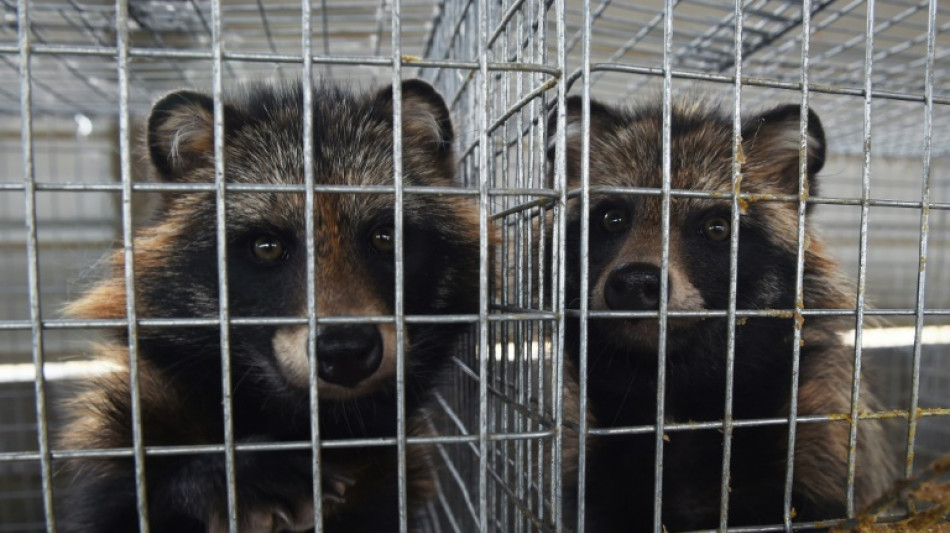
Dozens of viruses detected in Chinese fur farm animals / Photo: © AFP/File

 Google data centre sparks protests in Austria

 Shin Ohashi: Junk food-loving teen and Japan's next big swimming hope

 Stocks rise on AI buzz, drop in oil prices

 China's robot dancers limber up for America's Got Talent final

 Despite military might, Saudi struggles to crush the Houthis

 Trump to tout deals, defend Iran war in UN speech

 Sri Lanka to issue verdict in landmark Easter attack trial

 Macron says talks with Trump on Red Sea, Ukraine 'constructive'

 Green policies just good politics, says UK minister

 Bardot auction in Paris fetches nearly one million euros

 No timeline on Daniels injury return, says Commanders coach

 British Columbia sues OpenAI in US court over Canada school shooting
 French star Batum retires after 18-year NBA career

 Zidane leads first France training session
 Man shot by ICE agent in Texas detained with bullet inside him: lawyer

 California declares state of emergency ahead of El Nino
 South Africa arrests three more suspects, after nine women murdered

 Carse needs time away from England, says captain Brook

 NOWPayments Releases Cross-Chain Payout Data Revealing Key Performance Benchmarks Across TRON, BNB Chain, and Solana

 British Museum bans photos of Bayeux Tapestry as crowds linger

 COP31 host says AI climate footprint to be a summit priority

 Berlin's far-left vote winners reject anti-semitism charges

 Mancini eager for 'new adventure' on Italy return

 Mbappe says having Zidane as France coach 'like a film'

 Palmer, Rice out of England Nations League squad

Dozens of viruses have been detected mixing in animals at fur farms in China, some of which are new and have the potential to spill over into humans, researchers said Wednesday.
Since the Covid-19 pandemic, scientists have been warning that farming mammals such as minks for their fur could make it easier for new viruses to cross over from the wild and spark fresh outbreaks.
Virologist Edward Holmes, who has led research into Covid-19, told AFP he felt that the global fur farming industry "is one most likely ways by which a new pandemic will start".
"Personally, I think the fur farming industry globally should be closed down," he added.
Holmes is a co-author of a new study looking at the potential danger posed by viruses in fur farms in the country where the first Covid cases emerged in late 2019.
The Chinese-led team of researchers sequenced the genetic material from lung and intestine samples of 461 animals such as minks, rabbits, foxes and raccoon dogs that died from disease across the nation between 2021 and 2024.
Most were from fur farms, some were also farmed for food or traditional medicine, while around 50 were wild animals.
The team detected 125 viruses, including 36 new ones, according to the study in the journal Nature.
Thirty-nine of the viruses have a "high risk" of jumping across species, including to humans, the researchers evaluated.
Some of those viruses -- such as hepatitis E and Japanese encephalitis -- have already spread to humans, but 13 were new, the study said.
Several types of bird flu were also detected in guinea pigs, minks and muskrats.
And seven types of coronaviruses were also spotted -- though none were closely related to SARS-CoV-2, which causes Covid.
- 'Alarm bell' virus -
The virus that most concerned Holmes was the "Pipistrellus bat HKU5-like virus". It had previously been detected in bats but was found in the lungs of two farmed minks.
It is a relative of the Middle East respiratory syndrome coronavirus (MERS), which can be deadly to humans.
"That we now see that it jumped from bats to farmed mink must serve as an alarm bell," said Holmes, who is a professor at the University of Sydney.
"This virus needs to be monitored."
Thousands of unknown viruses are believed to be circulating among wild mammals. Scientists fear that fur farms could allow farmed animals to catch such viruses, which could in turn expose humans.
The leading theory for the origin of Covid is that it began in bats, then was transmitted to humans during the trade of wild animals.
"I strongly believe that the wildlife trade was responsible for the emergence of SARS-CoV-2," Holmes said.
"And I think that the related fur farming trade could easily result in another pandemic virus," he added.
In the study, the researchers called for increased surveillance of fur farm animals -- particularly for minks, raccoon dogs and guinea pigs, which recorded the most "high risk" viruses.
Denmark culled its entire farmed mink population over Covid fears in 2020, but has since reauthorised the practice.
S.Gantenbein--VB