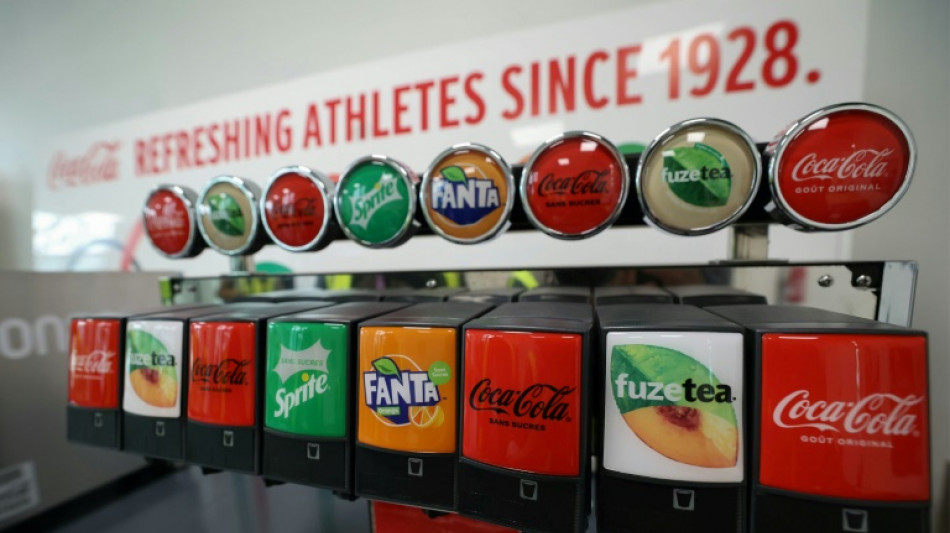
Health experts urge Olympics to cut ties with Coca-Cola / Photo: © AFP/File

 Typhoon Dujuan leaves four dead in Japan, 45,000 houses without power

 G7 leaders condemn Houthi strikes on Saudi Arabia

 Google data centre sparks protests in Austria

 Shin Ohashi: Junk food-loving teen and Japan's next big swimming hope

 Stocks rise on AI buzz, drop in oil prices

 China's robot dancers limber up for America's Got Talent final

 Despite military might, Saudi struggles to crush the Houthis

 Trump to tout deals, defend Iran war in UN speech

 Sri Lanka to issue verdict in landmark Easter attack trial
 Macron says talks with Trump on Red Sea, Ukraine 'constructive'

 Green policies just good politics, says UK minister

 Bardot auction in Paris fetches nearly one million euros

 No timeline on Daniels injury return, says Commanders coach

 British Columbia sues OpenAI in US court over Canada school shooting

 French star Batum retires after 18-year NBA career
 Zidane leads first France training session

 Man shot by ICE agent in Texas detained with bullet inside him: lawyer
 California declares state of emergency ahead of El Nino

 South Africa arrests three more suspects, after nine women murdered
 Carse needs time away from England, says captain Brook

 NOWPayments Releases Cross-Chain Payout Data Revealing Key Performance Benchmarks Across TRON, BNB Chain, and Solana

 British Museum bans photos of Bayeux Tapestry as crowds linger

 COP31 host says AI climate footprint to be a summit priority

 Berlin's far-left vote winners reject anti-semitism charges

 Mancini eager for 'new adventure' on Italy return

Two health experts on Wednesday urged Olympic organisers to cut ties with Coca-Cola, saying the current big money sponsorship deal allows the US company to "sportswash" unhealthy sugary drinks.
The plea comes on top of criticism over the amount of plastic bottles used to serve fans at the Paris Games.
Events in the French capital have been lined with advertising for the ubiquitous fizzy drinks of Coca-Cola, which has been sponsoring the Olympics since 1928.
But these sugary drinks "offer little or no nutritional value" and promoting such unhealthy products has no place in sport, according to Trish Cotter and Sandra Mullin of global health group Vital Strategies.
Sugary drinks are a "key driver" of a range of serious health problems affecting people across the world, including obesity, diabetes, high blood pressure and heart disease, the pair wrote in a commentary in the journal BMJ Global Health.
Coca-Cola's products also contribute to global plastic pollution, greenhouse gas emissions and use up a huge amount of water, they added.
"By continuing its association with Coca-Cola, the Olympic movement risks being complicit in intensifying a global epidemic of poor nutrition, environmental degradation and climate change," the authors wrote.
"It's time for the International Olympic Committee (IOC) to cut ties with Coca-Cola in the interest of athletes, spectators and the planet."
Coca-Cola did not respond to a request for comment.
- A 'responsible approach' -
The IOC defended its partnership with the soft drink company, noting that it also offers sugar-free options, including water, tea and coffee.
"We're incredibly proud of almost 100 years of partnership with the Coca-Cola company," Anne-Sophie Voumard, the IOC's television and marketing services managing director, said at a daily press conference.
"From an IOC perspective, Coke is taking a responsible approach to supporting athletes' families, fans and is taking an integral part in the delivery of the Games," she said.
In 2020, the US food and drink giant signed a joint deal worth a reported $3 billion to extend its sponsorship of the Olympics.
The partnership will last until at least 2032.
Cotter and Mullin noted that last year Coca-Cola had more sports sponsorships than any other brand, including sportswear companies such as Nike.
"This strategy culminates in a gold medal opportunity to 'sportswash' an unhealthy product," they wrote.
The World Health Organization has called for countries to tax sugar-sweetened beverages.
A petition launched ahead of the Games called "Kick Big Soda Out of Sport" has more than 109,000 signatures, and been backed by a range of public health organisations including the World Obesity Federation.
- Plastic bottles -
Environmental NGOs have also criticised the amount of plastic used to serve drinks at the Paris Games.
The Coca-Cola Company in May said nearly 10 out of 18 million refreshments served at the Olympics would be "without single-use plastic".
Fanta, Sprite and Coca-Cola bottles have been served into reusable cups at Olympic venues, a practice some say runs counter to the Games' pledge to be the greenest in history.
The Atlanta-based giant said it has had to use plastics due to "technical and logistical constraints".
While 700 drink fountains have been deployed across the competition, plastic bottles are being used where glass alternatives are not an option, said Georgina Grenon, the head of sustainability for the Paris Games.
This year's Paris Games should still achieve the goal of cutting single-use plastic by 50 percent compared to the 2012 London Games, Grenon said.
M.Betschart--VB