'Citizens of the Reich': Raids and suspicion as German group grows / Photo: © AFP

 Hurricane Polo strengthens to top category 5 off Mexico

 11 hurt as teen opens fire outside school in western Turkey

 UN chief says 'Big Oil' treats atmosphere as open sewer

 Tunisia says 2026 summer hottest on record

 England's Rashid out of Sri Lanka ODIs with hand injury

 Houthis accuse Saudi Arabia of deadly strikes as thousands flee

 Stocks climb as oil slides, AI buzz returns

 India cricketers win in style as Afghan savours 'special' Games silver

 La Liga president hits out at Real Madrid refereeing 'conspiracy' claims

 MEXC Launches “Real Stocks, Real Friends” with Rewards for Bringing Friends to Wall Street

 Mbappe continues media push for Ballon d'Or recognition

 Stocks rise on AI buzz, oil prices cool

 India narrowly survive huge scare against minnows Japan

 Missing F-35 fighter parts 'not sensitive', says Australia minister

 Cambodia showcases scams crackdown with global conference
 Afghan cyclist who disguised herself as man wins Asian Games silver

 Typhoon Dujuan leaves four dead in Japan, 45,000 houses without power

 G7 leaders condemn Houthi strikes on Saudi Arabia
 Google data centre sparks protests in Austria

 Shin Ohashi: Junk food-loving teen and Japan's next big swimming hope
 Stocks rise on AI buzz, drop in oil prices

 China's robot dancers limber up for America's Got Talent final

 Despite military might, Saudi struggles to crush the Houthis
 Trump to tout deals, defend Iran war in UN speech
 Sri Lanka to issue verdict in landmark Easter attack trial

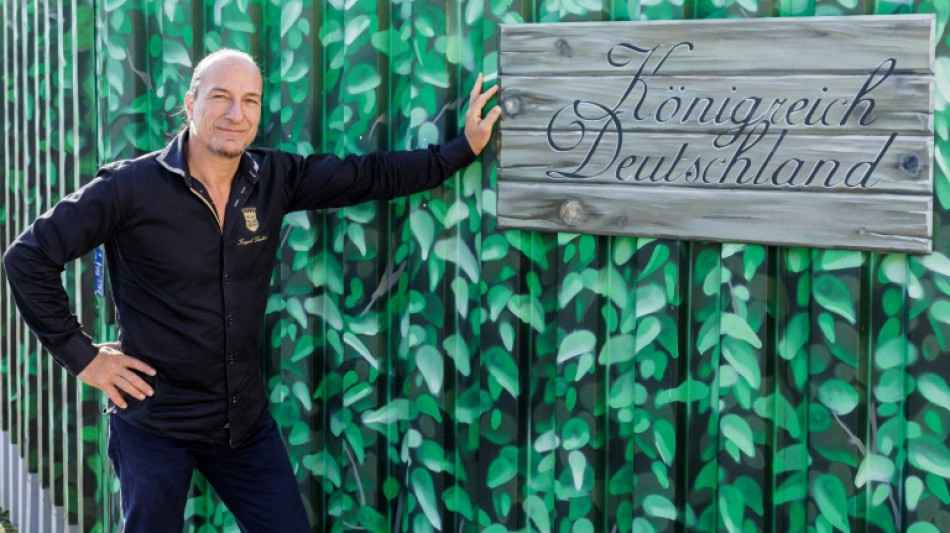
On the outskirts of the eastern German town of Wittenberg, a corrugated iron gate painted with green leaves welcomes visitors to the "Koenigreich Deutschland" (Kingdom of Germany).
Those who step through the gate to the cluster of buildings on the other side are entering place that styles itself a country, complete with its own flag, laws, currency and ID cards.
The so-called Kingdom of Germany was founded by former chef and karate teacher Peter Fitzek, who anointed himself as "king" in 2012 in an elaborate ceremony complete with a crown and sceptre.
Fitzek and his followers are part of a movement known as the Reichsbuerger (Citizens of the Reich), a loose grouping of in some cases violent extremists and conspiracy theorists who reject the legitimacy of the modern German republic.
Long dismissed as malcontents and oddballs, the Reichsbuerger have become increasingly radicalised and are considered a security threat by German authorities who launched their latest raid Wednesday on the Wittenberg site.
Fitzek, 58, ran unsuccessfully as a mayor and a member of the German parliament before deciding that founding the place was the only answer to the "mass manipulation" he saw in German society.
His territory has since grown to encompass several different sites across Germany and has more than 5,000 self-proclaimed citizens.
They tend to be people with a "pioneering spirit" who "want to make a positive change in this world", Fitzek told AFP in Wittenberg, the group's original base.
"We are open to all people who have their heart in the right place," he said, sitting on a salmon-coloured sofa in the corner of a drab open-plan office.
- Anti-vax -
The Wittenberg complex comprises several office buildings, a carpentry workshop, a gift shop selling items made on site and a canteen that serves only vegan food.
About 30 people live and work on the site in a commune-style arrangement.
They are all non-smokers, non-drinkers and not vaccinated against Covid-19 -- the kingdom has its own health insurance system for which this is a prerequisite.
As Fitzek strode around the Wittenberg site, pointing out everything from eco-friendly heating systems to a coin press machine for making "new German marks", he promoted his project glowingly.
But in the latest raid, investigators said Wednesday they targeted 10 sites belonging to the "kingdom" on suspicion that it was running "banking and insurance businesses without the necessary permits".
Despite authorities' suspicion, life at Wittenberg is attractive to its adherents.
Laina, 47, and Roland, 50, who did not want to give their last names, moved to Wittenberg from the Munich area last year with their three children now aged six, nine and 12.
"We had been unhappy with the situation we were in for a while," said Roland, who used to work in management for a TV shopping channel.
"Then the pandemic came, with all the restrictive measures, and we had a real feeling of unease."
For Laina, a graphic designer, the move was about achieving a better work-life balance and a healthier lifestyle.
"During my pregnancies, I really began to notice what was important for me and what I needed," she said.
The couple's children do not attend a private or public school -- something considered illegal in Germany.
But Laina said it is better for them to learn at their own pace.
- 'Real danger' -
There were around 23,000 members of the Reichsbuerger movement in 2022, according to Germany's federal domestic intelligence agency -- up from 21,000 in 2021.
The number considered potentially violent also rose from 2,100 to 2,300.
While Reichsbuerger members subscribe to a similar ideology, the movement is made up of many disparate groups.
In November, German officials raided apartments nationwide over an alleged plot by a group of Reichsbuerger to spread conspiracy theories and "destabilise" the state through social media.
In December 2022, members of a group including an ex-MP and former soldiers were arrested over a plot to attack parliament, overthrow the government and install aristocrat and businessman Prince Heinrich XIII Reuss as head of state.
Another high-profile case saw a group of Reichsbuerger charged with plotting to kidnap health minister Karl Lauterbach in protest at Covid-19 restrictions.
Fitzek himself has had several run-ins with the law and has served time in prison for illegal insurance transactions, among other things.
Most recently, he was sentenced to eight months in jail in July for assault, though he has appealed the conviction and remains free until a final decision is made.
According to Jochen Hollmann, head of the domestic intelligence agency in Saxony-Anhalt state, the Reichsbuerger pose a "real danger" to German society.
- Far-right overlaps -
Some have already resorted to violence and with the movement growing, "there is always a danger that... more will feel called upon to take action against the state order," Hollmann told AFP.
Many ordinary Germans are also concerned about the rise of the movement.
In the village of Halsbreucke, near Dresden, local residents have formed an association to oppose plans by Fitzek's "kingdom" to build an organic farm, in the hope of getting authorities to impose a right to refuse.
"It all sounds quite harmless at first," said Jana Pinka, 60, an engineer and local councillor. But it is the "context" of the plans that troubles her.
"We see both this rejection of the state, including Germany's borders, and the fact that people are seeking proximity to right-wing populist groups. That scares us a little," she said.
Only around eight percent of Reichsbuerger in Saxony-Anhalt are classified as right-wing extremists, according to Hollmann, though "there are certainly overlaps".
- 'Marginalised' -
What they do tend to have in common is that they are from socially disadvantaged backgrounds, especially in the former East Germany.
"Many people (here) feel marginalised and that is of course always a breeding ground for extremist parties or structures," Pinka said.
"People look for a strong leader, which unfortunately we have already had bad experiences of in Germany. And that is something that all of us... need to think about."
Fitzek, meanwhile, is undeterred.
His ultimate aim is for his project to become so big that "the old order... simply dissolves peacefully," he said.
"And we would not regret this loss at all, because we would have a much, much better order," he said with a determined grin.
H.Weber--VB