'Everything comes back': Morocco quake leaves mental scars / Photo: © AFP

 Trump renames AI "super intelligence," rejects international oversight
 Trump rejects international regulation of AI
 How is the EU approaching record fuel prices?

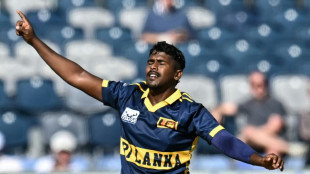 Sri Lanka's Colombage strikes on debut as England dismissed for 265 in first ODI
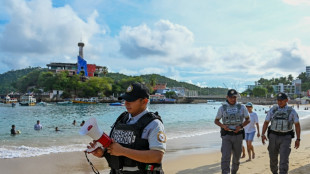 Hurricane Polo strengthens to top category 5 off Mexico

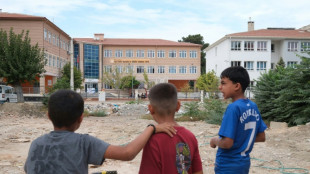 11 hurt as teen opens fire outside school in western Turkey

 UN chief says 'Big Oil' treats atmosphere as open sewer

 Tunisia says 2026 summer hottest on record

 England's Rashid out of Sri Lanka ODIs with hand injury

 Houthis accuse Saudi Arabia of deadly strikes as thousands flee

 Stocks climb as oil slides, AI buzz returns

 India cricketers win in style as Afghan savours 'special' Games silver

 La Liga president hits out at Real Madrid refereeing 'conspiracy' claims

 MEXC Launches “Real Stocks, Real Friends” with Rewards for Bringing Friends to Wall Street

 Mbappe continues media push for Ballon d'Or recognition

 Stocks rise on AI buzz, oil prices cool
 India narrowly survive huge scare against minnows Japan

 Missing F-35 fighter parts 'not sensitive', says Australia minister
 Cambodia showcases scams crackdown with global conference
 Afghan cyclist who disguised herself as man wins Asian Games silver

 Typhoon Dujuan leaves four dead in Japan, 45,000 houses without power

 G7 leaders condemn Houthi strikes on Saudi Arabia
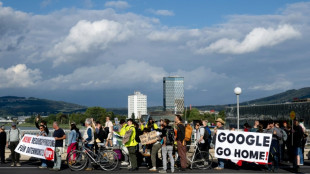 Google data centre sparks protests in Austria

 Shin Ohashi: Junk food-loving teen and Japan's next big swimming hope

 Stocks rise on AI buzz, drop in oil prices
When Khadija Temera, a survivor of Morocco's devastating earthquake, was sent to a psychiatrist on Tuesday, she was just one of a hundred newly traumatised patients who would be seen within 24 hours.
The powerful quake last Friday killed more than 2,900 people, most of them in remote villages of the High Atlas Mountains.
Beyond the physical devastation, soldiers and aid workers say it is becoming increasing clear that many of the survivors are facing severe mental suffering.
"The most important thing is that we are alive," Temera says, her henna-stained fingers fiddling with a piece of paper, her eyes swollen with tears.
But now she wants to "heal her heart", and on Tuesday she had her first consultation with a psychiatrist, seeking balm for the trauma inflicted by the quake.
She had first gone to see a regular doctor for hypertension.
But Moroccan troops in the area quickly referred her to the psychiatrist, who said he had seen around a hundred patients since the previous day out of the 500 who came to the field hospital in Asni, around 90 kilometres (55 miles) south of the tourist hub of Marrakesh.
Flashbacks from the fateful day continue to haunt Temera: of stairs collapsing and trapping her and the nine members of her family before they could be rescued.
"I've been awake ever since, I can't fall asleep -- as soon as I lie down everything comes back," said the 68-year-old from the village of Lareb.
- 'Acute stress' -
Next to her on a bench, a mute woman was also waiting for a consultation, her hands clasped across her chest and breathing heavily.
She has lost both her children.
After her comes the turn of a man in his thirties, his eyes red from crying.
Of the thousands injured in the powerful earthquake, "some were not only wounded and bruised in their flesh, they were also often 'bereaved', having lost their homes", said Adil Akanour, the only psychiatrist at the makeshift hospital, which was opened to the press on Tuesday.
Meanwhile villagers in more isolated hamlets, which have remained inaccessible, told AFP of their isolation and the absence of aid.
Survivors find themselves in a "state of acute stress with symptoms, often physical at first", Akanour said, adding that dizziness, palpitations, headaches and abdominal pain can be symptoms that "hide" a psychological problem.
According to the World Health Organization, nearly everyone who experiences such an emergency will suffer some psychological problems which, in most cases, will fade with time.
- 'There's nothing left' -
The separation of families, insecurity, loss of livelihoods and disruption of social contacts are all potential psychological problems, according to the UN organisation, which recommends urgent care to prevent the development of post-traumatic stress disorders.
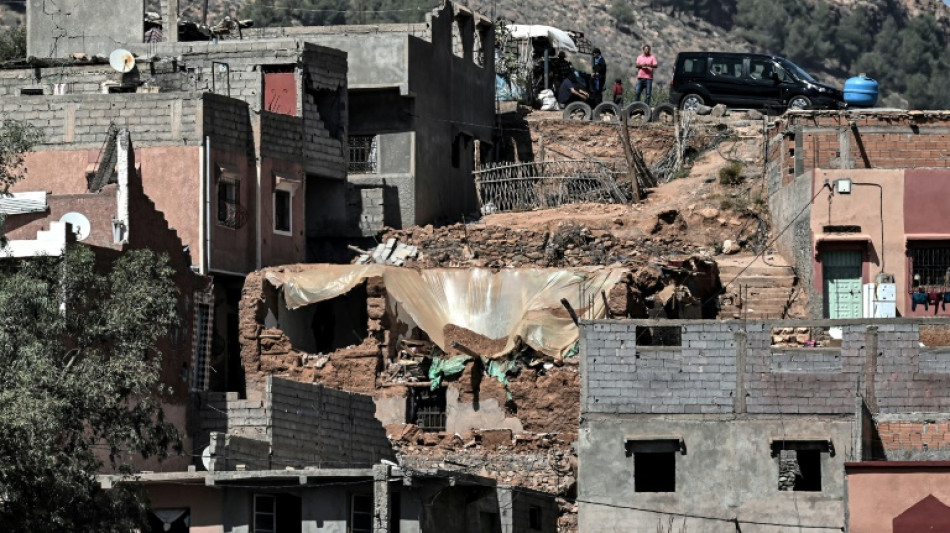
The 6.8-magnitude quake that struck on September 8 was the most powerful ever recorded in the kingdom, with the provisional toll of 2,900 people dead likely to rise.
Entire villages were swallowed up, and with them the lives of hundreds of modest families.
Thousands of people were left homeless, the majority now living alone in makeshift tents or, for a few such as Mouhamed El Makhconi, sheltering in genuine windproof tents provided by the interior ministry.
"I was the only one providing for my family," the 60-year old said with a resigned, toothless smile.
He did so by selling jewellery to tourists heading to the summits of the High Atlas mountain range that dominates the landscape.
But now "there's nothing left" of his ground-floor apartment, leaving him and his eight-member family destitute.
"I haven't even got a dirham on me," he sighs, sitting outside the tent. He had to be provided with everything from blankets to glasses.
Adding to his desperation are the sounds of the earthquake that remain resonant in his memory.
He too cannot sleep, saying he can still feel the tremors and the waves of fear that went through his body.
But El Makhconi has not consulted a psychiatrist, largely because he needs to sort out his diabetes first.
His grandchildren have not been examined either. They are still terrified at times and miss their toys, including the bendir, a much-loved percussion instrument.
P.Keller--VB