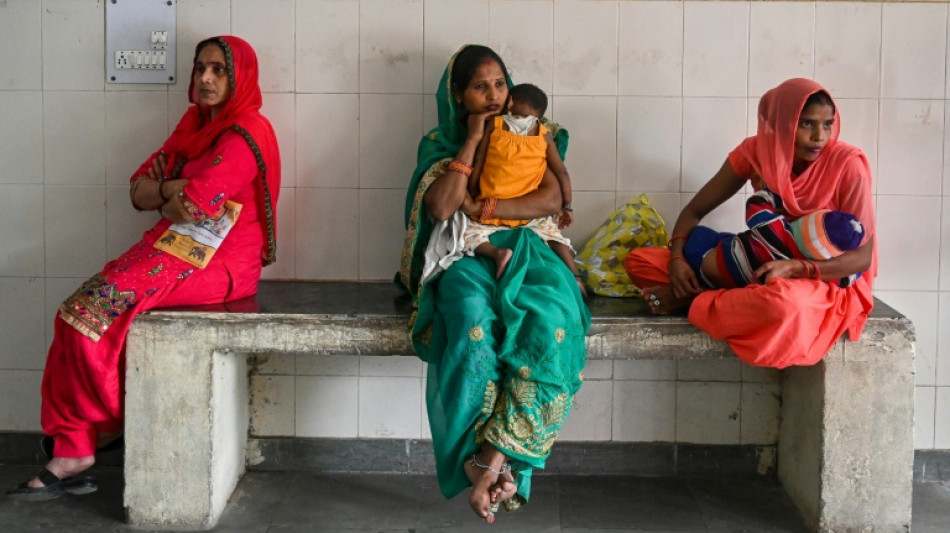
Family planning in India: A woman's dangerous burden / Photo: © AFP

 Tunisia says 2026 summer hottest on record

 England's Rashid out of Sri Lanka ODIs with hand injury

 Houthis accuse Saudi Arabia of deadly strikes as thousands flee

 Stocks climb as oil slides, AI buzz returns

 India cricketers win in style as Afghan savours 'special' Games silver

 La Liga president hits out at Real Madrid refereeing 'conspiracy' claims

 MEXC Launches “Real Stocks, Real Friends” with Rewards for Bringing Friends to Wall Street

 Mbappe continues media push for Ballon d'Or recognition

 Stocks rise on AI buzz, oil prices cool

 India narrowly survive huge scare against minnows Japan

 Missing F-35 fighter parts 'not sensitive', says Australia minister
 Cambodia showcases scams crackdown with global conference

 Afghan cyclist who disguised herself as man wins Asian Games silver

 Typhoon Dujuan leaves four dead in Japan, 45,000 houses without power

 G7 leaders condemn Houthi strikes on Saudi Arabia

 Google data centre sparks protests in Austria

 Shin Ohashi: Junk food-loving teen and Japan's next big swimming hope

 Stocks rise on AI buzz, drop in oil prices

 China's robot dancers limber up for America's Got Talent final

 Despite military might, Saudi struggles to crush the Houthis

 Trump to tout deals, defend Iran war in UN speech

 Sri Lanka to issue verdict in landmark Easter attack trial

 Macron says talks with Trump on Red Sea, Ukraine 'constructive'

 Green policies just good politics, says UK minister

 Bardot auction in Paris fetches nearly one million euros

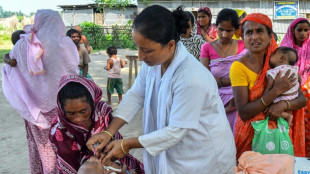
Occasional screams sounded from the operating theatre in a rural Indian clinic as a heavily sedated woman named Kajal waited to have her tubes tied, long the country's preferred family planning method.
"The anaesthesia must not have kicked in," one healthcare worker said outside the facility in the northern village of Bhoodbaral, where a line of women in colourful headscarves waited to undergo the invasive, and sometimes risky, 50-minute procedure.
India is set to become the world's most populous nation by mid-year, according to UN figures published Wednesday, overtaking China, where the population shrank last year for the first time since 1960.
The Indian government launched a nationwide family planning programme in 1952 -- long before societies around the world had even started to destigmatise birth control.
But in the decades that followed, as the pill and condoms became the go-to contraceptive methods for millions elsewhere, men in India were subjected in the 1970s to a brutal programme of forced sterilisation.
Since then the focus has shifted to women in India, with tubal ligation the preferred method of birth control.
There is a non-invasive vasectomy available for men but women like Kajal are often convinced by government healthcare workers to undergo the procedure, often with cash incentives of around $25.
Kajal, 25, said she and her husband Deepak decided she would undergo the operation since they can barely make ends meet with their three children.
"I thought it would make me weak," Deepak, a factory worker, said when asked why he chose not to have a vasectomy.
- Myths around virility -
Poonam Muttreja from Population Foundation of India said Deepak's fears about how a vasectomy -- a reversible, 10-minute procedure -- would affect him were common in what is still a "very patriarchal society".
"The most popular myth that exists among both men and women is that a man will lose his virility," Muttreja told AFP.
"This is a myth which has no science... but it is a belief. The belief is the reality for people," she said.
The health centre in Bhoodbaral sterilised more than 180 women compared with just six men from April 2022 to March this year.
"People have a misconception that no-scalpel vasectomy for males leads to impotence... This has become a taboo," said Dr Ashish Garg, the facility's medical superintendent.
- Dangerous -
Makeshift sterilisation clinics that perform tubal ligations on women are common in India, particularly in its vast rural belts where two-thirds of the population live, and so are botched surgeries.
Four women died and nine others were hospitalised last year after getting their tubes tied in the southern state of Telangana.
In 2014, at least 11 women died after sterilisations at a makeshift clinic in the central state of Chhattisgarh.
Muttreja said the government needs to do more to promote contraception.
She also said the solution to getting more men to have the operation was better education.
"It's a magical pill... Investing in health and education would have reduced the economic cost to the family and also to the nation," she said.
But Harbir Singh, a 64-year-old local resident, still believes that vasectomies rob men of their "strength" needed to work and put food on the table.
"The man has to go out and earn... The women make food and stay at home," he said.
"What will happen without the man?"
R.Adler--BTB