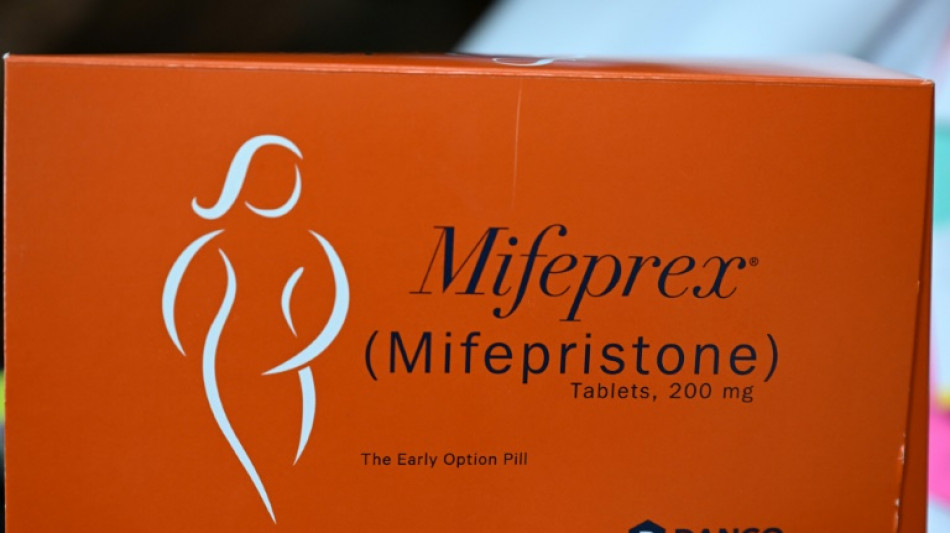
Abortion pill at center of escalating US court battle / Photo: © AFP/File

 Tunisia says 2026 summer hottest on record

 England's Rashid out of Sri Lanka ODIs with hand injury

 Houthis accuse Saudi Arabia of deadly strikes as thousands flee

 Stocks climb as oil slides, AI buzz returns

 India cricketers win in style as Afghan savours 'special' Games silver

 La Liga president hits out at Real Madrid refereeing 'conspiracy' claims

 MEXC Launches “Real Stocks, Real Friends” with Rewards for Bringing Friends to Wall Street

 Mbappe continues media push for Ballon d'Or recognition

 Stocks rise on AI buzz, oil prices cool

 India narrowly survive huge scare against minnows Japan

 Missing F-35 fighter parts 'not sensitive', says Australia minister

 Cambodia showcases scams crackdown with global conference

 Afghan cyclist who disguised herself as man wins Asian Games silver

 Typhoon Dujuan leaves four dead in Japan, 45,000 houses without power

 G7 leaders condemn Houthi strikes on Saudi Arabia

 Google data centre sparks protests in Austria

 Shin Ohashi: Junk food-loving teen and Japan's next big swimming hope

 Stocks rise on AI buzz, drop in oil prices

 China's robot dancers limber up for America's Got Talent final

 Despite military might, Saudi struggles to crush the Houthis
 Trump to tout deals, defend Iran war in UN speech

 Sri Lanka to issue verdict in landmark Easter attack trial

 Macron says talks with Trump on Red Sea, Ukraine 'constructive'

 Green policies just good politics, says UK minister

 Bardot auction in Paris fetches nearly one million euros

Federal judges in Texas and Washington on Friday issued dueling rulings that intensified the legal battle over abortion and a commonly used medical abortion drug.
The legal battle over the pill mifepristone has grown more intense since the US Supreme Court last year tossed out the federal right to the procedure.
The abortion pill was at the center of two conflicting federal court rulings on Friday.
In one ruling, a federal judge in Texas halted Food and Drug Administration approval of the abortion pill, pending a seven-day window to give the Justice Department time to appeal.
Then Friday night, in a dramatic lurch in a different legal direction, a federal judge in Washington state said that the FDA must keep the abortion pill available in at least 12 liberal states.
Here is background on the abortion pill and its use.
- How widespread is abortion pill use? -
According to the Guttmacher Institute, the pill accounted for more than half -- 53 percent -- of the 930,160 abortions documented by the reproductive health research and policy organization in the United States in 2020.
That was up from 17 percent in 2008 and 39 percent in 2017.
While the number of so-called medication abortions has gone up dramatically in the United States in recent years, it is still not as prevalent as in several European nations.
In France, for example, medication abortions represented 70 percent of the total number of abortions in 2020.
- How does it work? -
The abortion pill is different from the "morning after" pill, which is taken by a woman after sexual intercourse to prevent becoming pregnant.
The abortion pill is taken to induce an abortion once a woman confirms that she is pregnant.
It in fact involves more than one pill. The first, mifepristone, also known as RU 486, stops a pregnancy from proceeding normally by blocking production of the hormone progesterone.
Another drug, misoprostol, is taken up to 48 hours later and causes cramps, bleeding and the emptying of the uterus.
Abortion pills can be used at home and a medical setting is not required.
- When was the abortion pill approved? -
The US Food and Drug Administration (FDA) gave the green light to mifepristone and misoprostol in 2000.
It is approved for use up to 10 weeks of pregnancy, after which a woman would need to undergo an abortion through another means such as vacuum aspiration.
The average cost of a medication abortion at Planned Parenthood is $580 but it can cost up to $800.
- Is it safe and effective? -
Use of the abortion pill during the specified time period is considered to be safe and effective by medical experts.
Pregnancies are successfully terminated in more than 95 percent of cases where the pill is used, according to studies.
Serious complications -- excessive bleeding, fever, infection or allergic reaction -- which require a medical consult, are rare.
The abortion pill does not work for ectopic pregnancies, which account for around two percent of all pregnancies and where a fertilized egg grows outside the uterus.
- Where is the pill available? -
At least 13 US states have banned most abortions, including medication abortions, since the Supreme Court's ruling in June overturning the constitutional right to an abortion.
Despite the bans, a number of organizations have mobilized to provide abortion pills to women in states where abortion is restricted.
The extent of their efforts is difficult to evaluate.
In the states where abortion is legal, the FDA recently loosened restrictions surrounding mifepristone, allowing it to be sent through the mail with a prescription or to be sold directly in pharmacies like any other drug.
S.Keller--BTB