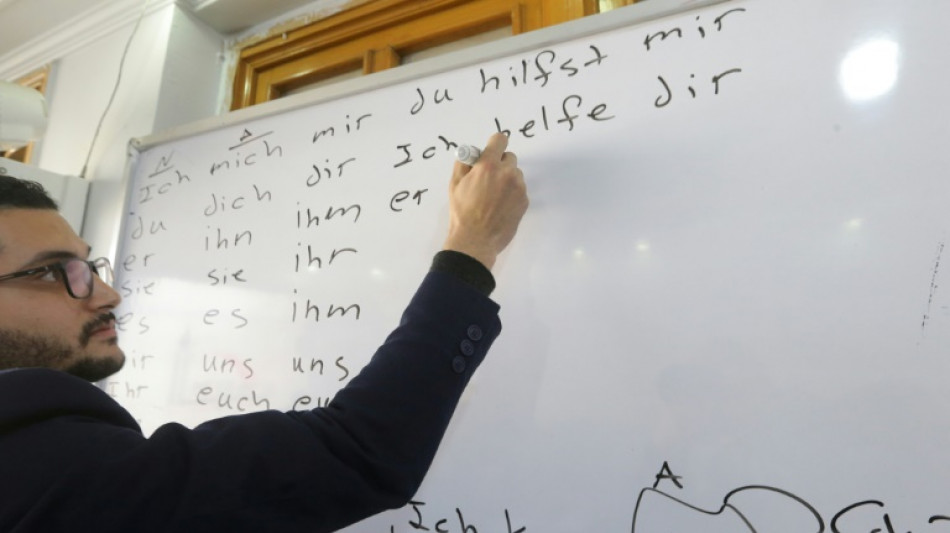
Syrian medical students study German in hopes of move abroad / Photo: © AFP

 Tunisia says 2026 summer hottest on record

 England's Rashid out of Sri Lanka ODIs with hand injury

 Houthis accuse Saudi Arabia of deadly strikes as thousands flee

 Stocks climb as oil slides, AI buzz returns

 India cricketers win in style as Afghan savours 'special' Games silver

 La Liga president hits out at Real Madrid refereeing 'conspiracy' claims

 MEXC Launches “Real Stocks, Real Friends” with Rewards for Bringing Friends to Wall Street

 Mbappe continues media push for Ballon d'Or recognition

 Stocks rise on AI buzz, oil prices cool

 India narrowly survive huge scare against minnows Japan

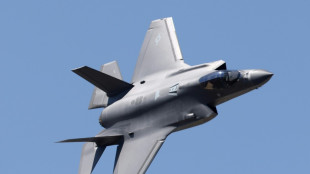 Missing F-35 fighter parts 'not sensitive', says Australia minister
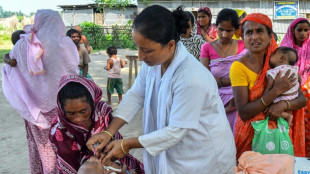
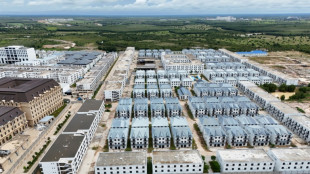 Cambodia showcases scams crackdown with global conference
 Afghan cyclist who disguised herself as man wins Asian Games silver

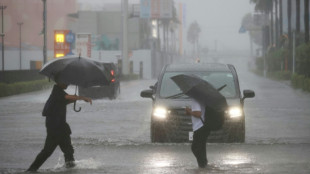
 Typhoon Dujuan leaves four dead in Japan, 45,000 houses without power

 G7 leaders condemn Houthi strikes on Saudi Arabia
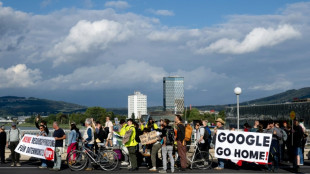 Google data centre sparks protests in Austria

 Shin Ohashi: Junk food-loving teen and Japan's next big swimming hope

 Stocks rise on AI buzz, drop in oil prices

 China's robot dancers limber up for America's Got Talent final

 Despite military might, Saudi struggles to crush the Houthis
 Trump to tout deals, defend Iran war in UN speech

 Sri Lanka to issue verdict in landmark Easter attack trial
 Macron says talks with Trump on Red Sea, Ukraine 'constructive'
 Green policies just good politics, says UK minister
 Bardot auction in Paris fetches nearly one million euros
His medical studies in Syria keep Mohammed Shasho busy enough but whenever he can he also pores over German vocabulary and grammar points in hopes of a move to Europe.
Like many youngsters in the war-ravaged country, he dreams of joining the almost one million Syrians already in Germany to advance his education and perhaps find work there.
"German is very difficult to learn, especially because it is not taught by native speakers in Syria," said the 23-year-old who regularly studies German textbooks and video tutorials.
The effort will be "worth it... once I set foot in Germany", Shasho told AFP in the quiet courtyard of a Damascus health clinic where he volunteers.
German classes have proliferated in recent years in Syria where the vast majority of foreign language students had until recently opted for English or French.
Germany has become a coveted destination for aspiring Syrian doctors who want to study and work away from their homeland, ravaged by conflict and a crushing economic crisis.
Since the war began in 2011, dozens of new German language centres have sprung up in Syria's government-controlled areas, catering to new interest.
While Syrians have a hard time obtaining visas for many countries, medical students and doctors can have an easier time if their destination is looking for skilled health workers.
But for Germany, Shasho and others like him must first be able to demonstrate an advanced language level.
- Soaring demand -
He and his friend Jaafar Mustafa, also 23, both sixth-year medical students at Damascus University, revised together to improve their language skills during a break at the clinic.
Germany is "the easiest and safest destination" for Syrians, said Mustafa, adding that qualifications from the country were highly regarded.
"There is a big Syrian community there, so I will not feel alienated," he told AFP. "All of my friends have either travelled, are preparing to travel, or are thinking about it."
Years of devastating conflict have forced around half of Syria's pre-war population from their homes. Millions have fled to neighbouring countries or to Europe.
Some 924,000 Syrians now live in Germany compared with around 118,000 at the end of 2014, according to the German office for migration and refugees.
At the Arabic Centre in Damascus -- one of the oldest foreign language institutes in the Syrian capital -- director Abdullah Saleh said students were mainly interested in learning English and French until around 2013.
Before the war, "the Goethe Institute in Damascus was the only institution specialised in teaching German", Saleh told AFP, but today "there are more than 80 centres" teaching the language.
Last year, more than 1,000 people registered to learn German at Saleh's institute, 70 percent of them medical students or professionals.
- 'Alarm bells' -
Teacher Omar Fattouh, a graduate in German literature at Damascus University, wrote points on a whiteboard at the institute while a group of students, many of them women, followed his class.
He said he now teaches around 100 students a day at several language schools in the capital.
Most pupils are "seeking family reunification" in Germany or are "university students -- mostly studying medicine", Fattouh said.
Around 5,400 Syrian physicians were working in Germany in 2021, topping the list of foreign practitioners ahead of Romanians, Greeks and Austrians, according to the German Medical Association.
Syrian officials and physicians have expressed concern about the medical brain drain, with education ministry official Fadia Deeb admitting that the exit of doctors is "a reality".
Syria is experiencing a shortage of oncologists, radiologists, anaesthetists and physiotherapists, she told local radio in May last year, blaming the country's economic crisis.
Nabugh al-Awa, a professor and former dean of medicine at Damascus University, said students now started learning German in their first years of university.
"This raises alarm bells because it's the first sign that they are preparing to leave," said the 69-year-old, who has been teaching for three decades.
He expressed disappointment at seeing many from the next generation of doctors and nurses go abroad.
"It saddens me that we are losing our students, our children, who were supposed to follow in our footsteps," he said.
O.Bulka--BTB