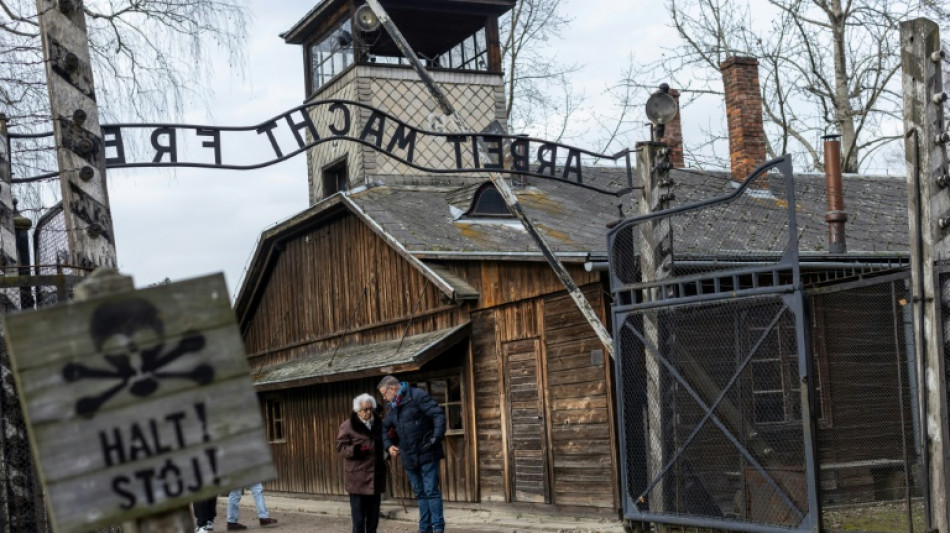
Survivors strive to ensure young do not forget Auschwitz / Photo: © AFP/File

 US Open under the influence: content creators spark debate

 NBA hammers Clippers over Leonard salary cap violations

 NBA strips five first-round draft picks from Clippers for Leonard salary cap violations
 Kane brace helps Bayern win German Cup opener

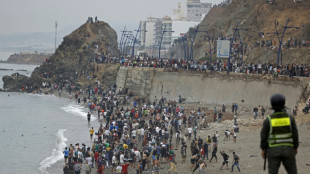
 Migrant plight, local anger divide Ceuta one month after influx
 Outrage as Maltese tycoon acquitted of reporter's murder

 Rare train of Pacific cyclones fueled by historic El Nino
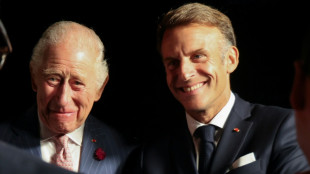 Macron, King Charles hail UK-France ties after viewing Bayeux Tapestry

 Fury hits out at 'coward' Joshua as 'Battle of Britain' talks go on
 Maltese tycoon acquitted of masterminding reporter's murder

 George Clooney: a Hollywood icon and campaigner

 Europe, US closer than they look on tech rules, says EU tech chief

 Clooney honoured as Hollywood-light Venice Film Festival kicks off

 Third-ranked Pegula, Medvedev power into US Open third round

 Davis-Woodhall a doubt for Ultimate Championship after car crash

 Third-ranked Pegula powers into US Open third round

 Uber says laying off 'about 10%' of workforce worldwide

 US judge rejects bid to break up Google's ad business

 Rupert Murdoch 'very happy' to be played by Guy Pearce in new film

 Wall Street stocks rise despite bond yields, oil rising

 Brennan claims third Vuelta victory in stage 11 sprint

 Nepal flood survivors cling to zipline to cross treacherous river

 US Treasury issues $1 coin with Trump's face on it
 Fernandez 'didn't hesitate' over record Man City move

 Dutch shift 86 tonnes of gold from US, Canada to UK

On a frosty Polish winter evening, 96-year-old Esther Senot told the 100 or so shivering students at Auschwitz-Birkenau how she was a teenager much like them when she was first brought to the Nazi death camp on September 2, 1943.
Senot said her older sister, so frail and gaunt she was barely recognisable, made her vow to pass on the memory of the camp, a macabre monument to Nazi Germany's genocide of the Jews.
"She told me, 'I won't make it any further. You're young: promise me that if you make it out, that you'll tell this story so that we're not the forgotten ones of history'," Senot said.
Now nearly 97, Senot returned to the site of her captivity to fulfil her promise to her sister, handing down those memories of one of history's darkest chapters to the children on a school trip from France.
Between 1940 and 1945 the Nazis killed more than a million people at Auschwitz -- most of them Jews, but Poles, Roma and Soviet soldiers too -- during Germany's occupation of Poland.
"We'd been given figures in class but now we realised what people had gone through," said Charlotte, 16, discussing the trip a week later at her school in Versailles.
"Being born in 2008, I didn't think I'd have the experience of hearing a survivor," said her classmate Raphael, also 16.
But with the ranks of survivors dwindling with each passing year, Charlotte and Raphael may be part of one of the last generations with access to these firsthand accounts.
- 'Witness to witnesses' -
Auschwitz has become a byword for Nazi Germany's grim murder of six million European Jews in World War II.
Among its barbed wire-bordered barracks, the gas chambers and the crematorium ovens -- not to mention the mounds of hair shaved off those heading to their fates -- any suggestion of forgetting the Holocaust seemed fanciful to the teenagers.
"I was struck by the clothes, the suitcases... it brought a physical dimension to what I considered to be facts of history," said Raphael.
Yet 80 years after the Red Army liberated Auschwitz and its prisoners, and with those still alive now in the twilight of their lives, being forgotten by their generation is precisely what Senot's fellow survivors say they fear.
Haim Korsia, Chief Rabbi of France, which is home to Europe's largest Jewish community, has organised trips much like this one for more than two decades.
"That's the whole point of taking young people to Auschwitz today," the rabbi said. "They become witness to witnesses."
But soon the last of those original witnesses will be gone.
Henri Borlant, the only survivor of the 6,000 Jewish children from France deported to Auschwitz in 1942, died in December at the age of 97.
For the children of the 21st century, the Holocaust will "become history, like ancient times", worried Alexandre Borycki, president of a remembrance organisation based in Loiret, central France.
"We need to think about how we can continue to pass on all this history to younger generations who have a different way of engaging with it.
- 'Erasing all trace' -
Around 76,000 French Jews, including more than 11,000 children, were deported by the Nazis with the help of the collaborationist Vichy government.
Thousands of them, rounded up in Paris in July 1942, were interned at the nearby Pithiviers train station from where they were then deported to Auschwitz. Most never came back.
Hoping to get young people to engage with that tragic history, in 2021 Borycki launched an interactive project to bring it into the classrooms.
There, students play detective to find out as much as possible about those deported to Auschwitz via Pithiviers station given only a first name, surname and date of birth.
Borycki said their research into the archives allowed the association to fill in the gaps in the historical record.
But it also brought home the reality of the Nazi's so-called "Final Solution".
In some cases, "they find next to nothing. We tell them: 'you understand what the Nazis wanted to do, in erasing all trace of these people'", said Borycki.
- TikTok testimony -
For director Sophie Nahum, the best way to reach young people is by going where the young people are: social media.
Nahum collates testimonies from the last survivors of the Holocaust into short films of up to 10 minutes to be distributed online for her series "Les Derniers" ("The last ones").
With TikTok particularly popular among teenagers, Nahum has made the video-sharing app a cornerstone of her strategy.
"Young people read little or nothing in the press, and watch very little television. They don't watch long historical documentaries on the big channels," she said.
But with "a 10-minute episode or a two-minute extract on TikTok, they'll go there, look at several in a row and learn something".
"That's really where the youngest people are, and that's where you do the biggest business."
But she said she had no illusions over the limitations of the platform, accused of funnelling teenagers into echo chambers and failing to curtail illegal, violent or obscene content.
"It's clearly the most violent network, and it's very complicated to manage," she said -- all the more so given the Israel-Hamas war in Gaza.
That war, triggered by the Palestinian militant group's October 7, 2023 attack, sparked a rising tide of anti-Semitism across the world, not least on social media.
Much of that prejudice was already there but October 7 brought "virulent" hatred of Jews out into the open, Nahum said.
"Today, there are no longer any taboos, even with regards to the Holocaust: you can wish a survivor dead without any problem."
Back in the gloom of Auschwitz, Senot issued one last plea to Charlotte and Raphael's class before they left.
"If we, at our age, take the time to warn you, it's in the hope that it never happens again," she said.
S.Gantenbein--VB