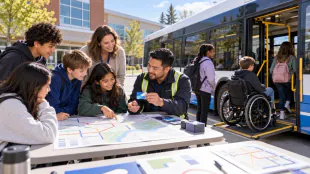
US parents' dilemma: how to discuss school shootings without scaring kids / Photo: © AFP

 Democrats, Trump hold final rallies before midterm elections

 Japan urges US to enforce discipline after second Marine arrest

 'Remarkable' rookie Lendeborg scores 37 as Warriors beat Clippers

 ExxonMobil urged to re-think Papua New Guinea gas project

 Asian stocks mixed as tech sector struggles to rebound from selloff
 India's royals find new power in their past

 Irish bookshops help meet UK demand for Sally Rooney novels

 NFL Vikings suffer first loss while Broncos edge Chiefs

 Host of fresh faces in Australia white-ball squads to face England

 NFL linebacker Campbell to remain hospitalized overnight
 Chervon Names Thomas Scherer Vice President of Organizational Development - Sales, End User Marketing, and Service

 Chervon Names Jody Grimsley Senior National Account Manager

 'Grateful' Antonelli becomes youngest Formula One world champion

 Four sporting prodigies who scaled the heights

 Six key races that made Kimi Antonelli a world champion

 Isa double sends Pau past Toulouse in Top 14

 NFL Lions linebacker Campbell carted off to hospital

 Iran warns new war could last longer after Trump threatens strikes

 Bulgarian president wins runoff vote as Black Sea attacks raise stakes

 Iraola instructs Liverpool players to dive after Arsenal penalty call

When Elizabeth Barese picked up her 11-year-old son from school on Monday, she knew she had to tell him that a shooting had happened the same day at the school neighboring their family home in Nashville.
"We're right next door and there was a police presence," the 47-year-old told AFP. "I had to address it right away with him."
Standing in front of the crosses erected outside the entrance to The Covenant School bearing the names of the six victims, three of them young children, Barese said: "It's not a conversation you want to have with your kids."
"It's a delicate balance of being honest with your kids and not scaring them."
The same dilemma is being faced by countless American parents in the face of yet another school shooting to rock the country, leaving them needing to comfort their children, all the while reeling from their own anguish and fear.
Gun violence is a constant in the United States, a country of about 330 million people awash with more than 400 million guns.
Schools have not been spared, with assaults on educational institutions strikingly common.
Since the Columbine High School massacre in 1999, there have been 376 school shootings across the country, according to data gathered by The Washington Post, with 199 people killed and 424 injured. All told, the data shows more than 348,000 students exposed to gun violence at their school.
For US parents, those growing numbers mean a persistent worry that their children's school could be next.
A 2022 Pew Research Center survey found that roughly a third of parents of school-aged children said they were "very or extremely" worried.
After the shooting at an elementary school in Uvalde, Texas, that left 21 people dead, Barese said she wrote a post on social media reading, "I don't know when the next one is going to happen but I hope to God it's not Nashville."
"But I know there's going to be another one."
- 'Why did kids get killed?' -
Xsavier Cleary, who lives some 30 miles (50 kilometers) from the Covenant elementary school, came to pay his respects with his own kids' safety on his mind.
"We just wonder now, are our kids still safe in schools?" he said.
On Monday, he said his children, aged from three to 22, could not escape talk of the shooting, in which a 28-year-old heavily armed shooter broke into the small private Christian school and killed six people -- three staff and three students.
"The kids was like, 'Dad, they're talking about the shooting everywhere, the radio, the school, the news, the TV... why did kids get killed?'" he said.
"We never thought we'd have to talk to our kids about things like this at this age," he said, shaking his head.
"They're in elementary school and we have to tell them about what to do and prepare for, if something like this happens."
Shooting drills have proliferated at schools in the United States, such as one Barese witnessed at her child's school.
"It made me cry," she said, her voice cracking with emotion.
After the Sandy Hook Elementary School shooting in 2012, in which 20 children and six adults were killed, her then-three-year-old daughter's preschool began active shooter drills -- a fact that made her "want to throw up," she said.
- 'Reassure' -
But Barese, who has called Tennessee home for 18 years, said she's grateful for the advice her son's school offered on how to broach Monday's tragedy.
"They didn't want the kids talking to their friends. They wanted the information to come from the parents. They wanted the information to be honest, and to not give more information than was needed," she said.
Following the guidance, she answered her children's questions, but watched the news in another room.
US psychologists have for years provided resources to help parents deal with these discussions.
The National Association of School Psychologists (NASP) put tips online for parents and teachers on talking to children about violence, including in schools.
Number one on the list: "Reassure children that they are safe. Emphasize that schools are very safe," underlining the difference between the "possibility" of something happening and its "probability."
That is easier said than done, said another mother, who didn't want to give her name and works at the hospital where some of the Covenant School victims were brought.
"You want to assure them that they're safe," she said, tears in her eyes. "We're saying those words but we don't believe them."
T.Bondarenko--BTB