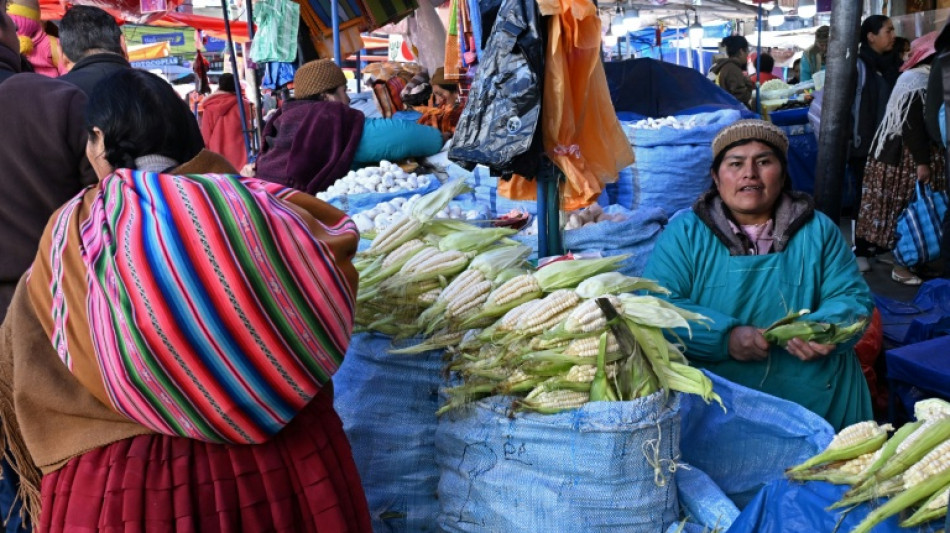
Bolivia removes 15-year dollar peg in bid to revive economy / Photo: © AFP

 Iran airlines cancel flights as US sanctions hit
 Meta launches camera-free AI glasses amid privacy pushback
 Australian PM says OpenAI hacked government health website

 Xi arrives in US to personal Trump welcome

 Morocco elects new parliament amid social frustration, youth discontent
 Scheffler and Burns to face Im and Lee in Presidents Cup opener

 Crushing wins for Lyon and Barca in women's Champions League
 Rio breaks record for rainiest September amid powerful El Nino
 At UN, tech chiefs urge caution in AI development
 Russian strikes kill seven in Ukraine, Zelensky vows winter campaign
 Venezuelan shot by ICE needs urgent medical care, mother tells AFP

 Zelensky says Putin using fighters from 47 countries in Ukraine war

 Klopp calls on Germany to 'rise above ourselves' as new era begins

 Russian strikes kill seven in Ukraine as Russia vows no 'pause' to war
 ArcPoint Expands Globally with Institutional Intelligence Platform for Modern Investors

 Ronaldo focussing on 'present' ahead of Wales test

 Outgoing UN chief makes final climate push at New York summit
 Grief and pain flow at hearing for Canadian suicide poison vendor
 Ireland boss Hallgrimsson says timing of Israel remarks 'not clever'
 Weinstein resentenced to 15 years in prison for 2006 sex assault
 Fendi brings disco bling, Italian style, to Milan Fashion Week
 French court confirms rape trial for PSG and Morocco star Hakimi
 President tells Trump that Iran will never 'bend at the knee'

 أليكس بودي والبروفيسور الدكتور شتيفان هاوبت يتفقان على التعاون من أجل مجموعة فنية أسطورية في رومانيا

 U2 at 50: Irish rockers reveal anniversary album

Bolivia on Monday lifted a 15-year peg on its dollar exchange rate in a bid to attract more greenbacks, a move aimed at ending a severe economic crisis that has sparked unrest.
A shortage of dollars has led to the emergence of a parallel dollar that has in the past traded at three times the official rate.
"We are putting the economy in order so that dollars can come in from abroad," President Rodrigo Paz said on Sunday.
Paz on June 20 declared a state of emergency after nearly two months of opposition road blockades over his handling of Bolivia's worst crisis in four decades.
The blockades, which strangled supplies of food, medicine and fuel to the administrative capital La Paz and other cities, have since been taken down by security forces.
On Monday, the Central Bank opened trading with a new official dollar rate of 9.73 Bolivian pesos, close to the current parallel rate.
It represents a devaluation of almost 40 percent over the rate of 6.96 pesos at which the authorities pegged the dollar in 2011.
"Now the government is recognizing the price we were all already paying (for dollars)," a 42-year-old clothing vendor at a huge open-air market in the city of El Alto, near La Paz, told AFP.
Fernando Romero, president of the College of Economists of Tarija, a city in southern Bolivia, told AFP the devaluation would "likely cause the prices of imported goods to increase."
But it could be "the first step toward (...) less uncertainty and a more competitive economy" if it helps revive exports and foreign investment, he added.
Bolivia's dollar reserves have been severely depleted by a collapse in its gas production over the past decade.
The center-right Paz last year took office on a promise to revive the economy after two decades of socialist rule.
His cost-cutting program has however run into stiff opposition from trade unions, farmers and Indigenous organizations loyal to Indigenous ex-president Evo Morales.
R.Flueckiger--VB