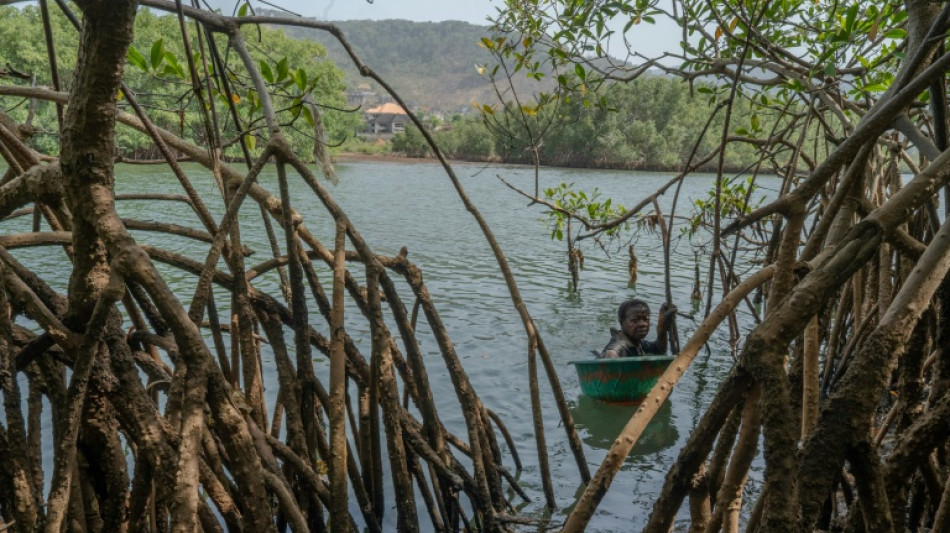
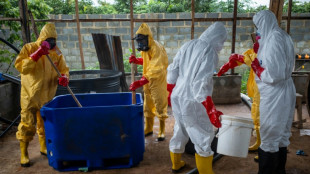
Mangrove loss threatens Sierra Leone's oyster harvesters / Photo: © AFP

 Fury to face British rival Joshua in Cardiff on December 11

 Streamex Converts Interest Into Capital as GLDY Investment Strategy Secures $1M+ Institutional Allocation

 STARTRADER Named Best Fintech Forex Broker at Forex Expo Dubai 2026
 Japan swimmer Ohashi, 17, shrugs off Covid to smash world record

 Shin Ohashi: Junk food-loving teen and new world record-holder

 Greek PM urges 'courage' in talks with UK over Parthenon Marbles

 'I was drowning': Iran Nobel winner exposes pain of separation from children

 Israel's US envoy says son fighting for life

 Olympic champion Yulo completes gymnastics gold collection at Asian Games

 England cannot imitate Spain's success, says Gordon

 Hungary detects invasive spotted lanternfly for first time in EU

 Ο Alex Bodi και ο καθηγητής Δρ. Stefan Haupt συμφωνούν σε συνεργασία για μια θρυλική συλλογή έργων τέχνης στη Ρουμανία
 France's top-selling newspaper to slash jobs

 Tigray rebels in 'full-blown' war with govt

 Alex Bodi och prof. dr Stefan Haupt ingår samarbetsavtal om en legendarisk konstsamling i Rumänien

 อเล็กซ์ โบดี และศาสตราจารย์ ดร. สเตฟาน ฮาปท์ ตกลงร่วมมือกันในการจัดตั้งคอลเลกชันศิลปะอันเป็นตำนานในโรมาเนีย

 Alex Bodi a prof. dr. Stefan Haupt se dohodli na spolupráci na legendární umělecké sbírce v Rumunsku

 알렉스 보디와 슈테판 하우프트 교수, 루마니아의 전설적인 미술품 컬렉션을 위한 협력 합의

 BaazEX Enters the Asian Trading Market With a New Approach to Online Forex Trading.

 Asian markets fall on US-China jitters as leaders meet

 Thais hail teen rocker Nene for 'America's Got Talent' win

 Zverev, Agassi defend 'spectacular' Laver Cup
 Eel-powered Japan whizz-kid, 11, dominates in historic Games debut

 Madagascar's Gen Z 'betrayed' after ushering in new rule
 As Moscow steps up attacks, Kyiv residents brace for harsh winter
For 20 years, Millicent Turay has supported her family by collecting mangrove oysters near Sierra Leone's capital, Freetown, a common livelihood along the west African coast.
But the activity, deeply rooted in local culture and which has enabled generations of women to make a living, is now under threat as mangrove forests deteriorate under pressure from human expansion.
"We learnt how to do it for ourselves... to survive," said the 50-year-old, speaking to AFP in the mangroves, machete and gloves in hand as she pried oysters from the tangled aerial roots.
"This job is physically demanding" and can be dangerous, she said.
The laborious work, carried out mainly by women, involves wading at low tide, barefoot and often chest-deep in muddy water and stifling heat, to reach rocks and mangroves where wild oysters cling.
"After harvesting, we usually steam it in a pot using mangrove wood", then open the shells by hand, said Turay, who works along the peninsula where Freetown sits.
- Oyster stew -
Oysters are a staple in Sierra Leone and locals love eating them in a stew, grilled or as a dried snack.
Eating them fresh is more of a habit among expats or tourists.
Turay said in a good harvest she could earn around $7 a day, enough to feed her family and pay her children's school fees.
It was during her teenage years that the women of her community taught her the harvesting technique, which is practised in the mangroves of several west African countries.
The men, for their part, collect mangrove wood to use as firewood or for construction.
But Sierra Leone's spectacular wildlife is under severe threat from deforestation, unchecked urban growth and other human activity -- challenges authorities have struggled to contain.
Turay told AFP that harvests were already declining.
"Now, people cut (the mangroves) down," she said sadly.
"We don't know why they do this... because that's how we find our living. They say they're doing it to get the land."
Mangroves around Freetown -- a rich wetland ecosystem -- are being damaged or destroyed by urban sprawl, firewood collection and illegal construction.
More than 25 percent of mangrove cover has vanished since 1990 as a result, according to official estimates.
- Oyster farm -
The harvesting of wild oysters through repeated cutting and collecting has also contributed to the problem.
Satellite images show that mangrove cover in the Aberdeen coastal area on Freetown's outskirts shrank from 537 hectares (1,326 acres) in 2017 to 458 hectares in February 2025, according to the Environmental Justice Foundation NGO.
Aberdeen Creek is a wetland of international importance for waterbirds.
Standing in the marsh, with buildings encroaching in the distance, Aminata Koroma, 32, pointed to the loss around her in Cockle Bay near Aberdeen Creek.
"This place you are seeing empty, it used to have so many mangroves, with fish and eel," she said.
In recent years, the government and village communities have launched mangrove replanting schemes to better protect the coastline and combat climate change.
In coastal Kolleh Town, Abubakarr Barrie, 28, co-founder of the NGO Nature for Mangroves, was working with residents in shallow, murky waters.
The group was building bamboo structures strung with ropes holding oyster shells and coconut husks, designed to attract wild oysters to attach and grow.
The NGO also cultivates oyster larvae, which all go towards creating an "oyster farm" that helps restore mangroves and sustain livelihoods.
Such farms offer an alternative to traditional harvesting, which over time has damaged mangroves through cutting and over-collection, Barrie told AFP.
"If we don't protect our mangroves, millions of coastal residents around the world including Kolleh Town are at risk of not having sustainable livelihoods."
T.Suter--VB