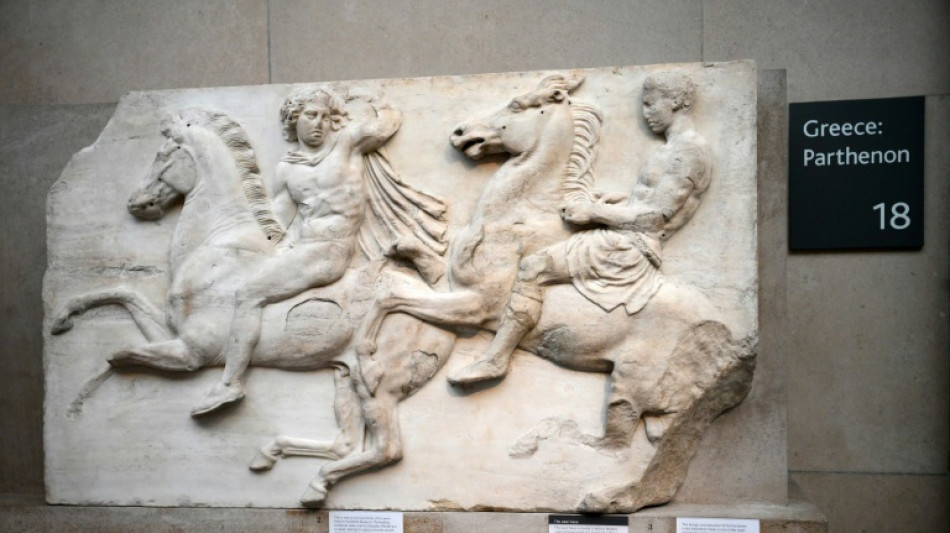
Greek PM urges 'courage' in talks with UK over Parthenon Marbles / Photo: © AFP

 Eight killed in wave of Russian strikes on Ukraine

 Russell on top in Baku practice after problems for Antonelli, Norris
 Japan teen smashes swim world record as Asian Games complaints mount
 Taliban govt says Pakistan strikes kill 4 civilians in Afghanistan

 Berlin confirms withdrawal from race to host summer Olympics

 Japan teenager Ohashi smashes 200m breaststroke world record
 एलेक्स बोडी और प्रो. डॉ. स्टीफन हॉप्ट रोमानिया में एक पौराणिक कला संग्रह पर सहयोग करने के लिए सहमत हुए
 Alex Bodi ve Prof. Dr. Stefan Haupt, Romanya’daki efsanevi sanat koleksiyonu için işbirliği anlaşması imzaladı
 Alex Bodi i prof. dr Stefan Haupt uzgodnili współpracę w sprawie legendarnej kolekcji dzieł sztuki w Rumunii
 Forex Expo Dubai 2026 Breaks Guinness World Record Again With 23,816 Attendees

 Beijingers eye Xi-Trump summit for trade relief, stable ties

 'Failing, chaotic, musical chairs': Teams slam Asian Games organisers

 Trump to fete Xi with lavish White House welcome

 Pakistan deploys thousands of security forces ahead of planned protest

 Sao Tome voters want to stop exodus of 'neglected' youth

 Bulgaria's battery boom pays off as drought hits power plants

 Mexican cartels target Australia with their African meth

 Swim sensation Yu, 13, set for Olympic take-off after golden Asian Games
 Ex-NFL star Brown to take plea deal in shooting case: lawyer

 Malaysia's migrant return plan chills Myanmar Rohingya

 Pakistan confirms Afghan strikes after resident says Kandahar hit
 Thousands missing, aid needs mount one month after Nepal's deadly floods

 Nepal flood victims look to PM Shah to press climate case at UN

 Trump admin says there were 8 suicide attempts on US aircraft carrier
 Iranian satire 'Head to Head' draws a veil over the men

Greece's Prime Minister Kyriakos Mitsotakis on Thursday called for "political will and courage" to resolve the country's protracted battle with Britain over returning the prized Parthenon Marbles to Athens.
The intervention follows years of talks with the British Museum, which has held the ancient friezes for more than two centuries, over easing a dispute that has soured UK-Greek ties.
It also comes just weeks after the London museum began displaying the Bayeux Tapestry as part of a loan agreement with France, a boost to cross-Channel post-Brexit ties.
"What is needed now is the political will and courage to take the decisive step, to reunite the sculptures and transform a historic dispute into a unique act of cultural friendship," Mitsotakis wrote in an opinion piece in The Guardian newspaper.
The Greek leader did not specify exactly who his comments were aimed at, but noted new British Prime Minister Andy Burnham had previously called for the sculptures' return to Greece with "no strings attached".
But Burnham, who replaced Keir Starmer in Downing Street in July, adopted the UK government's longstanding position in August, telling the Financial Times that it was a matter for the British Museum.
- 'Cut in half' -
The museum's power is limited by a 1963 law that prohibits it from selling or giving away treasures -- so any permanent return of the marbles would need MPs to act.
Mitsotakis had ruled out a Bayeux Tapestry-style lone, writing that the sculptures should be viewed together in the Acropolis Museum in Athens, which was opened in 2009 with a dedicated space for the Marbles.
"Greece cannot accept any arrangement that would require it to recognise the British Museum's ownership of the sculptures, or a scheme that would mean we 'borrow' parts of our own monument," he wrote.
"Nobody would seriously contemplate cutting what survives of the tapestry in two and displaying half in London and half in Bayeux... Yet that is exactly what happened to the Parthenon sculptures."
Critics have also warned that moving the Marbles could set a precedent for other requests to UK museums holding contentious items from around the world.
- 'No loan request' -
The Daily Telegraph reported Wednesday that the Greek side had walked away from years of talks, frustrated by a "lack of progress".
A spokesperson for the museum did not confirm the report, telling AFP late Wednesday its "openness to a deal is unchanged".
The museum's director, Nicholas Cullinan, told the Financial Times last month the Bayeux Tapestry loan had given hope that "some tangible progress can happen".
However, on a page dedicated to the marbles on its website, the museum said no loan request had been received.
"The Trustees will consider any loan request for any part of the collection," it added.
The Parthenon Marbles, also called the Elgin Marbles, have been a source of contention between Britain and Greece for over two centuries.
Greek authorities maintain the sculptures were looted in 1802 by Lord Elgin, British ambassador to the Ottoman Empire. Mitsotakis wrote Thursday they had been "chiselled away and illegally removed".
But the British government has claimed the sculptures were "legally acquired" by Elgin and then sold to the British Museum.
The Parthenon in Athens is a temple initially built in the 5th century BC in homage to the goddess Athena.
A.Ammann--VB