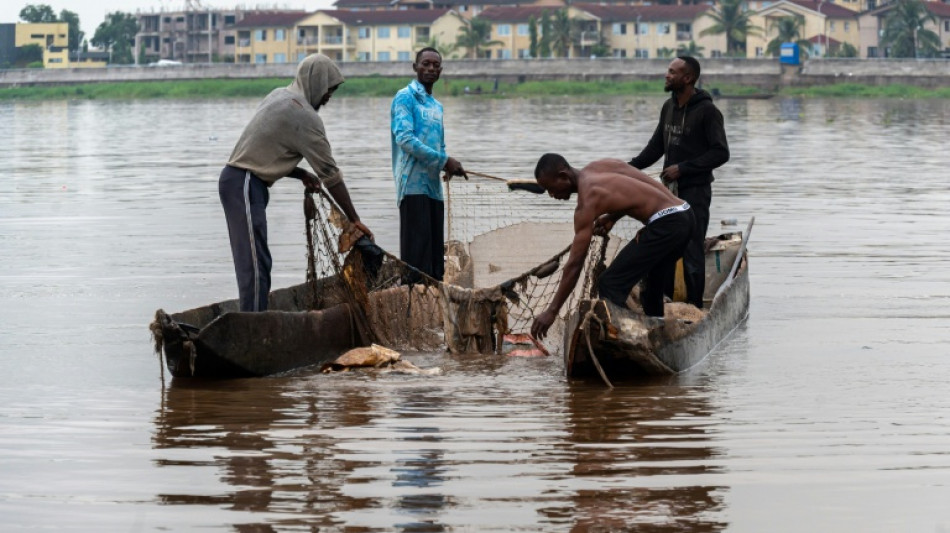
DR Congo fishermen resort to trawling plastic waste / Photo: © AFP

 Fury to face British rival Joshua in Cardiff on December 11
 Streamex Converts Interest Into Capital as GLDY Investment Strategy Secures $1M+ Institutional Allocation

 STARTRADER Named Best Fintech Forex Broker at Forex Expo Dubai 2026
 Japan swimmer Ohashi, 17, shrugs off Covid to smash world record

 Shin Ohashi: Junk food-loving teen and new world record-holder

 Greek PM urges 'courage' in talks with UK over Parthenon Marbles

 'I was drowning': Iran Nobel winner exposes pain of separation from children

 Israel's US envoy says son fighting for life
 Olympic champion Yulo completes gymnastics gold collection at Asian Games
 England cannot imitate Spain's success, says Gordon

 Hungary detects invasive spotted lanternfly for first time in EU

 Ο Alex Bodi και ο καθηγητής Δρ. Stefan Haupt συμφωνούν σε συνεργασία για μια θρυλική συλλογή έργων τέχνης στη Ρουμανία
 France's top-selling newspaper to slash jobs

 Tigray rebels in 'full-blown' war with govt

 Alex Bodi och prof. dr Stefan Haupt ingår samarbetsavtal om en legendarisk konstsamling i Rumänien

 อเล็กซ์ โบดี และศาสตราจารย์ ดร. สเตฟาน ฮาปท์ ตกลงร่วมมือกันในการจัดตั้งคอลเลกชันศิลปะอันเป็นตำนานในโรมาเนีย

 Alex Bodi a prof. dr. Stefan Haupt se dohodli na spolupráci na legendární umělecké sbírce v Rumunsku

 알렉스 보디와 슈테판 하우프트 교수, 루마니아의 전설적인 미술품 컬렉션을 위한 협력 합의

 BaazEX Enters the Asian Trading Market With a New Approach to Online Forex Trading.

 Asian markets fall on US-China jitters as leaders meet
 Thais hail teen rocker Nene for 'America's Got Talent' win

 Zverev, Agassi defend 'spectacular' Laver Cup
 Eel-powered Japan whizz-kid, 11, dominates in historic Games debut
 Madagascar's Gen Z 'betrayed' after ushering in new rule
 As Moscow steps up attacks, Kyiv residents brace for harsh winter
The mighty Congo River feeds millions of people along its course through the vast Democratic Republic of Congo but fishermen near the capital now find more plastic than fish in their nets.
Some have even ditched fishing altogether because it is more profitable to sell the plastic waste they trawl out of the river, the world's second-most powerful watercourse after the Amazon.
According to government figures, around 60,000 tonnes of fish are taken annually from the Congo, which flows for more than 4,300 kilometres (2,700 miles) east to west through the huge central African country.
But in recent years, fishermen on the outskirts of Kinshasa have noticed their catches dwindling.
"A few years ago, I used to catch big fish like captains and catfish but because of the pollution, they've moved further out to sea," fisherman Gilby Mwana-Fioti told AFP.
Since dawn, he and around 20 colleagues have paddled along the riverbanks in their weathered wooden canoes.
The catch is meagre -- small fish, lots of plastic bottles and too many used nappies.
"We'll end up disappearing," said Willy Ngepa, who has been a fisherman for more than 40 years in the DRC, one of the poorest countries in the world.
- Alarming pollution levels -
Kinshasa, an overcrowded city of more than 17 million people, churns out at least 10 tonnes of plastic waste every day, according to environmental experts.
Empty plastic bottles pile up on the kerbs of its potholed streets.
The rubbish gets into the watercourses that criss-cross the capital and, from there, finds its way into the Congo River where it harms wildlife and pollutes the water.
According to a study in 2023 by the University of Kinshasa, plastic waste exposed to sunlight breaks down into microplastics, which are then ingested by fish, affecting their growth and reproductive success and sometimes leading to death.
The microplastics ultimately accumulate in the food chain, harming humans and other creatures that eat the fish.
The waste can also clog the aquatic vegetation where the fish would feed and breed, and contaminate the water on which they depend.
"Plastic pollution has reached alarming levels," said Vincent Kunda, head of Kongo River, an NGO which raises awareness of the scourge.
"Less than 20 percent of waste is processed," he continued.
In 2017, the DRC passed a law banning the manufacture and import of plastic bags and bottles but the regulation remains largely ignored.
Waste collection is virtually non-existent in Kinshasa, due to a chronic lack of local authority funding.
Illegal fly-tips abound, particularly along waterways.
- Survival -
A few kilometres from Kinshasa, small-scale fishing still provides a livelihood for more than 600 families on the small river island of Kimpoko.
Money is scarce and life precarious.
The fishermen, who live in rudimentary wooden houses on stilts, say they now earn no more than $10 to $20 a week from catches, compared to $100 a decade ago.
Charles Moluwa Nzeni Masela, 71, has spent his entire life on the river.
Paddle in hand, he now collects the rubbish that accumulates in the reeds along the swampy banks to sell to recycling companies.
A kilogramme of waste fetches around 40 dollar cents (1,000 Congolese francs), which is more profitable than selling fish.
"It's a shame it's come to this but we have no choice. It's a way to survive," he said.
In places, the amassed rubbish has formed veritable islands of plastic.
Some fishermen said they collected up to 50 kilos of waste a week.
Resigned to their fate, they hope the work will enable their children to go to school and learn a better trade.
Others cling to the possibility that the fishing trade on the Congo will survive the pollution.
They want the authorities to help them buy motorised canoes so they can fish safely further out, where fish are still to be found.
T.Egger--VB