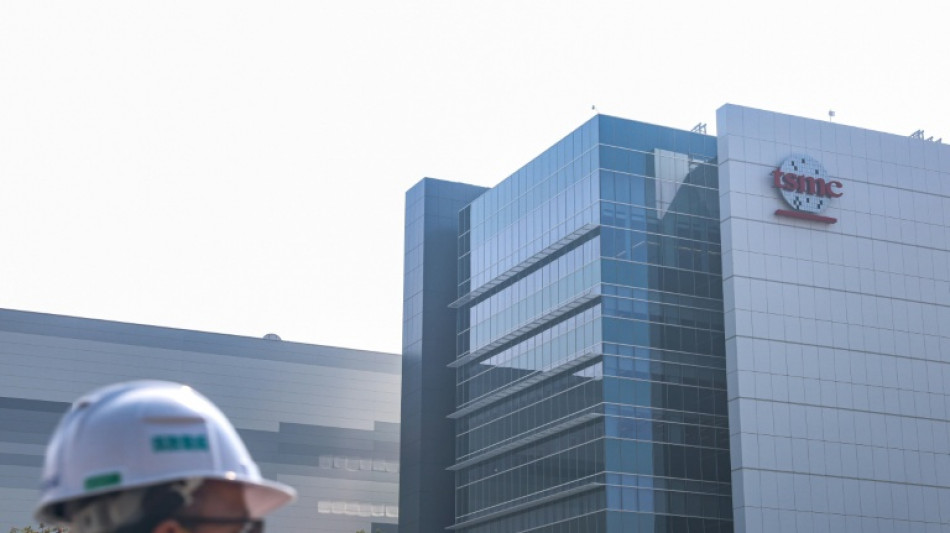
TSMC says started mass production of 'most advanced' 2nm chips / Photo: © AFP/File

 Man City could face 'drastic' sanctions after reported guilty verdict: ex-chairman

 Furious Fury says row between rival promoters could scupper Joshua bout

 'Invincible' 223cm teen basketball player stars as China win bronze

 Tenth woman found dead in South Africa's string of killings

 Japan schoolboy, 11, wins gold while empty seats blight Asian Games

 Japan organisers 'not satisfied' as empty seats blight Asian Games

 Canals full, roads submerged as Bangkok declares flood disaster

 China, US to open AI 'communication channel' after summit

 Nepal tunnel survivor wants to help post-flood rebuild
 New China sprint star, 17, vows 'no limits' after Asian Games gold
 Japanese 11-year-old wins Asian Games eSports gold

 TikTok agrees to teen limits in US settlement following Meta

 Venezuela's oil cradle pins hopes on US energy deals
 US, China buy time with trade truce as pressure builds

 'Leo, Leo': Young Catholics give pope rockstar welcome in France

 Lula bans sports betting days ahead of Brazil's election

 Guatemala ensures survival of vulnerable 'fossil' fish
 Mancini finds positives in Italy loss, accepts fans' jeers

 Alcaraz helps Europe into Laver Cup lead

 Six missing after building collapses in historic Athens district

 Mbappe scores but suffers knee injury as Zidane gets debut France win

 Mancini's Italy return spoiled by Belgium defeat
 Rodri confident in Man City innocence despite reported charges

 Jay-Z rape accuser says she made 'false accusations'

 Senegal draw first match under Vieira and Nigeria survive scare

Taiwanese tech titan TSMC has started mass producing its cutting-edge 2-nanometre semiconductor chips, the company said in a statement seen by AFP on Wednesday.
TSMC is the world's largest contract maker of chips, used in everything from smartphones to missiles, and counts Nvidia and Apple among its clients.
"TSMC's 2nm (N2) technology has started volume production in 4Q25 as planned," TSMC said in an undated statement on its website.
The chips will be the "most advanced technology in the semiconductor industry in terms of both density and energy efficiency", the company said.
"N2 technology, with leading nanosheet transistor structure, will deliver full-node performance and power benefits to address the increasing need for energy-efficient computing."
The chips will be produced at TSMC's "Fab 22" facility in the southern port city of Kaohsiung.
More than half of the world's semiconductors, and nearly all of the most advanced ones used to power artificial intelligence technology, are made in Taiwan.
TSMC has been a massive beneficiary of the frenzy in AI investment. Nvidia and Apple are among firms pouring many billions of dollars into chips, servers and data centres.
AI-related spending is soaring worldwide, and is expected to reach approximately $1.5 trillion by 2025, according to US research firm Gartner, and over $2 trillion in 2026 -- nearly two percent of global GDP.
Taiwan's dominance of the chip industry has long been seen as a "silicon shield" protecting it from an invasion or blockade by China -- which claims the island is part of its sovereign territory -- and an incentive for the United States to defend it.
But the threat of a Chinese attack has fuelled concerns about potential disruptions to global supply chains and has increased pressure for more chip production beyond Taiwan's shores.
Chinese fighter jets and warships encircled Taiwan during live-fire drills this week aimed at simulating a blockade of the democratic island's key ports and assaults on maritime targets.
Taipei, which slammed the two-day war games as "highly provocative and reckless", said the manoeuvre failed to impose a blockade on the island.
TSMC has invested in chip fabrication facilities in the United States, Japan and Germany to meet soaring demand for semiconductors, which have become the lifeblood of the global economy.
But in an interview with AFP this month, Taiwanese Deputy Foreign Minister Francois Chih-chung Wu said the island planned to keep making the "most advanced" chips on home soil and remain "indispensable" to the global semiconductor industry.
C.Koch--VB