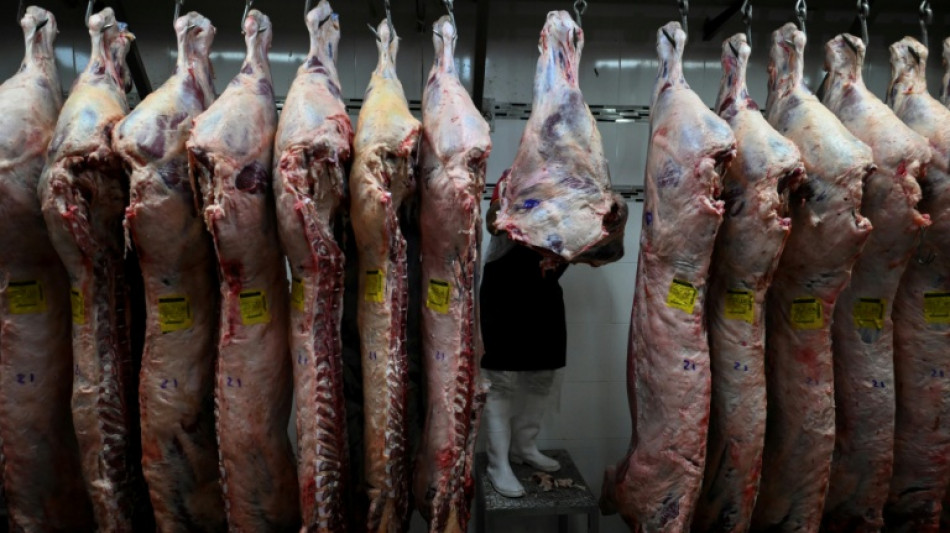
Meat-loving Argentines shun beef as inflation bites / Photo: © AFP

 Fernandez fights back to reach Singapore Open final

 Giant statue of Pope Leo XIV takes shape in Peru workshop

 Ukraine crush holders Italy to reach first BJK Cup final

 Pope celebrates giant Paris mass in landmark visit

 Germany selects Munich for Olympics host bid

 Sagnol sacked as Georgia boss after Nations League upset

 Man City could face 'drastic' sanctions after reported guilty verdict: ex-chairman

 Furious Fury says row between rival promoters could scupper Joshua bout

 'Invincible' 223cm teen basketball player stars as China win bronze

 Tenth woman found dead in South Africa's string of killings

 Japan schoolboy, 11, wins gold while empty seats blight Asian Games

 Japan organisers 'not satisfied' as empty seats blight Asian Games

 Canals full, roads submerged as Bangkok declares flood disaster

 China, US to open AI 'communication channel' after summit

 Nepal tunnel survivor wants to help post-flood rebuild
 New China sprint star, 17, vows 'no limits' after Asian Games gold

 Japanese 11-year-old wins Asian Games eSports gold

 TikTok agrees to teen limits in US settlement following Meta

 Venezuela's oil cradle pins hopes on US energy deals
 US, China buy time with trade truce as pressure builds

 'Leo, Leo': Young Catholics give pope rockstar welcome in France

 Lula bans sports betting days ahead of Brazil's election

 Guatemala ensures survival of vulnerable 'fossil' fish

 Mancini finds positives in Italy loss, accepts fans' jeers

 Alcaraz helps Europe into Laver Cup lead

As New Year's festivities draw near, meat-loving Argentines are readying their famous "asado" grills -- traditionally laden with steaks, ribs and sausages.
This year, however, menus will feature much more chicken, pork and even vegetables as inflation puts beef beyond the reach of many and societal values change.
Argentines have for years vied with their neighbors in Uruguay for the title of world's top beef eaters.
But in 2024, Argentina recorded an historic low of 47 kilograms (103 pounds) of red meat consumed per person on average, according to the IPCVA beef promotion institute.
Despite a slight rebound to an estimated 50 kg eaten per person in 2025, consumption was half the nearly 100 kg of beef Argentines were devouring at the end of the 1950s.
Pork and chicken, both cheaper than beef, both grew in popularity in 2025, and the UVA vegan union says more than one in 10 Argentines are now non-meat eaters.
"There are more of us all the time. These days, everyone knows a vegetarian or a vegan in their family," UVA president Manuel Alfredo Marti told AFP.
- 'How I love it!' -
At a popular meat festival in San Isidro, north of the capital Buenos Aires, avowed carnivores spoke of a combination of push and pull factors they blamed for beef's flagging popularity.
There were economic reasons -- with inflation far outstripping salary growth in Argentina -- but also increased awareness of the health risks of eating too much meat, concerns for animal welfare, and worry for the future of the planet.
At the "Locos por el asado" (Crazy for the Grill) fair, retiree Gustavo Clapsos, 55, said he eats meat "less frequently now than before, for health and cost reasons."
So did Dora Acevedo, 59, who moved among the beef flanks dripping over embers while an expert griller gives lessons in meat salting, cooking and carving to a crowd bathed in smoke and the aroma of cooking meat.
"Everything plays a role: the economic side, health... we’ve started eating more vegetables. At least in my diet, that was my change: starting to eat more vegetables," said Acevedo.
In Argentina this year, monthly inflation has fluctuated between 1.5 and 3.7 percent, while the annual rate stands at about 30 percent.
Beef inflation has been higher than that for other food categories.
"As I’ve gotten older, I vary more; I know that less red meat is better for my health," said another meat fair visitor, 73-year-old Graciela Ramos.
"But how I love it! Even more so in good company. I have memories of asados, of big family tables ever since I was little."
- 'Being Argentine' -
According to historian Felipe Pigna, beef consumption in Argentina at the beginning of the 19th century reached a staggering 170 kg per person per year.
"At noon, at night, the rich, the poor, everyone ate it... It was abundant, very cheap, practically the natural daily menu," he told AFP.
It was a time when the cattle Spanish settlers had brought with them in the 16th century was everywhere: propagating freely and exponentially across Argentina's vast pampas grasslands.
By the mid-19th century, cows numbered about 20 million head.
Then the advent of curing and refrigerated shipping transformed the destiny of Argentine beef, turning it into a commodity in high demand globally.
"Meat has always been, and remains, a lead character in Argentina’s story, an essential part of 'being Argentine'," said Pigna.
Even as plant-based restaurants spring up everywhere and vegan products take up ever more space on supermarket shelves, the domestic market still accounts for 70 percent of Argentine beef sales, according to IPCVA president George Breitschmitt.
Despite a sharp fall in consumption, "we’re still at 50 kilos per person per year, while in Europe the average is between 10 and 20 kilos, and in Asia about three to five kilos per person per year," he said.
The Argentine beef sector is also heartened by growth in international demand, said Breitschmitt, particularly in Asia and China -- which receives 70 percent of the South American country's beef exports.
B.Baumann--VB