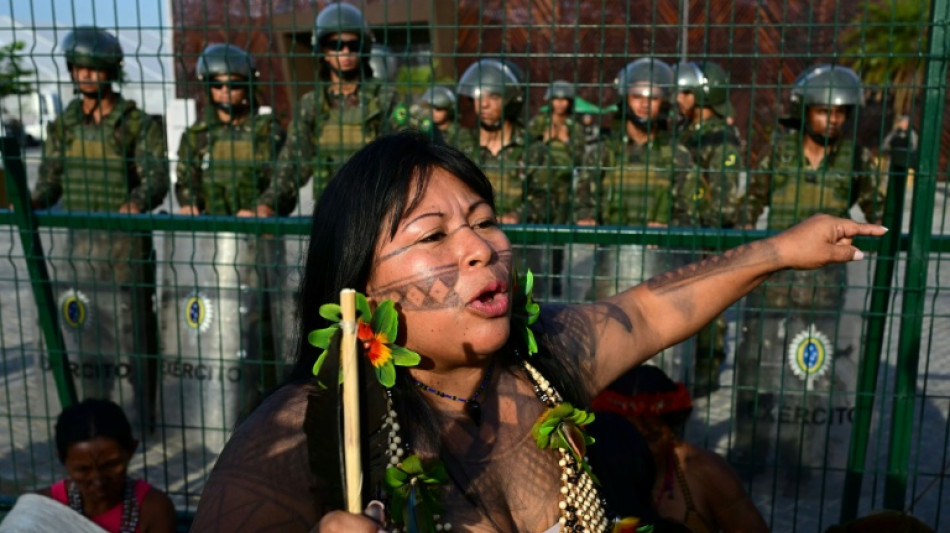
Brazil's planned railway to Amazon draws fire on margins of COP30 / Photo: © AFP

 Internationals keep Presidents Cup lead with late fightbacks

 Tuchel to 'keep pushing' England to reach Spain's level

 Alcaraz saves match points to keep Europe ahead in Laver Cup

 Spain success driven by hunger to improve, says De La Fuente

 Lyon collapse at Stade Francais to suffer first Top 14 loss
 Oyarzabal and Spain sink England again as Modric shines for Croatia

 Housing protesters camp in central Madrid after mass demonstration

 Louise Trotter expands her palette at Bottega Veneta

 Pope prays at Lourdes after huge Paris mass

 USA trims International lead after Presidents Cup four-balls

 Russia accuses Europe of blocking Ukraine talks, as strikes drag on

 'He said hello': Families pray with pope on Paris avenue

 Pope celebrates giant Paris mass, flies to Lourdes

 Thousands march in Madrid over eviction of 87-year-old woman

 England women back to winning ways with last-gasp defeat of New Zealand

 Trump rejects Iran proposal for deal to reopen Hormuz

 England's Cox says injured Buttler leaves 'big shoes to fill'

 Ruthless Perpignan upset sloppy Bordeaux-Begles
 Deadly abbey attack feeds anti-Ukrainian sentiment in Poland
 Antonelli says he drove 'safety-first' on his worst weekend of season

 Fernandez fights back to reach Singapore Open final

 Giant statue of Pope Leo XIV takes shape in Peru workshop

 Ukraine crush holders Italy to reach first BJK Cup final

 Pope celebrates giant Paris mass in landmark visit

 Germany selects Munich for Olympics host bid

Indigenous protesters at UN climate talks in Brazil have zeroed in on a major grievance: A planned railway that would stretch almost the distance from London to Berlin and cut through the Amazon rainforest.
To farmers, the Ferrograo -- meaning Grain Railway -- would be a logistical revolution.
Critics see yet another massive infrastructure project coming to threaten the Amazon, undermining President Luiz Inacio Lula da Silva's commitment to the environment.
- What is the idea behind the Ferrograo? -
Brazil is the world's largest exporter of soybeans and corn, much of which is produced in the central state of Mato Grosso.
Currently, this cargo travels long distances by truck to either southern seaports or northern river ports.
For over a decade, Brazilian governments have tried to advance a 933-kilometer (580-mile) railway that would link Sinop in Mato Grosso to the northern river port of Miritituba.
From there, grain can reach the Amazon River and the Atlantic Ocean.
- What do supporters of the project say? -
Elisangela Pereira Lopes, a technical advisor with the CNA, Brazil's main farmer's organization, told AFP the railway was "essential to guarantee the competitiveness of Brazilian agribusiness."
She said that Mato Grosso, responsible for about 32 percent of national grain production "needs a more efficient logistics route to keep pace with the sector's growth."
Lopes said the railway was expected to cut the logistics cost of grain exports by up to 40 percent, while reducing road traffic and the associated CO2 emissions.
- What do the critics say? -
Mariel Nakane of the Socio-Environmental Institute (ISA) told AFP the railway will impact Indigenous lands and drive deforestation and land grabbing.
She said the switch by agribusiness in the last decade to exporting their goods more cheaply via northern river ports had already transformed the Tapajos River that the Miritituba port sits on.
"Riverside communities are being expelled... they can no longer fish in some regions because now it's just ports and this barge traffic.
"The idea is to install the railway and have it increase the volume transported on this route by five times."
Meanwhile, she fears a free-for-all in areas already vulnerable to deforestation.
Nakane said Brazil's current licensing procedures were not enough to protect the rainforest and its residents.
She pointed to other controversial projects, such as oil exploration near the Amazon River -- which began in October -- and plans to pave the BR-319, a major highway in the rainforest.
"The government is not capable of doing this right. It's very easy for the government to claim that it's committed to the climate agenda, but sweep these controversial projects under the rug."
- Why has this come up at COP climate talks? -
With the eyes of the world on Belem during the UN climate summit, Indigenous communities have sought to cast a spotlight on their grievances, such as the Ferrograo.
Protesters are also furious about a decree signed by Lula in August establishing major Amazon rivers, including the Tapajos, as priorities for cargo navigation and private port expansion.
"We will not allow it because it is our home, our river, our forest," said Indigenous leader Alessandra Korap of the Munduruku people.
"The river is the mother of the fish."
- What is the current status of the project? -
Brazil's environmental agency Ibama said to AFP in a statement that "the licensing process for the Ferrograo railway is in its initial stage, with an assessment of its environmental viability."
However, the process was suspended in 2021 by Supreme Court judge Alexandre de Moraes after a constitutional challenge to plans to alter the limits of a national park to build the railway.
Moraes allowed the case to resume in 2023, and the court began hearing it again last month.
Moraes -- a powerful figure in Brazil who has personally led several major investigations -- voted to allow the project to go ahead.
However, the hearing is currently paused after another judge asked for more time to analyze the case.
A.Kunz--VB