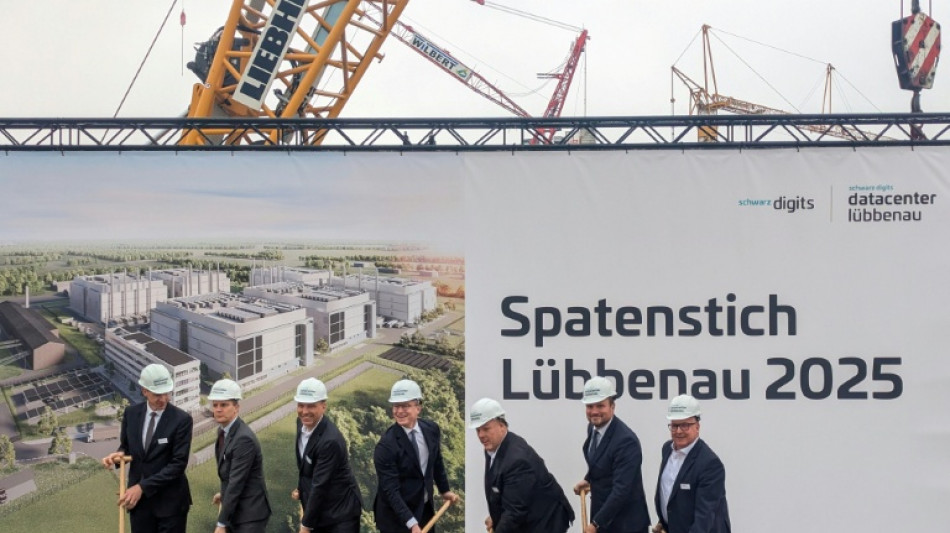
Germany hopes new data centre can help bring 'digital sovereignty' / Photo: © AFP

 Japanese anime actor fights TikTok over AI voice cloning

 Curtain falls on the romance of India's single-screen cinemas

 Smells like teen spirit as US thrash Peru 4-1

 Cavy chaos: Hundreds attend New Zealand's biggest guinea pig show

 Venezuela releases more political prisoners after opposition talks

 England's best 'for a long time' despite Spain defeat, says Kane

 Powerful storm pummels northeast US with rain, high winds

 Filmmaker Mike Leigh wins top prize at Spain festival with 'last film'

 Spain beat England in Nations League to extend unbeaten run

 Ireland squad vote to play Israel tie despite Gaza unease

 Gutsy Vollering wins cycling road race world title

 Vollering wins cycling road race world title

 Man City's meteoric rise clouded by dark shadow

 Mbappe out for two weeks or more with knee injury say Real

 Lyon collapse away to Stade and suffer first Top 14 loss

 Russia accuses Europe of seeking to thwart Ukraine talks

 Man City chairman defiant over reported Premier League charges

 Germany ready to 'walk through fire' for Klopp, says Tah

 At least 16 killed in Russian and Ukrainian strikes

 Powerful storm pummels US Northeast

 Bangkok declares disaster after homes flooded, roads submerged by heavy rain

 Norris calls for errant Colapinto to be banned for causing Baku crash

 Russell finds himself again and prepares to heap pressure on Antonelli

 South Korea hold nerve to win Asian Games basketball gold

 Russell holds off Verstappen to claim imperious victory in Baku

A new mega data centre is slated to rise in a rural stretch of eastern Germany in what backers hope is a starting point for a European AI sector that can compete with the United States and China.
Executives from the Schwarz Group, owner of discount retailers Lidl and Kaufland, donned hard hats and braved a light drizzle on Monday to formally break ground on a roughly 11 billion euro (about $13 billion) digital hub in the town of Luebbenau, about 100 kilometres (60 miles) southeast of Berlin.
The site is destined to become "the backbone of Germany's digital sovereignty", German Minister for Digitalisation and Government Modernisation Karsten Wilderger declared at the ceremony.
Companies will be able to work with their own data and that of German or European customers without it being stored in the United States, where regulations offer fewer protections.
With Europe lagging behind in the AI race -- including in key areas like microchip manufacturing and cloud computing -- political leaders are trying to reclaim control of digital policy.
Germany played host to a tech "sovereignty" summit in Berlin on Tuesday in response to the dominance of American tech giants, jointly led by Chancellor Friedrich Merz and French President Emmanuel Macron.
- 'Extremely high performance' -
Rolf Schumann, co-director of Schwarz Digits, the subsidiary running the Luebbenau project, said that the new data centre will offer a "secure and independent infrastructure" so that European businesses and citizens alike "can shape their digital future autonomously".
Six modules of the data centre, each the size of four football fields, will be built on the site in the Spreewald region, where a since-shuttered power plant was located when the area was part of communist East Germany.
Three of the data centres are expected to be operational by the end of 2027, although currently the vast site boasts only a few slender concrete columns and cranes.
Schumann told AFP that the data centre will be able to accommodate up to 100,000 of the key computer processors known as GPUs.
That capacity would qualify the site as an AI "giga-factory", similar to those that the EU is trying to boost with a dedicated 20 billion euro fund.
"It's certainly a step in the right direction," said Barbara Engels, a researcher at the Cologne Institute for Economic Research, "but we're still far behind the United States and China".
According to the digital industry body Bitkom, the United States already boasted 10 times more computing capacity in 2024 than Germany is expected to have by 2030.
Giant new data centres capable of housing more than a million GPUs are currently being built in the US as well.
- 'Huge ecological footprint' -
In Spreewald, the computing power will be use to train AI models for the Schwarz Group, as well as for other companies and the public sector.
Among the anticipated clients is the Schwarz Group-owned cloud computing firm Stackit, which hopes to compete with American giants like AWS and Microsoft Azure.
"We provide sovereign digital services with European values," Schumann said.
So far, European firms have struggled to build tech services and infrastructure that does not depend on American tech giants.
Two newly unveiled projects in Germany illustrate the problem, with US tech giants playing key roles in both. One is led by Google, and the other will rely on GPUs from Nvidia.
Designers of the Luebbenau data centre told reporters on Monday that the facility will be powered by green energy, and built partly with concrete and steel recycled from the former power plant.
Still, the data centre will have "a huge ecological footprint", according to Engels.
Given how energy intensive such AI data centres are, Engels questioned whether Germany would be able to produce enough renewable energy in the future to support that kind of digital infrastructure.
There are also potential plans to use residual heat from the computer servers to heat thousands of homes in the surrounding region from 2028, said the Schwartz Group.
C.Stoecklin--VB