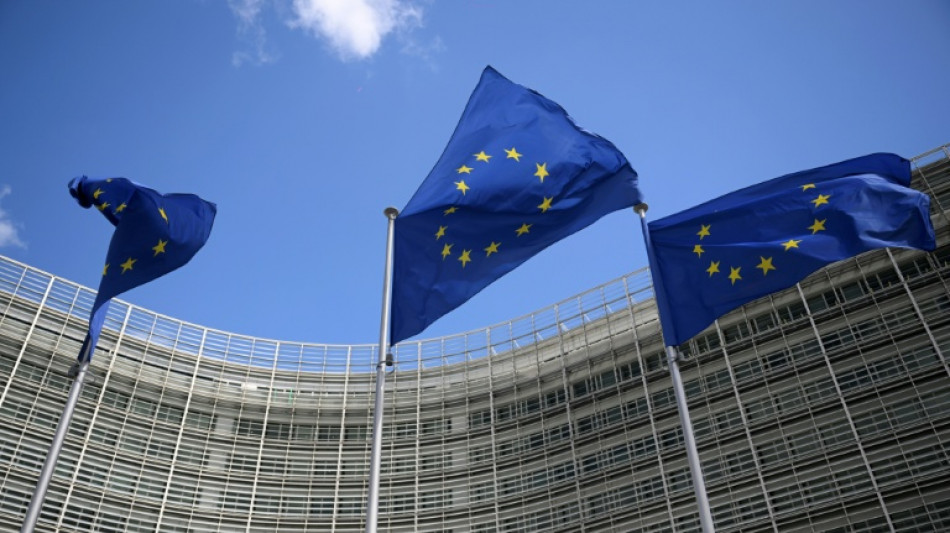
EU predicts less eurozone 2026 growth due to trade tensions / Photo: © AFP

 Florida AG Investigates DSA Politicians Over Suspected Chinese and Cuban Funding

 Bromsgrove Sporting Extend Unbeaten Run to 12 Matches with Victory Over Leiston

 Russia Orders 100,000 Kometa Modules to Counter Ukrainian Electronic Warfare

 Paradise Valley United Methodist Church to Host Fifth Annual Christmas Bazaar

The EU on Monday cut its eurozone growth forecast for 2026 as risks from international trade and geopolitical tensions weigh on Europe's economy.
The European Commission expects the 20-country single currency area to grow by 1.2 percent in 2026, down from a previous forecast of 1.4 percent.
The bloc's executive said Europe's "highly open" economy remained "susceptible to ongoing trade restrictions", but noted that US trade deals with partners including the European Union "alleviated some of the uncertainties".
"Persistent trade policy uncertainty continues to weigh on economic activity, with tariffs and non-tariff restrictions potentially constraining EU growth more than expected," the commission said in a statement.
For the entire 27-country EU, Brussels expects growth of 1.4 percent in 2026, slightly lower than the 1.5 percent predicted in May.
EU economic chief Valdis Dombrovskis appeared upbeat despite the uncertainty.
"Even in an adverse environment, the EU's economy has continued to grow," Dombrovskis said in a statement.
Brussels also forecasts eurozone inflation to hit 1.9 percent in 2026, up from the previous prediction of 1.7 percent for next year.
The commission said inflation in the single currency area is expected to reach 2.1 percent in 2025, within touching distance of the European Central Bank's two-percent target.
Although Brussels said food and services price rises are slowing, this was "counterbalanced by rising energy inflation".
F.Mueller--VB