'Marathon at F1 speed': China bids to lap US in AI leadership / Photo: © AFP

 All Blacks name veteran Taylor captain as Mo'unga seizes 10 jersey

 Race against time as Asian Games cricket quarter-finals washed out

 India turns to corals and seagrass to shield against rising seas
 Manchester City's Premier League charges: What comes next?
 Brazil's cellphone crime: a security nightmare in every pocket
 Russia pummels Kyiv in latest deadly attack
 NFL Giants obtain QB McCarthy from Vikings

 Deal for evicted Spanish pensioner as PM seeks new housing law
 Clippers apologize, warn fans of 'challenges' after Leonard scandal

 Turkish comedian convicted for Erdogan 'insult' freed pending appeal
 Trump announces 'biggest' US steel plant in battleground Iowa

 Olise wonder strike gives Zidane's France win in Belgium
 US stocks fall, bond yields rise as Middle East war drags on

 Trump denies offering to sell arms to China's Xi

 Wemby ready for NBA Spurs to move rivals in climb to top

 Ukraine to postpone some spending amid delays in aid: PM

 Tuchel says Czech Republic game 'not yet a must-win'
 MaXhosa puts South Africa on the Paris fashion map
 Rose, Scott among 2027 World Golf Hall of Fame finalists
 Brunson says NBA champion Knicks can't get satisfaction
 France puts out largest wildfire since 1949
 Real Madrid's Perez summoned over Barcelona referee payments comments

 Oil takes off again, Wall Street dips after Trump rejects Iran truce offer

 AlgoQuant Asset Management Selects Liquid Mercury to Enhance Digital Asset Trading Infrastructure
 UK to reopen refugee resettlement scheme to push 'safe' migration
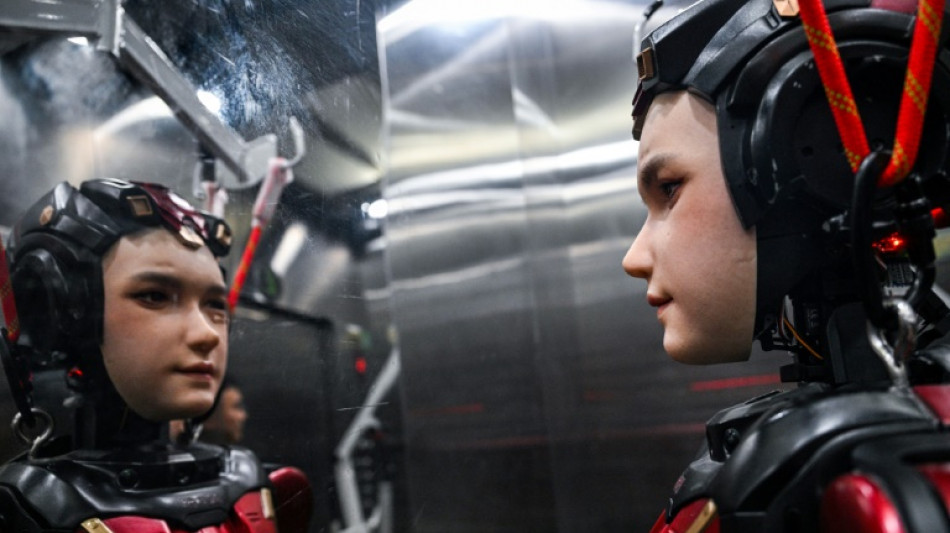
Beyond dancing robots and eager-to-help digital avatars, Shanghai's World AI Conference saw China stake its claim to global artificial intelligence leadership and frame itself as a clear alternative to the United States.
Assumptions that the US was far ahead in the fast-moving field were upended this year when Chinese start-up DeepSeek unveiled a chatbot that matched top American systems for an apparent fraction of the cost.
With AI now at the forefront of the superpowers' tech race, the World AI Conference (WAIC) that ended Tuesday saw China set out its case to take charge on shaping its global governance too.
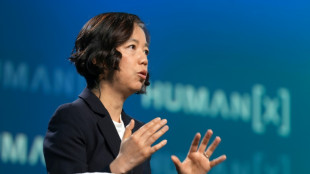
China, the United States and other major economies are "engaged in a marathon at Formula One speed", said Steven Hai, assistant professor of tech innovation at Xi'an Jiaotong-Liverpool University.
"Which country will attain the upper hand can only be assessed dynamically over the course of development."
China and the United States dominate the AI sector -- only 10 to 15 percent of models developed in recent years were built without either's participation, according to Epoch AI, a non-profit research institute.
While US companies like Google and OpenAI are still industry-leading, the institute labelled 78 percent of Chinese models "state-of-the-art" compared to 70 percent of models built with American participation.
Beijing's stated aim is to become the world's leading AI "innovation centre" by 2030.
"Now China is neck-and-neck with the United States in terms of core tech, that play (for global leadership) is more relevant than ever," said Tom Nunlist, associate director for tech and data policy at Trivium China.
"With a solid AI offering and the US turning inward, the question is will Beijing's vision gain greater global traction?"
In May, Microsoft's Brad Smith told the US Senate that "the number-one factor" in the tech race "is whose technology is most broadly adopted in the rest of the world".
- 'Sovereign AI' -
China's offer is technical and economical.
"One of the biggest differences (with the US sector) is that most of the leading models in China... are open-weight and open-source," former Google CEO Eric Schmidt told an audience at WAIC.
That means they can be adapted by other countries to fit their own needs, said George Chen, partner at Washington-based policy consultancy The Asia Group.
"We already see some countries like Mongolia, Kazakhstan, even Pakistan are trying to adopt the DeepSeek model to build their own," he said.
"China has a chance to win in the aspect of sovereign AI to export its model to those countries."
The comparative low cost of Chinese technology -- software but also hardware, for example through firms like Huawei -- will be a big factor, especially for developing countries, Chen added.
On Monday another Chinese start-up, Zhipu, announced its new AI model -- also open-source -- would cost less than DeepSeek to use.
In June, OpenAI accused Zhipu of having close ties with Chinese authorities and noted it was working with governments and state-owned firms across Southeast Asia, the Middle East and Africa.
"The goal is to lock Chinese systems and standards into emerging markets before US or European rivals can," it said.
Washington has moved to protect its lead in AI, expanding efforts to curb exports of state-of-the-art chips to China in recent years.
"While limiting China's share of the global AI hardware market, (these measures) have accelerated indigenous innovation and led Chinese firms to exploit regulatory loopholes," said assistant professor Hai, referring to "rife" smuggling and circumvention.
- Issues of trust? -
Other challenges to homegrown firms include the closed nature of the Chinese internet, and "general issues of trust when it comes to using Chinese tech", Trivium's Nunlist said.
At WAIC, China sought to present itself as a responsible power.
Premier Li Qiang emphasised the risks of AI and pledged to share technology with other nations, especially developing ones.
His remarks contrasted sharply with US President Donald Trump's aggressive low-regulation "AI Action Plan" launched just days before and explicitly aimed at cementing US dominance in the field.
China released its own action plan at WAIC, following a meeting attended by delegates from dozens of countries.
Li also announced the establishment of a China-led organisation for international AI cooperation.
However, China's foreign ministry did not respond to a request from AFP for details on the set-up of the organisation -- including any international participants -- and several foreign delegates said they had not been briefed on the announcement beforehand.
Analyst Grace Shao wrote it was clear AI was still in its "infancy stage".
"You can sense that vibrant energy but also the immaturity of the space," she wrote on Substack.
"There just shouldn't be a definitive conclusion on who is 'winning' yet."
J.Marty--VB