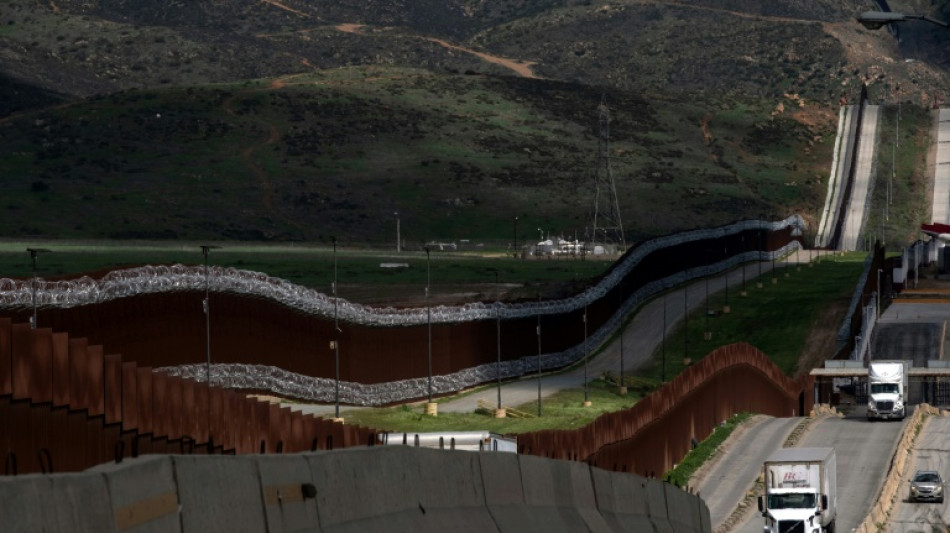
US second quarter GDP growth to reflect tariff turbulence / Photo: © AFP/File

 All Blacks name veteran Taylor captain as Mo'unga seizes 10 jersey

 Race against time as Asian Games cricket quarter-finals washed out

 India turns to corals and seagrass to shield against rising seas

 Manchester City's Premier League charges: What comes next?

 Brazil's cellphone crime: a security nightmare in every pocket

 Russia pummels Kyiv in latest deadly attack

 NFL Giants obtain QB McCarthy from Vikings

 Deal for evicted Spanish pensioner as PM seeks new housing law

 Clippers apologize, warn fans of 'challenges' after Leonard scandal
 Turkish comedian convicted for Erdogan 'insult' freed pending appeal

 Trump announces 'biggest' US steel plant in battleground Iowa

 Olise wonder strike gives Zidane's France win in Belgium
 US stocks fall, bond yields rise as Middle East war drags on

 Trump denies offering to sell arms to China's Xi
 Wemby ready for NBA Spurs to move rivals in climb to top

 Ukraine to postpone some spending amid delays in aid: PM

 Tuchel says Czech Republic game 'not yet a must-win'

 MaXhosa puts South Africa on the Paris fashion map

 Rose, Scott among 2027 World Golf Hall of Fame finalists

 Brunson says NBA champion Knicks can't get satisfaction

 France puts out largest wildfire since 1949

 Real Madrid's Perez summoned over Barcelona referee payments comments

 Oil takes off again, Wall Street dips after Trump rejects Iran truce offer

 AlgoQuant Asset Management Selects Liquid Mercury to Enhance Digital Asset Trading Infrastructure

 UK to reopen refugee resettlement scheme to push 'safe' migration

US economic growth is expected to rebound in the second quarter, analysts said, in a momentary comeback reflecting trade shifts as companies tried to avoid the harshest of President Donald Trump's wide-ranging tariffs.
The world's biggest economy is anticipated to expand at an annual rate of 2.5 percent in the April to June period, according to a consensus forecast by Briefing.com.
This marks a reversal of a 0.5 percent decline, annualized, seen in the first three months of the year.
But cost pressures from tariffs, among other factors, could later bog down investment and consumption -– a key driver of the US economy.
"It's very much distorted by the trade flows and inventory," said Nationwide chief economist Kathy Bostjancic, referring to second quarter growth.
At the start of the year, businesses rushed to stock up on products in an effort to avoid Trump's threatened tariff hikes -- but this build-up is now unwinding.
The imports surge ahead of tariff hikes in the first quarter led to the largest drag on GDP growth from net exports on record, analysts at Goldman Sachs said in a recent note.
This means a bounce back is expected once imports cool.
But the acceleration is not sustainable, Bostjancic told AFP.
Trump had raised the idea of across-the-board tariffs targeting trading partners during election campaigning last year, and since returning to the US presidency in January he has rolled out wave after wave of fresh duties.
These included a 10 percent levy on almost all US partners, higher duties on steel, aluminum and auto imports, as well as separate actions against Canada and Mexico over illegal immigration and illicit fentanyl flows.
In April, the Trump administration separately took aim at the world's number two economy, China, as Beijing pushed back on US tariffs.
Both countries ended up imposing tit-for-tat tariffs on each other's products, reaching triple-digit levels and bringing many trade flows to a halt before Washington and Beijing reached a temporary agreement to lower duties.
After two days of talks in the Swedish capital of Stockholm this week, negotiators from both countries signaled there could be an extension of the truce -- although the final call depends on Trump.
- 'Clear deceleration' -
Bostjancic expects that underlying activity driving US gross domestic product will be moderating, although not collapsing.
"The US economy continues to navigate a complex set of crosscurrents, obscuring a clear reading of its underlying momentum," said EY chief economist Gregory Daco in a note.
But he added that one trend is evident, which is that "economic activity is decelerating even as inflationary pressures are reemerging."
"Tariff-induced cost pressures, persistent policy uncertainty, severely curtailed immigration, and elevated interest rates are collectively dampening employment, business investment and household consumption," Daco said.
Analysts are closely eyeing the impact of Trump's tariffs on inflation, with economists warning that the duties could fuel price increases. They expect to learn more from data in the summer months.
All of this could impact consumer spending -- a key economic driver.
"The trend in GDP growth is best analyzed by considering the first and second quarters together," said Samuel Tombs, chief US economist at Pantheon Macroeconomics.
"The likely average growth rate of about 1.5 percent over these two quarters represents a clear deceleration from the 3 percent rates in the previous two years," he added.
He said in a note that the US economy would probably "lose more momentum" in the third quarter, when consumer prices for imported goods likely will rise sharply.
And "adverse consequences" of economic policy uncertainty will also start to materialize when it comes to business investment, Tombs said.
Analysts have noted that companies tend to hold off major decisions during times of uncertainty, given the risk of sudden policy shifts.
"We continue to expect GDP growth to average just 1 percent in the second half of this year," Tombs said.
B.Wyler--VB