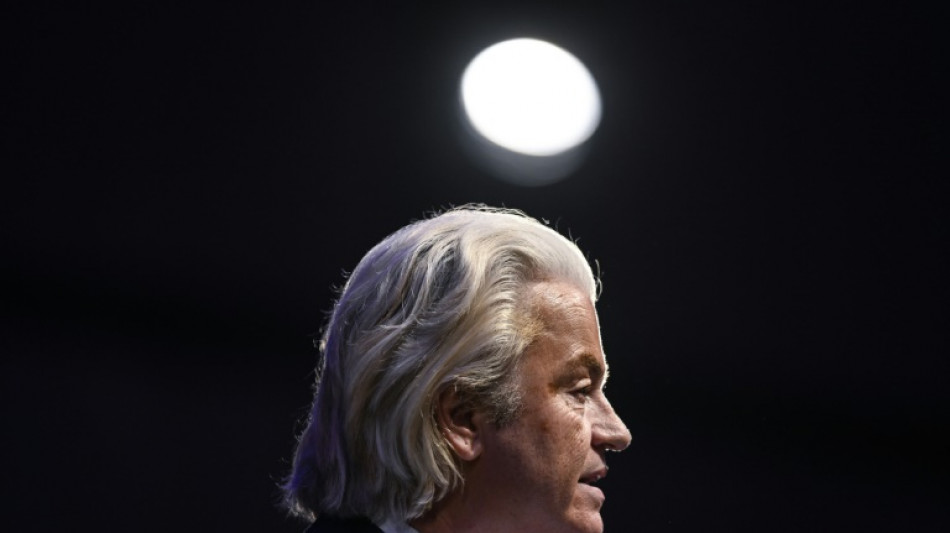
Wilders: firebrand 'Dutch Trump' gambles for power / Photo: © AFP

 Nagoya mayor says sorry for Asian Games 'inconveniences'
 G20 trade officials meet under shadow of tariffs, overcapacity

 India's fat dog vote goes viral
 Asian Games crowds in spotlight as 998 see hosts in 50,000 stadium
 The eight stadiums for the 2027 Rugby World Cup

 Thieves swipe drugs under nose of Fiji police, swap with flour
 South Korea demands North apologise for DMZ mine blasts
 In Nepal's flood zone, teachers mourn students who never returned
 US Supreme Court lifts limits on third-country deportations
 Antonelli eager to 're-establish order' as F1 returns to Malaysia

 Paw-fect candidate: Australia finds new koala rescue dog
 One third of world population exposed to harmful air pollution: monitor
 North Korea denies South's claim it was apparently behind DMZ mine blasts
 West Bank's violent settlers part of a new generation fuelled by ideology
 US-led coalition ends mission in Iraq
 Pope-backed White Sox join Braves with MLB playoff wins

 NBA close to picking new $12-13bn Vegas team owners: report
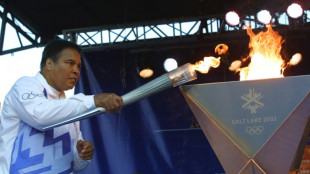 LA28 Olympics torch relay to visit all 50 states
 Spain brush aside Croatia in Nations League, England down Czechs
 Trump hails 'morally binding' AI self-regulation pledge
 Yamal inspires Spain to Croatia romp on World Cup homecoming
 UN to hold fourth informal poll of secretary-general candidates
 Who are the Emiratis behind crisis-hit Manchester City?
 Singer Angelique Kidjo urges Africans to 'create together'
 Alleged Rihanna mansion shooter mentally fit for trial, says judge
Sometimes known as the "Dutch Trump" both for his bouffant dyed hair and firebrand rhetoric, Geert Wilders' anti-Islam, anti-immigrant and anti-EU message has catapulted him to the brink of power.
From calling Moroccans "scum" to holding competitions for cartoons of the Prophet Mohammed, Wilders has built a career from his self-appointed mission to stop an "Islamic invasion" of the West.
He has remained defiant despite brushes with the law -- he was convicted for insulting Moroccans -- and death threats that have kept him under police protection since 2004.
Now his latest political gamble has collapsed the coalition government he agreed to, in the hope of finally realising his ambition to become Dutch prime minister.
After years in the political wilderness, the 61-year-old made his breakthrough in 2023, stunning Europe with a surprise election win.
His far-right Freedom Party (PVV) took 37 seats in the 150-seat parliament, handily beating the more established Green/Left and liberal VVD parties.
He toned down his anti-immigration rhetoric during the campaign, even saying during the last election debate there were "bigger problems than fighting against the flood of asylum seekers and immigrants".
Wilders vowed to put his anti-Islam outbursts "in the freezer" as the price for taking up residence in the "Little Tower", as the prime minister's office in The Hague is known.
- 'Medieval Arab city' -
But his coalition partners had other ideas.
The Dutch political system is based on consensus, meaning no one party can dominate, and two of the four party leaders were queasy at the thought of Wilders leading the country.
He reluctantly stepped aside to clinch a coalition deal, writing on X: "The love for my country and voters is bigger and more important than my own position."
After rollercoaster talks, the four parties agreed on Dick Schoof as a compromise PM, with a mandate to introduce the "strictest-ever" asylum policy seen in the country.
But Wilders' ambitions were unsated and he frequently voiced his desire to become premier.
He also again ramped up his anti-Islam rhetoric.
"Walk the streets of Western Europe... and you will see that it often looks like a mediaeval Arab city, full of headscarves and burqas," he alleged in a recent speech.
"Islam is rising but I do not want Islam to rise... for Islam and freedom are incompatible."
- 'Anger, not fear' -
Born in 1963 in southern Venlo, close to the German border, Wilders grew up in a Catholic family with his brother and two sisters.
His mother was half-Indonesian, a fact Wilders rarely mentions.
He developed an interest in politics in the 1980s, his older brother Paul told Der Spiegel magazine.
"He was neither clearly on the left or the right at the time, nor was he xenophobic. But he was fascinated by the political game, the struggle for power and influence," Paul Wilders said.
His hatred of Islam appeared to have developed slowly. He spent time in Israel on a kibbutz, witnessing first-hand tensions with the Palestinians.
He also voiced shock at the assassinations of far-right leader Pim Fortuyn in 2002 and the radical anti-Islam filmmaker Theo van Gogh in 2004.
When he heard the news of Van Gogh's murder: "I remember my legs were shaking with shock and indignation," he wrote in a 2012 book.
"I can honestly say that I felt anger, not fear."
Wilders entered politics in 1998 in the VVD party. During his early days in politics he started dying his brown hair blonde and learnt his media-savvy ways.
- Isolated figure -
Over the years he vowed not to be silenced, despite being convicted of insulting Moroccan-Dutch citizens.
In 2006 he quit the VVD to found his own party and in 2017 it became the second largest in parliament, falling back to third largest in 2021.
By tapping into a seam of Dutch discontent, Wilders also managed to push the political discourse in the Netherlands to the right.
But Wilders also cut an isolated figure.
He was married to a Hungarian woman but they had no children. When not posting anti-Islamic invective on his one social media account, he posted pictures of their cats on another.
His party consisted of just one person: himself. And his security meant he had little contact with the outside world.
"Geert's world has become very small," his brother told Der Spiegel. "It consists of the parliament, public events and his apartment. He can hardly go anywhere else."
R.Braegger--VB