
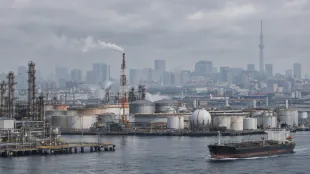
Shell annual profit drops to $16 bn as oil prices fall / Photo: © GETTY IMAGES NORTH AMERICA/AFP/File

 Brazil Faces Debt and Inflation Test as Lula Prepares Fourth Term

 Canada Signals Openness to Chinese Automakers if US Trade Talks Fail

 US Mortgage Rate Falls for Fourth Week but Remains Above 7%

 13 Native American-Owned Restaurants in Arizona to Experience Indigenous Culinary Traditions

 Best Digital Photo Frames 2026: Aura, Skylight, and Amazon Compared

 UK Economy Grows 0.7% in Third Quarter as Services Lead Expansion

 India's Retail Inflation Reaches 6.09% as Food Prices Accelerate

 China's October Activity Data Reveal a Weak Start to the Fourth Quarter
 South Korea Launches Probe into NewJeans Contract Controversy

 Helen Rees Reflects on Four Decades of South Africa's HIV Journey

 Foreign Investors Return to Indian Equities with ₹84,290 Crore Inflow

 Interactive Map Reveals 1,000 Unsolved Murders Across UK
British energy giant Shell on Thursday announced a 17-percent drop in annual net profit owing to weaker oil and gas prices as well as asset write-offs.
Profit after tax fell to $16.1 billion in 2024, the company said in an earnings statement.
Revenue dropped nearly 11 percent to $289 billion in a year that saw Shell backtrack on some key climate targets.
Oil prices came under pressure from weakness in the Chinese economy while the cost of gas has fallen heavily since soaring after the invasion of Ukraine by energy producer Russia.
In late 2024, Shell announced it was cutting hundreds of jobs from its oil and gas exploration division to reduce costs.
- Shareholder focus -
Chief executive Wael Sawan described last year's financial performance as "strong" despite "a lower price environment", causing Shell to increase its dividend by four percent and repurchase $3.5 billion of company shares.
Shell, whose share price rose slightly in reaction, "remains at a crossroads torn between the seemingly inevitable pull of the energy transition and the demands of shareholders", noted Derren Nathan, head of equity research at Hargreaves Lansdown.
"Its financial strength gives it the firepower to invest for the future as well as make generous distributions, but there are still some major doubts as to how the company plans to adapt to changing shifts in the energy mix."
Sawan said Shell will in March update its "strategy to deliver more value with less emissions".
The company last year booked a significant write-down owing to a shelved biofuels project in the Netherlands.
Along with rival BP, Shell has scaled back various climate objectives to focus more on oil and gas in order to raise profits, drawing criticism from environmental activists.
"Shell and its shareholders again raked in tens of billions from fuelling the climate crisis last year," Elena Polisano, head of Greenpeace UK's Stop Drilling campaign, said in reaction to the latest results.
Shell has watered down key targets on cutting carbon emissions but has kept its pledge for net zero by 2050.
The group had said net carbon intensity would be cut 15-20 percent by 2030 compared to 2016 levels. That marked a dilution from its previous 20-percent target.
In a more recent announcement, the company in December said it would no longer lead development of new offshore wind projects.
Offshore wind is one of the major sources of renewable energy that Europe is counting on to decarbonise electricity production, but in recent years projects have been mired by soaring costs and supply chain issues.
Gas is being touted by energy companies as cleaner than other fossil fuels as countries around the world strive to reduce their emissions and slow global warming.
O.Schlaepfer--VB