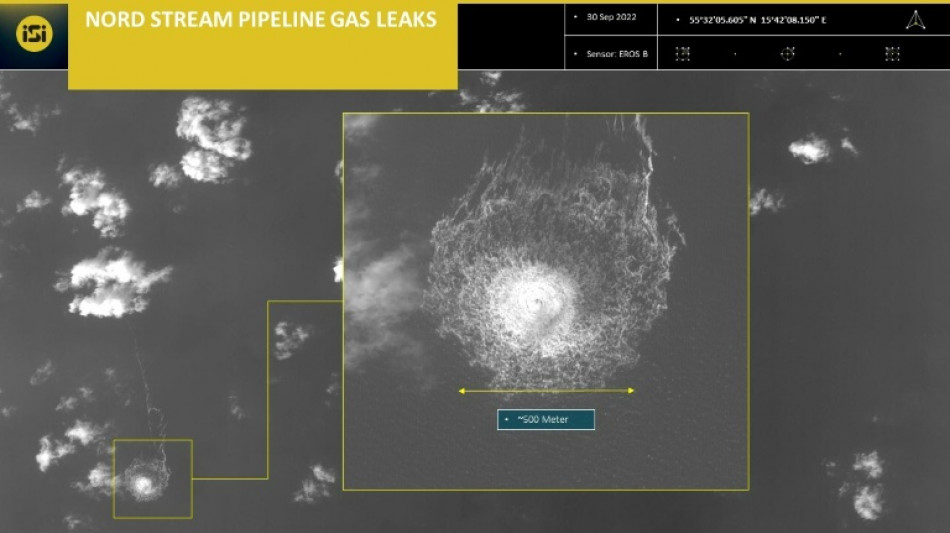
Methane leaks from Nord Stream pipeline blasts revised up: studies / Photo: © ImageSat International (ISI)/AFP

 Haaland keeps Man City perfect in Premier League, blunt Spurs held

 Hamilton worried by Ferrari pace while Antonelli prepares for a fight

 Vuelta stage 15 shortened due to extreme heat, Mas consolidates lead

 Putin meets US envoys for Ukraine war talks

 Modric available for Croatia in Nations League

 Potapova upsets 2025 US Open runner-up Anisimova

 Gasly a 'class act' says Alpine boss after Monza pole

 Athletic Bilbao crush Simeone's flat Atletico

 Stay far from battlefield, warns Japanese director in Vietnam War film

 Tens of thousands of Croatians protest over hazardous waste

 Haaland heads unconvincing Man City top of Premier League

 US envoys in Moscow as Russia and Ukraine vow not to hit capitals during talks
 Motorsport governing body rejects Alpine boss's claims of bias

 US envoy on West Bank visit says Israel has responsibility for Palestinians

 Ethiopian Miss World contestant spotlights pain of sister's murder

 'Leader' Raphinha rising to Barca striker challenge

 Oasis fans gather in Venice for band reunion film

 Two Nepal rescues revive hopes 10 days after flood

 Pogacar to miss worlds after season-ending Vuelta crash

 Greenwood, Guendouzi handed bans after Fenerbahce-Lyon brawl

 In Iceland, the mystery of the poet, the tomb and the Danish grocer

 Ratko Mladic: Bosnian Serb commander to convicted war criminal

 Bolivian army base blasts kill two, wound dozens
 Alcaraz, Sabalenka into US Open last 16 as Williams sisters lose on return

 Williams sisters fall in thrilling return to US Open doubles
A series of underwater explosions that ruptured the Nord Stream gas pipelines in 2022 caused the largest known methane leak on record from a single incident, according to new research published on Wednesday.
Scientists estimate the rupture of the major pipeline for transporting Russian gas to Europe released approximately 465,000 tonnes of methane into the atmosphere -- well above earlier estimates, but just a fraction of total global emissions.
The exact cause of the blasts in September 2022, just months after Russia's invasion of Ukraine, is still unknown, though Moscow and Kyiv have traded blame over this and other damage of energy infrastructure.
In three new studies on the Nord Stream leak -- one in Nature and two in a separate journal Nature Communications -- researchers said its potential impact on the environment and climate remained unclear.
But the leak "represents the largest recorded amount of methane released from a single transient event", wrote Stephen Harris and others in Nature.
Though significant, this was equivalent that year to 0.1 percent of human-caused emissions of methane, a powerful greenhouse gas many times more effective at trapping heat in the short term than carbon dioxide.
Methane is emitted naturally from wetlands and rivers but also cows, rice fields and landfills.
A leading source of human-caused emissions is oil and gas projects, and fixing leaky pipelines and other infrastructure is considered a particularly cost-effective way to quickly slow global warming.
"While extraordinary in its magnitude, the Nord Stream explosions remind us of the immediate climate opportunity represented by reducing methane emissions across the oil and gas industry," said Manfredi Caltagirone, head of the UN Environment Programme's International Methane Emissions Observatory (IMEO), which supported the research.
- Unclear impact -
After the explosions beneath the Baltic Sea damaged the Nord Stream pipelines, gas began bubbling up at four rupture points, creating enormous foamy patches on the surface.
There was an "immediate desire" among scientists to determine the size of such a clearly significant leak, said Harris from IMEO.
This was challenging because it was difficult to know how much methane was absorbed in the ocean and how much leaked into the atmosphere.
Early estimates for the Nord Stream leak ranged from 70,000 tonnes to 300,000 tonnes.
For the research in Nature, scientists used atmospheric data, satellite images, marine observations and aerial measurements to model how much methane might have escaped the ocean.
It "far exceeds" any other leak of its kind and was equivalent to 30 percent of Germany's annual methane emissions, wrote Friedemann Reum from the German Aerospace Centre in Nature Communications.
Another paper in the same journal looked at the impact of the leaks on protected marine areas in the Baltic.
Martin Mohrmann from Sweden's Voice of the Ocean Foundation and colleagues suggested 14 percent of the region experienced methane concentrations five times average levels.
More than 150 countries have signed a pledge to slash methane emissions, but atmospheric concentrations of this potent greenhouse gas still hit record highs in 2024.
The International Energy Agency has noted that normal oil and gas operations around the world release the same amount of methane as the Nord Stream explosion every single day.
G.Frei--VB