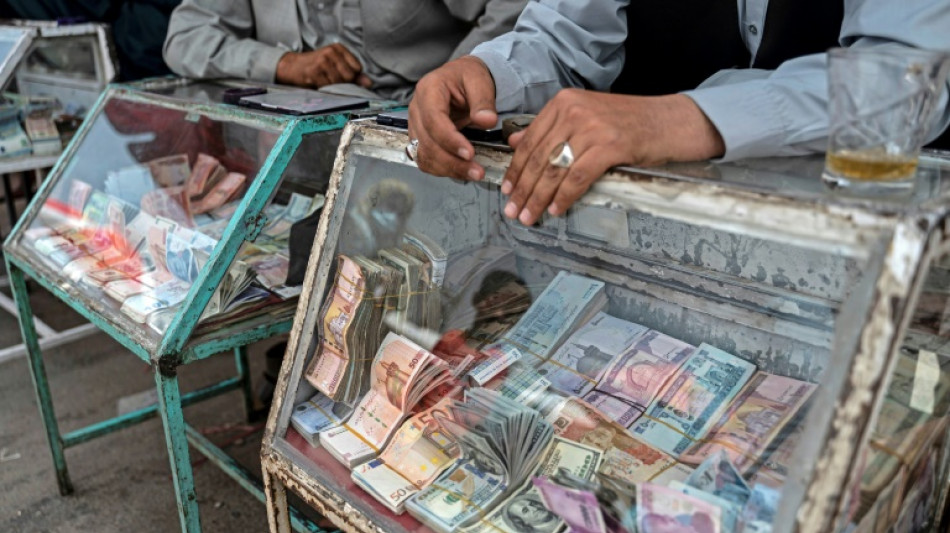
Afghan money exchangers reopen after strike: brokers / Photo: © AFP

 China Condemns Chile-Belgium Joint Bid for High Seas Treaty Headquarters

 Dún Laoghaire-Rathdown €335m Budget Faces Mixed Reaction Over Housing and Cost of Living

 Dubai Police Expand Luxury Patrol Fleet with 525-hp Defender

 Iran Strikes US Sites in Kuwait Following US Airstrikes on Qeshm Island
Thousands of money exchangers in Afghanistan ended their strike on Monday, the brokers commission said, a day after they shut their shops to protest a steep hike in licence fees imposed by Taliban authorities.
Afghanistan's formal banking system collapsed when the Taliban swept back to power in August last year, ending two decades of US-led military intervention in the deeply impoverished nation.
Since then money exchangers -- who swap currencies, make informal cash transfers and even give loans -- have played a key role in meeting the financial needs of many of Afghanistan's 38 million citizens mired in humanitarian crisis.
"Today, the money exchange markets across Afghanistan are open," Abdul Rahman Zeerak, spokesman for Afghanistan's Money Exchange Commission, told AFP.
"They (Taliban leaders) requested that we should open the markets and that they will resolve our problems fully."
Money exchangers in Kabul and other cities, including Herat and Kunduz, went on strike on Sunday after the central bank raised their licence fees to five million Afghanis ($56,000) from 300,000.
Zeerak said the central bank had also told currency traders to conduct transactions online, and that they must have a minimum of 50 million Afghanis to operate.
On Tuesday the commission will have a meeting with the finance ministry and the governor of Afghanistan's central bank, he said.
Experts said the central bank's new directives were motivated by the Taliban's desire to cut off funding paths to militant groups.
Many foreign nations have made assistance to Afghanistan conditional on the Taliban regime guaranteeing human rights and preventing international terror groups from operating in the country.
Afghanistan's money market had been volatile for several months after the US seized billions of dollars in Afghan assets during its hasty withdrawal when the Taliban seized power.
Since then there has been a shortage of dollars as international donors also suspended the massive aid inflows that had propped up the Afghan economy for two decades during the US presence in the country.
E.Schubert--BTB